
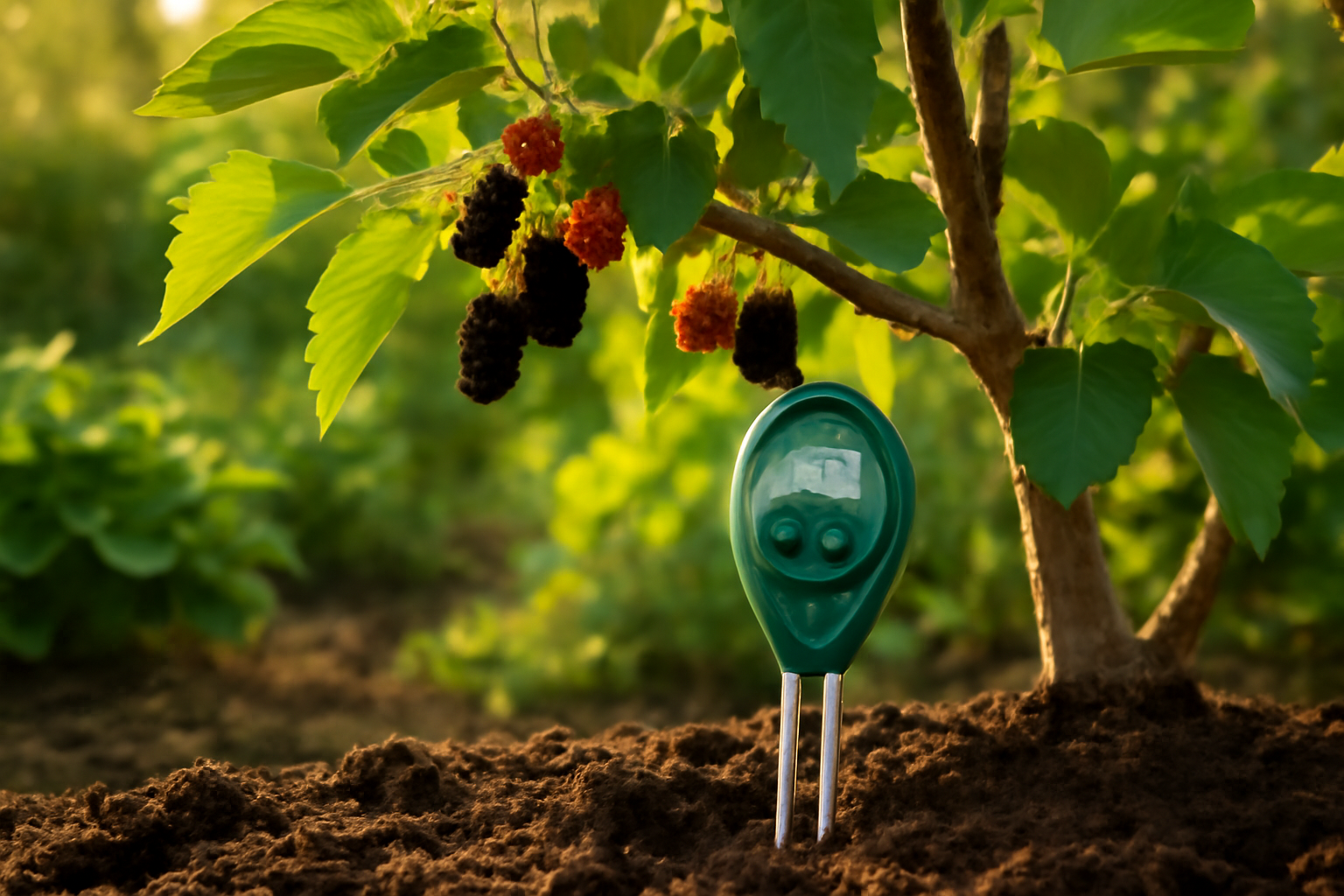
Last spring, three of my established mulberry trees started showing pale, yellowing leaves despite regular feeding. I’d been growing mulberries for over six years, and something was clearly off. After ruling out pests and overwatering, I started suspecting my soil chemistry. That suspicion sent me down a rabbit hole of reading every soil pH meter mulberry tree review I could find. Eventually, I landed on a simple $15 tool that changed how I manage every single one of my beds.
Mulberries are generally forgiving trees. Most varieties thrive in a pH range of 5.5 to 7.0, and they tolerate a lot of neglect. But even forgiving plants have limits. When the pH drifts too far outside that range, nutrient uptake slows down — especially for iron and manganese. My chlorotic leaves were a textbook symptom, and I had no idea what my actual soil pH was because I’d never bothered testing it properly.
I’d been eyeballing my amendments for years. Occasionally I’d throw down some sulfur or lime based on guesswork and hope for the best. That approach clearly wasn’t working anymore. So I decided to actually measure what was happening in the soil before adding anything else. Spending $15 felt a lot smarter than continuing to guess.
Why I Chose the SONKIR MS02 Over Other Options
Shopping for a basic soil meter feels overwhelming at first. There are dozens of options ranging from $10 to well over $100. I spent about two evenings reading through reviews on gardening forums and Amazon before narrowing things down. Most hobby gardeners recommended keeping it simple, especially for home orchard use where laboratory precision isn’t necessary.
The SONKIR Soil pH Meter, MS02 3-in-1 Soil Moisture/Light/pH Tester Gardening Tool Kits for Plant Care, Great for Garden, Lawn, Farm, Indoor & Outdoor Use (Green) kept appearing across multiple recommendations. Three features made it stand out specifically for my situation. First, the 3-in-1 design meant I could also check moisture and light levels in the same pass — useful when diagnosing multiple possible problems at once. Second, it requires no batteries, which eliminates one more thing to manage. Third, the price point was low enough that I wasn’t risking much if it turned out to be inaccurate.
I also considered a digital meter with a backlit display, but honestly the added complexity felt like overkill for what I needed. I wasn’t looking for laboratory data. I wanted a consistent, directional reading I could trend over time. The analog design of the SONKIR MS02 actually suited that goal well.
First Impressions: Unboxing and Build Quality
The package arrived in a slim cardboard box with minimal plastic waste, which I appreciated. Inside was the meter itself, a small instruction sheet, and a cleaning cloth. That’s it. No batteries, no calibration solutions, no extra probes. It felt appropriately no-frills.
The build quality is honestly what you’d expect at this price. The plastic housing feels lightweight but not flimsy. The dual-probe design is straightforward — two metal probes extend from the base and insert directly into the soil. The analog dial on the face is clearly printed and easy to read. There’s a small switch to toggle between the three measurement modes: moisture, pH, and light.
My first reaction was mild skepticism. The whole thing felt very simple. I kept thinking: can something this basic actually give me useful pH data? That doubt sat with me through most of the first week of testing. But I decided to commit to the process before making any judgments.
One thing worth noting right away: the instructions clearly state the meter should not be used in dry or very hard soil without pre-moistening the area first. That detail matters a lot for getting consistent readings, and I’ll come back to it.
My Testing Protocol Across Six Mulberry Beds
I grow six mulberry trees in separate raised and in-ground beds. Varieties include Illinois Everbearing, Shangri-La, and two Pakistani mulberry trees. Each has a slightly different soil history depending on what amendments I’ve added over the years. Testing all six gave me a meaningful spread of data.
Here’s exactly how I ran each test:
- Watered each bed 24 hours before testing to ensure consistent moisture
- Inserted both probes about 4 inches deep, 6–8 inches from the trunk
- Waited a full 60 seconds before reading the dial
- Took three readings per bed at different spots and averaged them
- Cleaned the probes with the included cloth between each bed
I repeated this process at four-week intervals over about three months. That gave me a before-and-after picture as I started adjusting my soil with amendments. I recorded everything in a basic spreadsheet so I could track changes rather than relying on memory.
I also ran a rough verification test early on. I mixed a small batch of soil with a known pH using distilled water and a calibrated test kit I borrowed from a neighbor. The SONKIR reading landed within about 0.5 pH units of the control. That’s not laboratory precision, but it was close enough to give me confidence in the directional accuracy.
What Actually Changed in My Mulberry Beds
The initial readings were eye-opening. My three symptomatic trees — the ones with the yellowing leaves — all showed pH readings above 7.2. That’s on the alkaline side of the mulberry-friendly range. My two Pakistani mulberry beds, which had been doing fine, read right around 6.5. The difference was stark and immediately pointed me toward a solution.
Based on those readings, I applied elemental sulfur to the high-pH beds at a modest rate, following recommendations from my local extension office rather than guessing. I also switched to an acidifying fertilizer for the rest of the season.
Over the next two months, here’s what I observed:
- pH readings in the problem beds dropped gradually from 7.2+ down toward 6.8–6.9
- New leaf growth on all three affected trees came in visibly greener by week six
- One tree showed slower improvement — likely due to heavy clay that resists amendment faster
- My two healthy beds stayed stable, confirming I shouldn’t tinker with what wasn’t broken
The biggest practical win wasn’t dramatic. It was the confidence to stop adding unnecessary amendments. Before this tool, I was piling on products based on guesswork. Now I test first, then act. That shift alone is worth more than the $15 purchase price.
I also used the moisture function more than I expected. It helped me realize one bed was staying consistently too wet — something I hadn’t noticed visually. Adjusting drainage there made a real difference in root health over the summer.
The Downsides: What the SONKIR MS02 Doesn’t Do Well
Honest review means talking about the limitations, and there are a few real ones here.
The pH reading is not laboratory-grade. That’s worth saying plainly. If you’re managing a commercial orchard or doing research, you need a calibrated digital meter or actual soil lab testing. The SONKIR Soil pH Meter, MS02 3-in-1 is a directional tool for home gardeners — it shows trends, not precise absolutes.
Dry soil is a real problem for this meter. In my raised beds during a hot, dry stretch in July, I got erratic readings until I pre-watered. The probes need soil moisture to conduct properly. That’s not a flaw so much as a physical limitation of the technology, but it can frustrate you if you don’t know about it.
The light meter function is fairly basic. It gives a general low/medium/high reading rather than actual lux values. For my purposes — outdoor mulberry trees in full sun — it wasn’t very useful. It’s probably more helpful for diagnosing houseplants or shade-garden placement.
Probe corrosion is also worth watching. After about two months of regular use, I noticed some surface oxidation on the probes. Regular cleaning with the included cloth helps, but it requires consistent maintenance. Neglecting it affects reading accuracy over time.
Finally, the analog dial can be slightly tricky to read in bright outdoor sunlight. The needle is small, and squinting at it while crouching over a garden bed gets old. A digital display would be easier on the eyes — though it would also cost more and require batteries.
Final Verdict: My Soil pH Meter Mulberry Tree Review Summary
After three months of consistent use, I’m genuinely glad I bought the SONKIR Soil pH Meter, MS02 3-in-1 Soil Moisture/Light/pH Tester Gardening Tool Kits for Plant Care, Great for Garden, Lawn, Farm, Indoor & Outdoor Use (Green). It isn’t a perfect instrument, and I wouldn’t trust it for anything requiring precision. But for a home mulberry grower trying to understand basic soil chemistry trends, it absolutely delivers on its promise.
Buy it if:
- You grow mulberries or other fruit trees and have never tested your soil pH
- You’re troubleshooting chlorosis or unexplained poor growth
- You want a simple, battery-free tool for routine monitoring
- You’re working with a tight budget and need directional data, not lab accuracy
Skip it if:
- You need precise pH measurements for commercial or research purposes
- You frequently test in dry or rocky soil conditions
- You want a digital readout with a backlit display for easy outdoor use
For most hobby mulberry growers, $15 is an easy yes. The insight I gained from knowing my actual pH values — rather than guessing — changed how I manage my entire orchard. That’s a meaningful return on a very small investment.
Looking for a Digital Alternative?
If you prefer a digital readout with more features, take a look at the YAMRON 4-in-1 Soil Moisture Meter. It adds temperature sensing and a backlit LCD display to the standard moisture/pH/light combo. It runs on batteries and costs more, but the digital readout is significantly easier to read outdoors. It’s a solid step up if the analog dial of the SONKIR feels limiting for your workflow.