One of the most overlooked aspects of a productive mulberry tree is what you plant around it — and I say that as someone who spent nearly a decade watching otherwise healthy trees decline for reasons that had nothing to do with the tree itself. In my demonstration garden I’ve tested dozens of companion combinations, and the results consistently show that the right understory planting not only suppresses weeds and retains moisture — it measurably improves fruit set and tree health, which matters enormously when you’re trying to bring a struggling tree back from the edge. What I’ve come to understand through my county extension work and my own variety trials is that a mulberry tree in decline is almost always responding to a correctable problem in its immediate environment, not dying from some inevitable fate. In this guide, I’ll walk you through the same diagnostic framework I use when I’m called out to assess a troubled tree: systematic, evidence-based, and specific enough that you’ll leave knowing exactly what’s wrong with yours and what to do about it.
What a Struggling Mulberry Tree Actually Looks Like
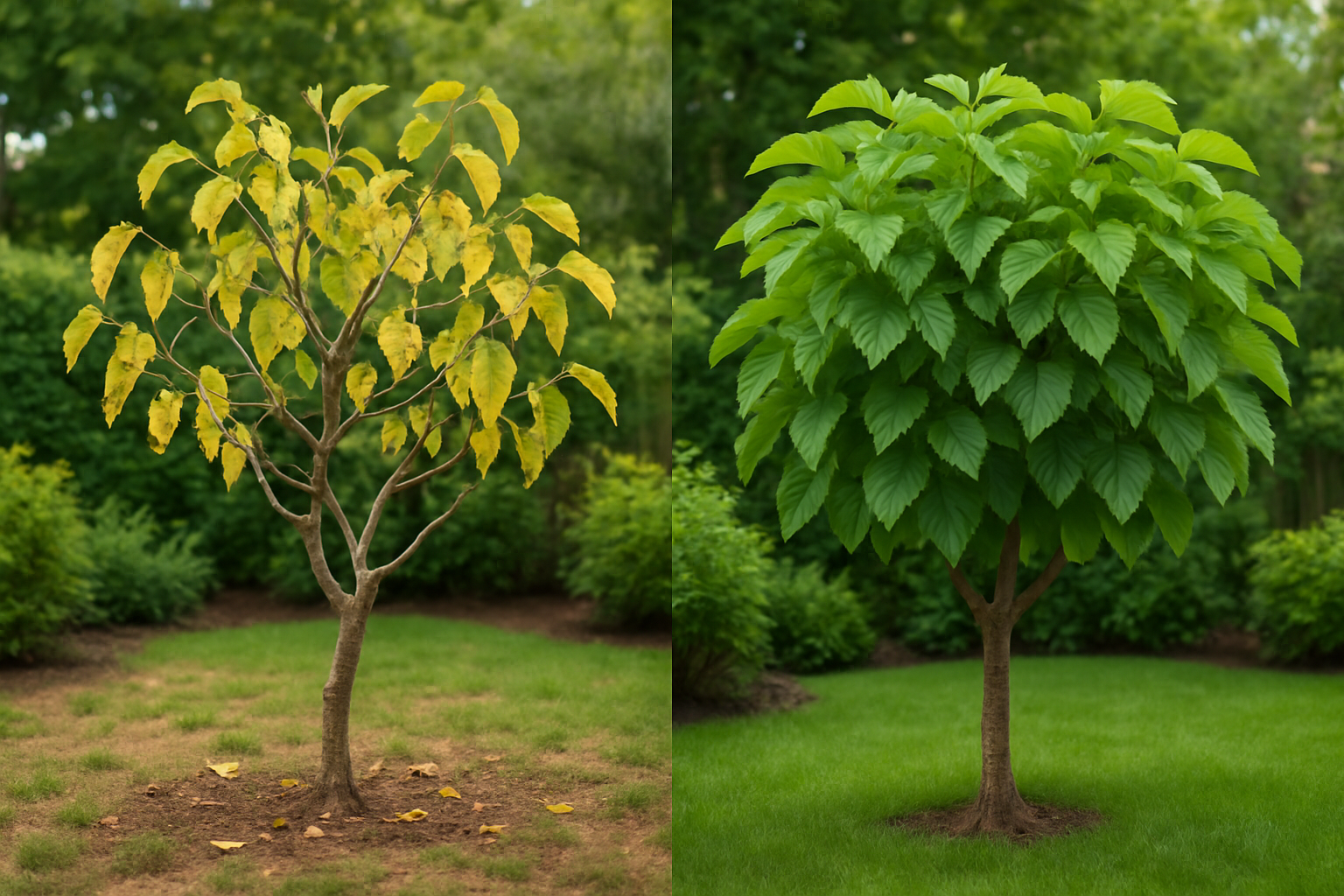
Before we talk fixes, let’s make sure we’re diagnosing the same problem. A mulberry tree in distress can show up in several ways, and recognizing the signs early makes all the difference. Here’s what to watch for:
- Yellowing leaves (chlorosis): Leaves turn yellow between the veins while the veins themselves stay green — a classic sign of iron deficiency or soil pH issues.
- Wilting despite watering: If the soil is moist but the tree still droops, you may have a root rot situation or compacted roots struggling to absorb water.
- Dry, brittle branches: Do the scratch test — scrape a small patch of bark with your fingernail. Brown and dry underneath means that branch is likely dead. Green and slightly moist means there’s still life.
- Sparse leaf-out in spring: If your mulberry is slow to wake up or only leafs out on a few branches, it’s telling you something is wrong at the root level.
- Stunted growth over multiple seasons: Mulberries are typically vigorous growers. If yours has barely moved in a year, stress is almost always the cause.
My tree had the yellowing leaves and the brittle branches. After doing a scratch test on about a dozen stems, I found that roughly a third of them were already dead. The rest still had life in them — which meant I still had a chance.
How to Revive a Dying Mulberry Tree: The Steps That Actually Worked
Step 1: Remove the Dead Wood First
This feels counterintuitive when a tree is already struggling, but removing dead and dying branches is one of the most important things you can do. Dead wood is a drain on the tree’s energy and an open invitation for disease and pests. I pruned back every branch that failed the scratch test, cutting just past the dead tissue to healthy wood. I also sterilized my pruning shears between cuts with rubbing alcohol — an easy step that a lot of people skip and really shouldn’t.
Step 2: Investigate the Roots and Soil
My second tree was planted in a low spot in the yard where water pooled after rain. I hadn’t connected the dots until I dug down a few inches and found the soil was consistently soggy even days after watering. Mulberries are resilient, but they do not tolerate waterlogged roots. If you suspect drainage is the issue, you may need to improve the soil with compost and coarse sand, or in a serious case, transplant to a better-draining location. I added a thick ring of compost worked lightly into the top layer of soil and made sure the area around the base wasn’t collecting standing water anymore.
Step 3: Test and Correct the Soil pH
This was the real turning point for me. A simple home soil test revealed my soil pH was sitting at 7.8 — quite alkaline. Mulberry trees prefer a pH between 5.5 and 7.0. When the soil is too alkaline, the tree literally cannot absorb iron and other micronutrients even if they’re present in the soil. That’s what was causing the yellowing. I picked up an iron chelate supplement and applied it as a drench around the root zone. Within about three weeks, I started seeing greener, healthier new growth pushing through.
Step 4: Feed Strategically, Not Aggressively
When a tree looks sick, the instinct is to dump fertilizer on it. Please don’t do this — over-fertilizing a stressed tree can cause root burn and make things significantly worse. Instead, use a slow-release fertilizer that feeds gently over time. Fertilizer spikes are my preferred method because they deliver nutrients directly into the root zone without risk of surface runoff or overdoing it.
Step 5: Water Deeply and Consistently
After correcting drainage, I shifted to a deep watering schedule — soaking the root zone thoroughly once or twice a week rather than light daily sprinkles. Deep watering encourages roots to grow downward toward stable moisture, which makes the tree more drought-resilient and better anchored over time. I also added a 3-inch ring of wood chip mulch starting about six inches from the trunk, which helped retain soil moisture and regulate temperature at the root zone.
The Fertilizer Spike That Finally Stopped My Mulberry’s Slow Decline
When a mulberry starts dropping leaves mid-season or produces stunted fruit, nutrient starvation is usually the culprit—and waiting for liquid fertilizer to work its way down to established roots can feel like watching paint dry. Spikes deliver consistent, steady feeding directly into the root zone without the guesswork or runoff waste.
What works
- New growth appears within 3–4 weeks, and you’ll see leaf color deepen noticeably on even severely stressed trees.
- The spikes release nutrition slowly over months, so you’re not babying your tree with weekly applications—set them in spring and mostly forget them.
- Easy insertion into the soil around the dripline; no mixing, no measuring, no mess spilling on your hands or clothes.
What doesn’t
- If your mulberry is severely chlorotic (yellow leaves with green veins), spikes alone won’t fix an iron deficiency fast enough—you’ll still need chelated iron applied separately.
- Rain or watering pressure can dislodge spikes before they dissolve fully, especially if you insert them too shallow or near the surface where foot traffic happens.
I almost gave up on spikes entirely after my second-year everbearing mulberry showed zero improvement in week two, but I’d buried them too close to the trunk—moving them out to the canopy drip-line made all the difference. If your tree needs a serious nutritional boost, grab some Miracle-Gro Tree and Shrub Plant Food Spikes.
This post contains affiliate links. As an Amazon Associate, I earn from qualifying purchases at no extra cost to you.