
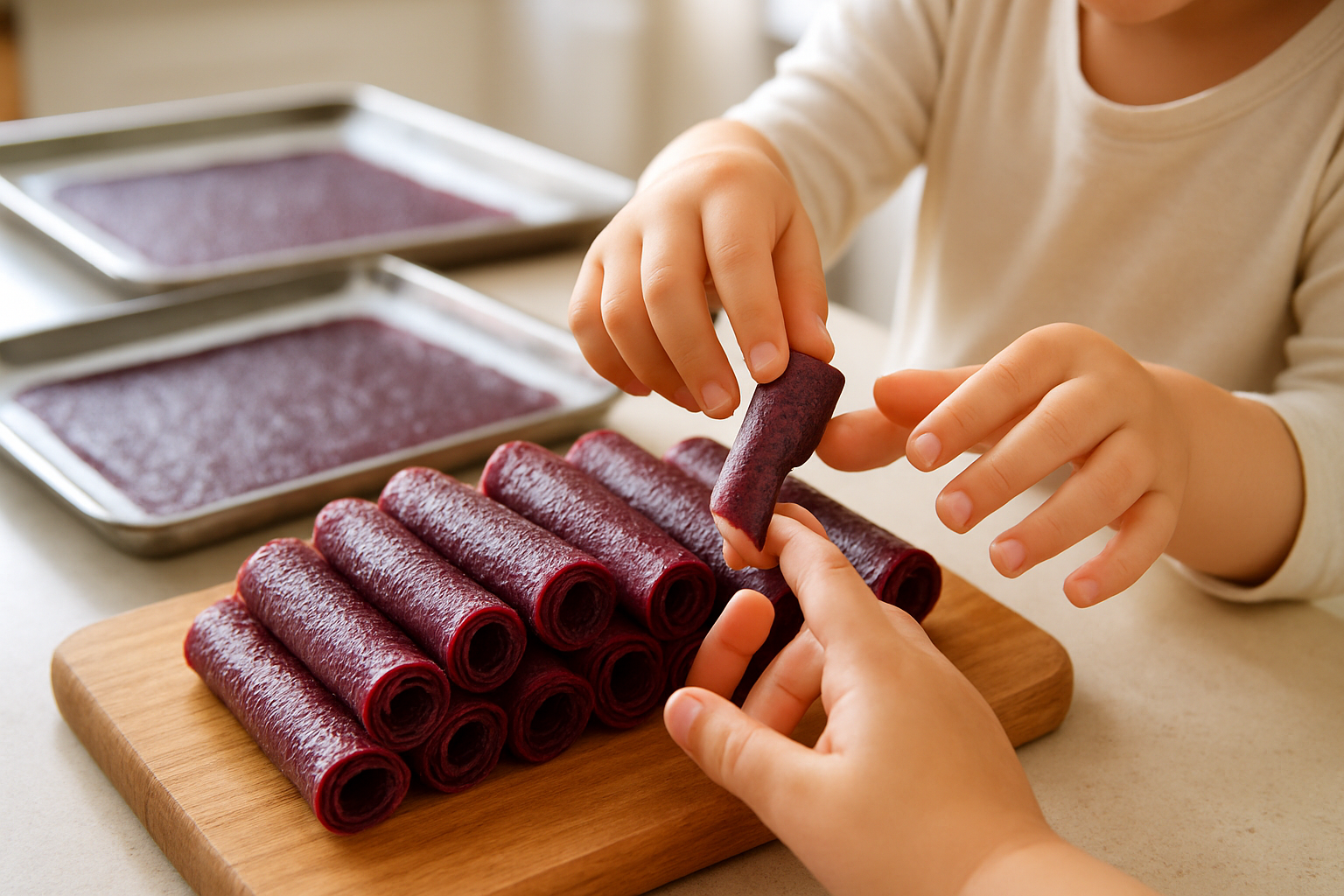
The smoke alarm went off three times. My seven-year-old was crying purple tears — actual purple tears, because she’d been eating mulberries straight off the tray the entire time — and I was standing in the kitchen holding what can only be described as a sheet of sweet, delicious mulberry asphalt. I had set the oven too high, forgotten to prop the door, and somehow convinced myself I was nailing this mulberry fruit leather recipe. Reader, I was not nailing it.
This post contains affiliate links. As an Amazon Associate, I earn from qualifying purchases. If you click a link and buy something, I may earn a small commission at no extra cost to you. I only recommend products I’ve actually used in my own (occasionally smoky) kitchen.
But here’s the thing — that disaster was two summers ago. This summer, my daughter and I made four perfect batches of mulberry fruit leather together, and she hasn’t cried once. (She has eaten approximately her body weight in it, but that’s a different problem.) If you’ve got a mulberry tree dropping fruit faster than you can use it, and kids who want to be involved in the kitchen, this is the project for you. Let me show you exactly how to do it right — starting with everything I did wrong.
Why Mulberries Are Perfect for Fruit Leather
Not all fruit is created equal when it comes to leather. Mulberries are genuinely ideal for this — and I say that as someone who has now experimented with more stone fruit than any reasonable person should. Mulberries are naturally high in pectin, which means they set up beautifully without needing added thickeners. They’re also intensely sweet when ripe, so you need far less added sugar than you would with tart fruits like rhubarb or gooseberries.
The flavor is complex and almost jammy — somewhere between blackberry and fig — and it concentrates beautifully during the drying process. One cup of fresh mulberries becomes a small but deeply flavored strip of leather that kids go absolutely feral for. The color alone is enough to get children excited: that deep, jewel-toned purple-red is genuinely gorgeous, and it comes entirely from the fruit itself. No food coloring required.
You can use red, white, or black mulberries for this, though black mulberries will give you the most intense flavor and color. If you’re working with white mulberries, add a squeeze of lemon juice to brighten things up and help with color.
The Easy Mulberry Fruit Leather Recipe (With Tips From My Mistakes)
This recipe is genuinely simple. The technique is where most people — including past me, standing in a smoke-filled kitchen — go sideways. Here’s the full process.
What You’ll Need
- 4 cups fresh or frozen (thawed) mulberries
- 1–2 tablespoons honey or sugar (optional — taste your berries first, they may not need it)
- 1 teaspoon lemon juice
- Pinch of cinnamon or vanilla extract (optional but wonderful)
The Method
Start by blending your mulberries until completely smooth. If your berries are very seedy, strain the puree through a fine mesh sieve — this is optional, but it gives you a silkier final product and kids tend to prefer it. Pour the puree into a small saucepan with your lemon juice and sweetener if using. Simmer over medium-low heat for about 8–10 minutes, stirring frequently, until the mixture thickens slightly and reduces by about a quarter. This is the step I skipped the first time. Don’t skip it. That brief simmer concentrates the flavor and helps the leather dry evenly rather than staying sticky in the middle.
Let the puree cool for 10 minutes, then spread it onto your prepared drying surface in a thin, even layer — roughly ⅛ to ¼ inch thick. Thinner is better. Uneven spreading is the enemy of fruit leather. I let my daughter use an offset spatula to spread hers, and honestly she’s better at it than I am.
Oven method: Set your oven to the lowest possible temperature — ideally 140–150°F. Prop the door open slightly with a wooden spoon to allow moisture to escape. This is the step I famously did not do. Dry for 4–6 hours until the leather is no longer sticky to the touch but still pliable. If it cracks, it went too long. If it sticks to your finger, it needs more time.
Dehydrator method: Set your dehydrator to 135°F and dry for 6–8 hours. This is honestly the easier and more reliable method. You don’t have to babysit it or prop anything open, and the results are consistently better.
Tools That Help (And Make Cleanup So Much Easier)
The right equipment makes a real difference here. The biggest game-changer for me was switching from greased parchment to proper silicone dehydrator sheets. The fruit leather peels off cleanly every single time, and nothing tears or sticks. Here are the tools I actually use.
Silicone Dehydrator Sheets
If you’re using a dehydrator, silicone liners are absolutely worth it. The Lova Silicone Dehydrator Sheets (14×14, 12-Pack) are BPA-free, nonstick, and cut-to-fit for most major brands including Excalibur and Cosori. They’re reusable and rinse clean in about thirty seconds. Another great option is this 12-Pack Premium Silicone Mesh set, also 14×14 inches — same idea, very similar quality, slightly different mesh texture. If you own a Cosori C267-FD specifically, the Kispog 12×13 Silicone Tray Liners (6-Pack) are made to fit that model exactly, which is a nice bonus.
Parchment Paper for Oven Method
If you’re going the oven route, good parchment paper is your best friend. I use these 200-count Unbleached Precut Parchment Sheets (12×16 inches) — they fit a standard half-sheet pan perfectly and the nonstick surface is reliable. This similar 200-count unbleached option is also excellent and works beautifully for fruit leather. Having precut sheets means one less thing to fuss with when your