Last summer, I draped bird netting over my mulberry tree, stepped back to admire my handiwork, and promptly watched my neighbor’s cat get completely tangled in it within four minutes. The cat was fine — dramatic, but fine — and I stood there holding a cup of coffee, wondering how I’d managed to build a cat trap instead of a bird deterrent. If you’re researching bird netting mulberry trees methods, I promise you can learn from my chaos so you don’t have to live it.
This post contains affiliate links. As an Amazon Associate, I earn from qualifying purchases.
Mulberry trees are generous to a fault. They produce so abundantly that you’d think there’d be plenty for everyone — you, the birds, the squirrels, and apparently one very nosy tabby cat. But if you’ve ever watched a flock of starlings strip your tree in a single afternoon, you know the heartbreak is real. After three seasons of experimenting (and one cat-related incident I will never fully live down), I’ve tested four different netting approaches on my trees. Here’s my honest breakdown of each one.
Why Bird Netting Mulberry Trees Requires a Specific Strategy
Mulberry trees aren’t like blueberry bushes. They get big — sometimes 20 to 30 feet wide — and their fruit ripens unevenly over several weeks rather than all at once. That means a netting solution that works great on a compact raised bed might be completely useless on a sprawling mulberry canopy. You need something that accounts for size, fruit access over time, and — I can’t stress this enough — wildlife escape routes. Netting that traps birds or small animals is worse than no netting at all. Always use mesh with openings no larger than half an inch so birds can’t push their heads through and get stuck.
4 Bird Netting Mulberry Trees Methods: What Actually Works
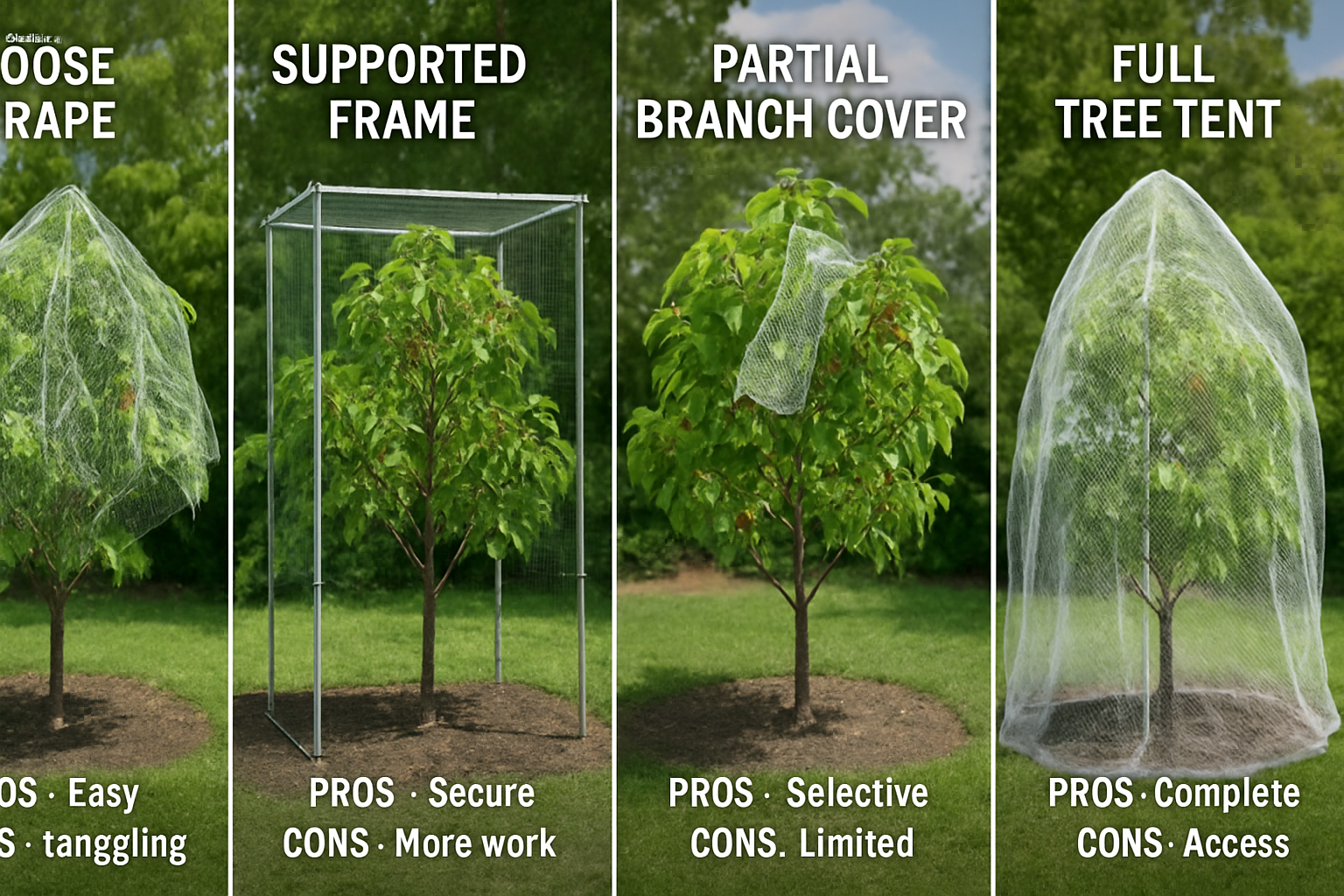
Method 1: The Drape-Over-the-Canopy Approach
This is where most people start — and where I started with my infamous cat-trap incident. You toss netting directly over the tree canopy and secure the edges to the ground or trunk. The appeal is simplicity. The problem? Loose netting at ground level creates exactly the kind of tangle that snares curious animals, and netting that rests directly on branches lets birds perch right on top and peck straight through the mesh.
If you’re going to use this method, use a heavy-duty woven mesh that holds its shape rather than a floppy knotted net. The Meanchen Bird Netting with 1/2-inch mesh is a solid choice here — it’s stiff enough to keep some distance from the branches and strong enough that birds can’t push through it. Gather the base snugly around the trunk and tie it off so nothing can crawl underneath. Honestly, this method works best on younger, smaller mulberry trees where the canopy isn’t enormous.
Method 2: The Supported Hoop Frame
After the cat incident, I got serious. A supported frame keeps the netting lifted off the branches so birds can’t perch-and-peck, and it eliminates the ground-level tangle problem. For smaller or pruned mulberry trees, garden hoops work beautifully as a lightweight internal frame. I’ve had great results using the 60-piece fiberglass greenhouse hoop kit around my dwarf mulberry to create a dome-like structure before draping the netting over it. These rust-free fiberglass hoops are flexible enough to arch over a wide spread, and the clips make attaching netting incredibly easy.
For slightly larger trees, the 8-foot fiberglass greenhouse hoops give you more height and coverage. This is my personal favorite method for medium-sized mulberries that you’ve kept pruned to a manageable shape. Yes, it takes thirty minutes to set up. But you’ll actually be protecting the fruit instead of just decorating the tree with a net and hoping for the best.
Method 3: The Stake-and-Frame Net Kit
If you’re protecting a younger mulberry or one you’ve trained into a bush form, a pre-built net support kit is a fantastic shortcut. The Metal Garden Netting Kit with 2.6-foot stakes and fine mesh insect netting gives you metal stakes, clips, and a fine-mesh cover all in one package. The fine mesh also blocks insects, which is a nice bonus during mulberry season. This isn’t the right tool for a full-sized tree, but for a container mulberry or a young tree in its first few years, it’s a wonderfully tidy solution.
Method 4: The Large-Format Roll Net (For Big Trees)
For mature, full-sized mulberry trees, you need sheer coverage area. The BirdBlock 14′ x 45′ protective mesh gives you enough material to work with a large canopy without constantly running out of net. I use this one on my oldest tree, gathering the excess into pleats and securing it with garden clips so the base is tight. The large format means less seaming and fewer gaps where clever birds sneak through. Tie the base firmly — and please, check under the edges daily during peak fruiting season to make sure nothing has gotten trapped overnight.
Quick Tips Before You Net Your Tree
- Net early — put your protection up before berries start ripening, not after the birds have already found the tree
- Always use half-inch mesh or smaller to prevent birds from getting their heads caught
- Secure the base tightly around the trunk or ground to block entry from below
- Lift netting off branches whenever possible — contact netting lets birds peck right through it
- Check for trapped wildlife every morning during harvest season
- Remove netting promptly after your harvest window closes so it doesn’t become a season-long hazard
The Happy Ending (And My Final Thoughts on Bird Netting Mulberry Trees Methods)
So what happened after the great cat-netting disaster? I switched to a supported hoop frame on that tree, secured the base properly, and had the most successful mulberry harvest of my life. I picked enough berries for four batches of jam, two cobblers, and a mulberry syrup I’m still bragging about. My neighbor eventually forgave me — her cat was completely unharmed and probably deserved the scare — and she now uses the same hoop-frame method on her own tree after I walked her through it over the