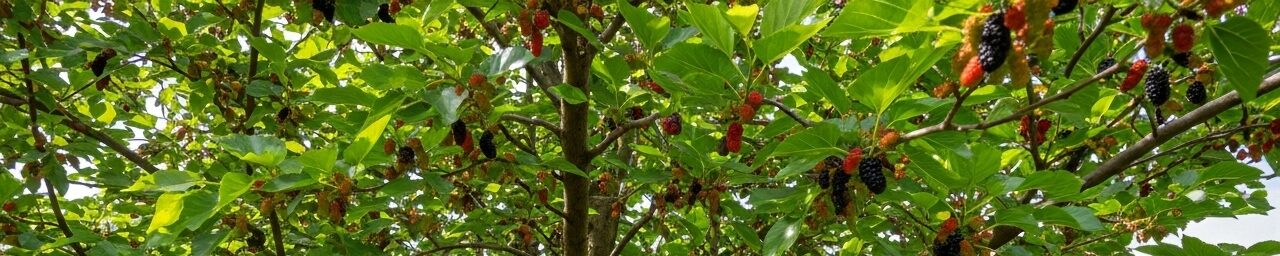
Mulberry yields can vary significantly depending on tree selection and spacing. Growing multiple varieties suited to different ripening windows extends the harvest across nearly twelve weeks rather than a compressed ten-day window. The difference between consistent production and poor yields often comes down to one insight: choosing the right trees for your climate and planting with intention.
Back when I started here, I had one mulberry — a volunteer seedling that had established itself along the property line without any help from me. I figured that was sufficient. The reality turned out to be far messier. Fruit would ripen all at once over maybe ten or eleven days in late June, I would miss half of it thanks to other commitments, and whatever I did collect would spoil before I could turn it into anything useful. That cycle repeated for three seasons before I understood the actual problem.
What changed was recognizing that the issue was not the tree itself — it was the strategy. The answer came through deliberate variety selection. I now maintain three distinct cultivars, each chosen to produce during a different part of the growing season, and together they extend my usable harvest across nearly a dozen weeks. These days I process several hundred pounds annually into jam, wine, dried goods, and frozen material. The gap between those early years and my current setup stems almost entirely from this realization: mulberries are not interchangeable, and randomly grabbing whatever happens to be available at a nursery is a recipe for disappointment.
Let me walk you through how I arrived at the three varieties I grow now, and what each one contributes to the bigger picture.
| Variety | Harvest Window | Yield | Height |
|---|---|---|---|
| Dwarf Everbearing | Late May through early July | 6 to 8 weeks | approximately 8 feet |
| Illinois Everbearing | Late June through late July | 60 to 80 pounds | roughly 18 feet |
| Standard Red Mulberry | Late July through mid-August | enters peak production in late July | not specified |
Why a Single-Tree Setup Leaves You Scrambling
Mulberries deteriorate quickly in a way that other fruit simply does not. An apple or a pear can sit in cool storage for months. A ripe mulberry gives you maybe forty-eight hours on a kitchen counter, perhaps seven days if it is refrigerated. The moment a mature tree dumps its entire crop — something that typically unfolds across eight to twelve days — you are facing a choice between round-the-clock processing or accepting loss.
I encountered this myself in 2014 when my volunteer tree reached peak ripeness while I was away attending my daughter’s graduation ceremony. The ground beneath it was thick with fallen, rotting fruit by the time I returned. Watching months of growth waste away in four days forced me to take variety selection seriously in a way I had not before.
The fix is not simply planting additional trees of the same cultivar. The answer is creating intentional overlap by selecting varieties that mature at different moments throughout the season. Commercial berry growers have used this approach for decades, and there is nothing preventing a home gardener from adopting the exact same method.
First Choice: Dwarf Everbearing (The Steady Producer)
When I decided to expand beyond my single volunteer tree, a compact Dwarf Everbearing cultivar — specifically the Morus nigra dwarf form — was my first intentional planting. It does not receive as much attention in gardening circles as some of the larger white-fruited types, but given my limited acreage and the need to avoid sacrificing thirty or forty feet of canopy to a single fruit tree, it became essential to my system.
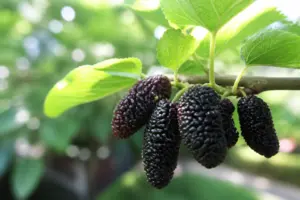
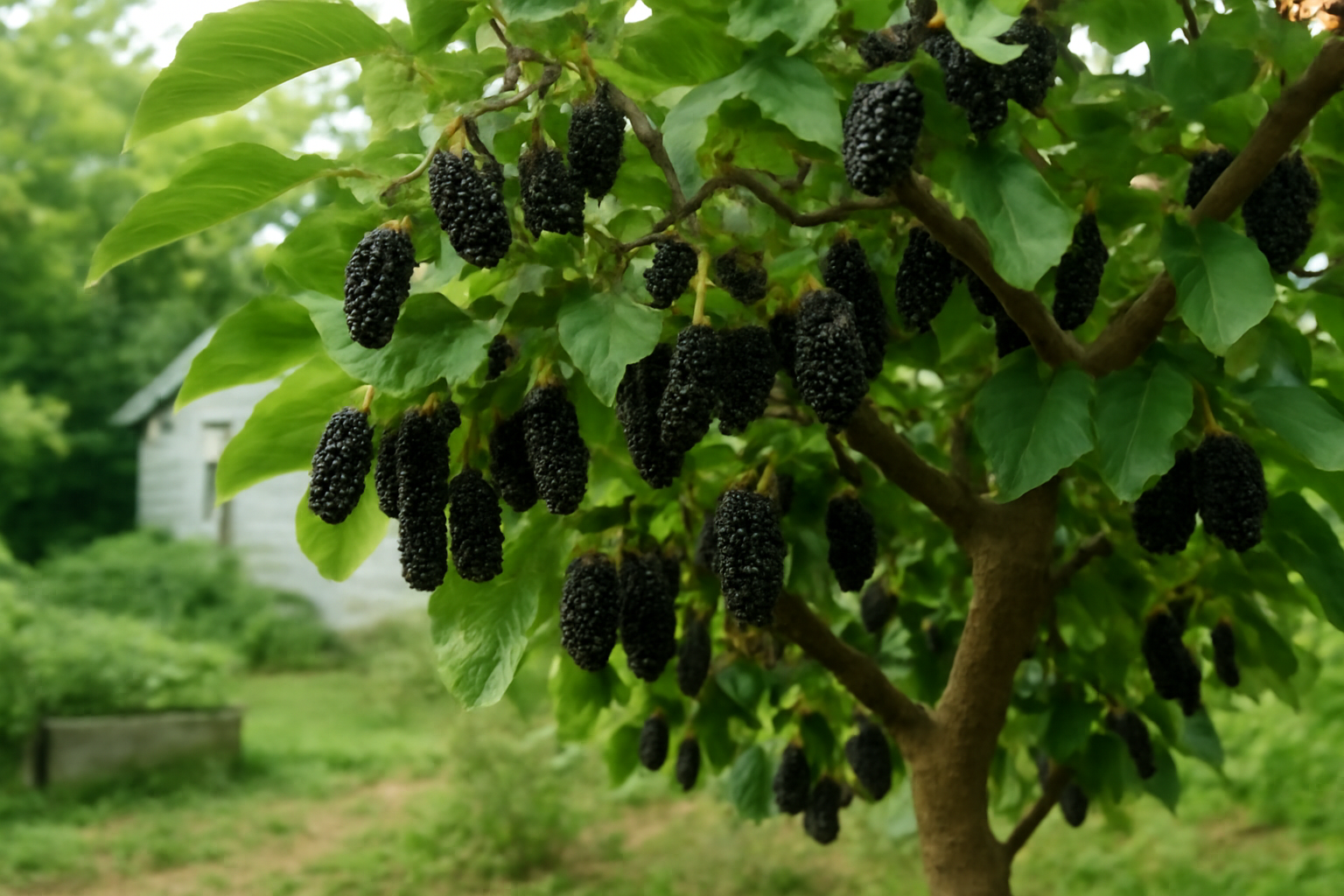
The name genuinely describes what happens. My tree began setting fruit in its second season and by year four it was delivering harvests spread across six to eight weeks — a dramatic contrast to the typical two-week concentrated burst that standard-sized varieties produce. The individual berries themselves are modest in size and deep in color — nearly black when fully mature — with a taste profile that is decidedly sweeter and more nuanced than either the white or red mulberry species. That higher natural sugar concentration becomes significant when you are turning fruit into preserves without loading in added sweeteners.
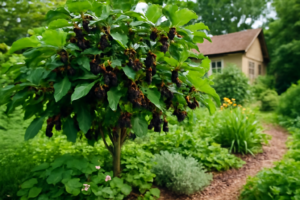
Through annual trimming, I maintain mine at approximately eight feet of height. Left unpruned, these trees can stretch to twelve or even fifteen feet, which remains workable. What really sets the Dwarf form apart is root behavior — the root system does not behave as aggressively underground as a standard-size mulberry does. This matters tremendously when your beds are positioned near pavement, water lines, or structures. I made a costly error in year one by putting a full-size red mulberry only eleven feet from my garage foundation. By year six the roots had located my drainage line and have been a persistent problem ever since. The dwarf types simply do not create this headache.
If you are setting out with limited experience and want a variety that yields consistently, fits within residential space constraints, and delivers fruit with genuine taste complexity, begin with this one.
Second Choice: Illinois Everbearing (The Heavy Yielder)
My volume producer is an Illinois Everbearing — a hybrid cross between Morus alba and Morus rubra developed with cool-climate success in mind. Living in USDA Zone 6b, I have watched this variety demonstrate cold hardiness that exceeds my other plantings. It has weathered two late-May freeze events in the past eight years without significant flower loss, while identical conditions caused blossom drop on my other mulberries both times.
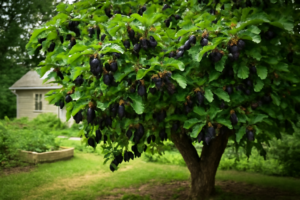
The Illinois Everbearing is a heavyweight in terms of production. At maturity, this variety reaches roughly eighteen feet after heavy dormant-season pruning every other year, and it bears abundantly. During favorable growing seasons, an established Illinois Everbearing tree yields 60 to 80 pounds of fruit. The berries themselves are elongated, almost finger-shaped, and shift to a dark burgundy-black as they ripen. The taste is clean and sweet without much complexity — this is not the preferred variety for eating fresh or fermenting wine, but for preparations like frozen puree, blended smoothies, and dehydrated slices, it performs reliably.
Timing-wise, my Illinois Everbearing hits its production window roughly two to three weeks after the Dwarf Everbearing starts yielding. That stagger is the whole foundation of the system — it keeps the processing work flowing continuously rather than arriving in exhausting surges.
Third Choice: Standard Red Mulberry (The Season Extender)
A traditional Morus rubra specimen — native to eastern North America and genuinely cold-hardy — serves as a late-season producer. When both the Dwarf Everbearing and Illinois Everbearing are winding down in late July, this variety enters peak production, sometimes pushing ripe fruit into August during cooler growing years.
It’s worth being straightforward about the drawbacks, because much of what gets written about mulberries tends to gloss over the reality. Red mulberries are slower to establish. They typically do not produce any meaningful yield until their fourth season, and do not reach heavy production until around year seven. If you need fruit sooner rather than later, this should not be your priority planting. Additionally, red mulberries show greater vulnerability to bacterial leaf scorch compared to hybrid and dwarf varieties—branch loss and significant dieback can occur and may require removal.
However, the later-season productivity provides genuine value to the overall system. By August, most other fruit-producing trees on a homestead have completed their season or are still weeks away from maturity. Having a robust late-season mulberry harvest plugs a gap in the annual production calendar that nothing else fills as economically or as dependably.
How Three Varieties Create a Continuous Harvest Schedule
This is what the actual production calendar looks like when all three are functioning at capacity:
- Late May through early July: The Dwarf Everbearing is the primary source. My harvesting method involves spreading tarps beneath the canopy and gently shaking branches to release ripe berries. Smaller quantities go directly into the refrigerator for fresh consumption; bulk harvests transfer immediately to the chest freezer in one-gallon freezer bags.
- Late June through late July: The Illinois Everbearing moves into high production as the Dwarf begins tapering off. This window is when I operate the dehydrator most intensively and handle the majority of my jam-making workload.
- Late July through mid-August: The Red mulberry finishes out the season. By this point in the calendar, I am primarily stockpiling fruit in the freezer and accumulating material for larger wine batches. The naturally cooler temperatures of late summer also slow fruit deterioration, meaning berries stay harvestable for one or two extra days, which provides welcome scheduling flexibility.
Taken together, this three-tree setup stretches my productive window to approximately eleven or twelve weeks. That contrasts sharply with the eight-to-twelve-day window from my original single tree, and the productivity difference is substantial.
The Reality of Time and Patience
A three-variety setup demands both strategic thinking and a willingness to wait. Your overlapping harvests will not materialize in year one or year two after planting. If you begin this project today, reasonable production from a Dwarf Everbearing materializes in year two, the Illinois Everbearing reaches useful productivity by year three, and a red mulberry requires year four or five before it contributes significantly. The system delivers exceptional returns once it reaches maturity, but that maturity requires a genuine long-term commitment. Do not anticipate that your first season will validate the whole approach. Anticipate instead that by your fifth season, you will feel glad you made the initial investment.
The Takeaway
People regularly ask me which single mulberry variety stands above all others. My response does not change: the superior approach centers on varieties that function as a coordinated system. One cultivar manages the calendar. One delivers volume. One extends the productive season when other plantings are slowing down. Operating in concert, this trio accomplishes what no individual tree can achieve — it generates a harvest that you can actually handle instead of one that outpaces your capacity to use it.
Over a dozen years of managing these plantings, this represents my most practical takeaway about mulberry cultivation. Identify a variety suited to your space and regional conditions, add a second cultivar in the following season, and intentionally build toward this staggered system. The fruit you harvest will repay every season of planning and waiting that the process required.
Staggering Your Harvest: Why I Now Plant Multiple Everbearing Varieties Instead of Chasing One Tree
A single mulberry tree with a narrow fruiting window means you either harvest everything at once or watch it rot on the branch—I learned that lesson the hard way. Planting multiple everbearing varieties spreads your harvest across weeks, so you’re not scrambling to process pounds of fruit in ten days or missing an entire crop to a family trip.
What works
- Everbearing varieties actually stagger their production—fruit appears in waves over 4–6 weeks instead of one chaotic all-at-once drop, which means manageable harvests rather than overwhelming gluts.
- Dwarf cultivars fruit younger and stay compact enough to net or harvest by hand without needing a ladder or losing fruit to birds before you reach it.
- The 4-pack format lets you plant backups and experiment with placement—one in a pot for mobility, one in full sun, and one in dappled shade to see which conditions suit mulberries best.
What doesn’t
- “Everbearing” doesn’t mean fruit every day—it means longer season, but you still get gaps between flushes, and those gaps can be weeks in cold or dry stretches.
- Young trees from a 4-pack take 2–3 years to produce at full capacity, so don’t expect commercial-level yields in year one—you’re building toward abundance, not instant gratification.
I nearly gave up on the second year when my newly planted dwarf trees only produced a handful of berries each, but I stuck with the plan and resisted ripping them out. Now, three mature staggered trees give me far more fruit to actually use than that original single volunteer ever did. Mulberry Dwarf Everbearing Live Tree for Sale (4 Pack) | Easy to Grow Plants | Edible Fruit Plant for Sustainable Living
Frequently Asked Questions
How long can ripe mulberries stay fresh before spoiling?
A ripe mulberry gives you maybe forty-eight hours on a kitchen counter, or perhaps seven days if refrigerated. They deteriorate quickly compared to other fruits like apples or pears, which is why staggered harvests from multiple varieties are so helpful for managing the fruit before it spoils.
What is the Dwarf Everbearing mulberry best used for?
The Dwarf Everbearing produces modest-sized, nearly black berries with sweeter, more nuanced flavor than other mulberry species. That higher natural sugar concentration makes it ideal for preserves without loading in added sweeteners, and it yields across six to eight weeks instead of a concentrated burst.
How cold hardy is the Illinois Everbearing mulberry?
The Illinois Everbearing is a hybrid developed with cool-climate success in mind and demonstrates cold hardiness that exceeds other varieties in USDA Zone 6b. It has weathered two late-May freeze events without significant flower loss, while identical conditions caused blossom drop on other mulberries.
When does the red mulberry tree start producing fruit?
A standard red mulberry is slower to establish than hybrid or dwarf options. My tree did not produce any meaningful yield until its fourth season, and did not deliver heavy production until year seven, so it is not the best choice if you need fruit sooner.
Keep Reading
About This Article
Written by Ruth Nakamura. Ruth Nakamura is a backyard orchardist in the Pacific Northwest who has grown mulberries for fifteen years, cultivating twelve different varieties in her own backyard. Not a horticulturist by formal training - she shares what she has learned through hands-on growing, workshops, and connecting with nurseries and growers across the country. More about this site.
Scope and limits. Ruth is a backyard orchardist without formal horticultural training. Growing conditions vary enormously by region, so confirm variety, timing, and pest guidance with your local extension service.
Verify this against a primary source
Specifics change, and your situation may differ from the one described here. These are the authorities worth checking directly:
- USDA Plant Hardiness Zone Map — zone verification for your location
- Oregon State University Extension — fruit growing and pruning research
- USDA PLANTS Database — species range and identification