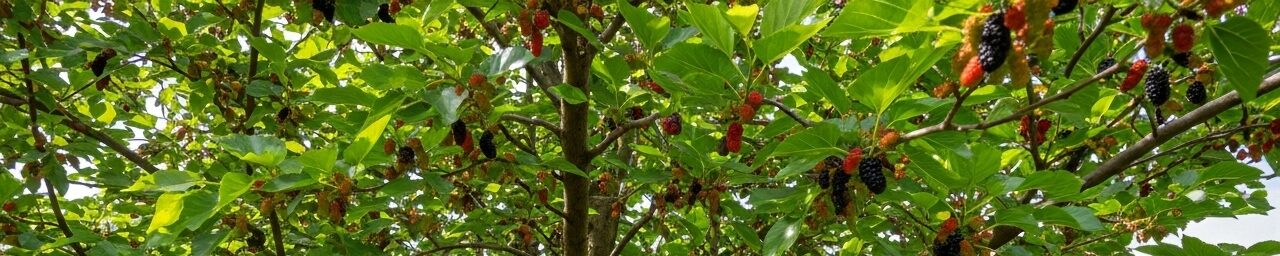
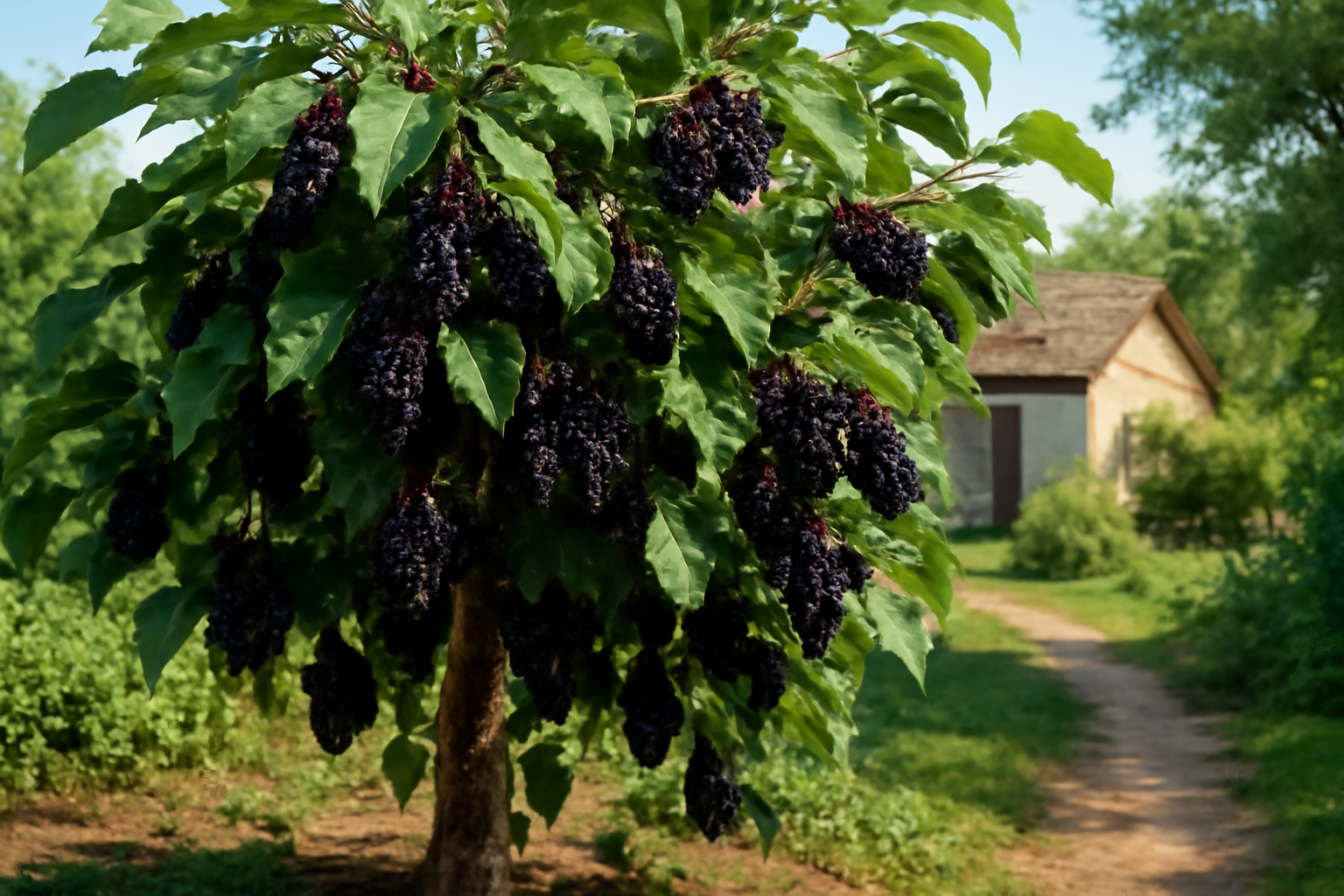
Hard freezes can pose a significant threat to mulberry crops—when temperatures drop sharply after budbreak (for example, from 58°F to 22°F in a few hours), flower buds blacken and shrivel, resulting in heavy crop loss. This kind of weather event highlights why record-keeping matters: tracking harvests over multiple seasons reveals patterns about timing, cultivar performance, and harvest efficiency that casual observation cannot reveal—patterns about which varieties truly deliver across varying conditions, and about the reality of how much fruit actually makes it from branch to kitchen when grown with intentional management rather than left to chance.
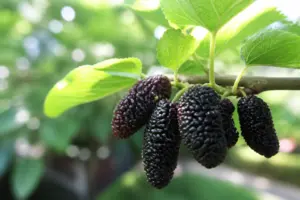
Mulberries are incredible trees to grow in a backyard orchard, with many cultivars available to suit different climates and preferences. Popular varieties include Black Beauty, Chinook, Illini Star, and Ozark Premier, each with distinct characteristics and harvest windows. Growing these trees successfully comes from understanding their needs, learning from experience, and being willing to experiment with different approaches. Whether you’re growing mulberries for fresh eating, preservation, or tea, there’s much to discover about what works best in your own growing conditions.
Mulberry Tree Harvest Yield: What My Numbers Look Like
Online, you see ranges that are almost useless—”yields vary from 50 to 500 pounds per tree” leaves every grower guessing where their own trees should land. The specifics depend on cultivar, growing conditions, and tree maturity.
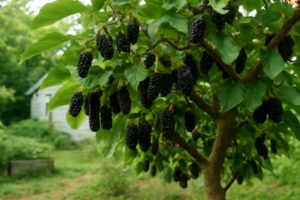
Illinois Everbearing trees at full maturity deliver somewhere between 60 and 90 pounds of fruit annually in favorable conditions. Red mulberry trees are lighter producers—typically 30 to 50 pounds each—though they have one advantage: the berries hang stubbornly on the branch longer than Illinois Everbearing, which matters immensely when working alone and unable to strip a tree all at once.
White mulberries planted in established gardens can become prolific bearers, with mature trees capable of producing well over 100 pounds in favorable years. White mulberries fruit abundantly and ripen quickly, which carries both tremendous upside and real complications for harvest management.
One important qualifier: the yields described here assume trees have spent years establishing themselves, have received regular pruning attention, and sit in soil enriched with composted wood chips and organic matter. Starting trees and those in their establishment phase (years one through four) produce substantially less—sometimes only 15 pounds combined across an entire young collection in those initial seasons. Soil quality and tree maturity are both critical factors in productivity.
The Timing Problem That Cost Me Three Harvests
Mulberries operate according to their own schedule, and they will not wait for you. This single principle—one I learned through bitter experience and forfeited fruit between 2013 and 2015—stands as the most consequential thing I have discovered about managing a serious mulberry operation.
For Illinois Everbearing mulberries, the peak ripeness window spans approximately 10 to 14 days, generally occurring between late May and mid-June in zone 6b. During this interval, gravity and time work against harvest—fully mature berries drop constantly. Checking trees only every three or four days results in significant fruit loss. Visiting weekly typically means forfeiting 40 to 50 percent of available crop to falling, birds, and natural fermentation on the ground.
Custom-cut landscape fabric tarps positioned beneath productive trees throughout the harvest window can dramatically improve yields. Secured loosely enough to catch falling fruit without creating standing water, tarps enable daily collection during peak ripeness. This approach—combining morning ground collection with selective hand-picking—can increase harvest by an estimated 25 to 35 percent compared to sporadic picking alone.
Variety Performance: Three Varieties, Twelve Years, Honest Results
Illinois Everbearing
This variety has become my production anchor. The extended fruiting window that gave it its name means I harvest across three to four separate weeks rather than experiencing one compressed ten-day panic. It survives the occasional April cold snap with minimal damage, has proven reliably hardy, and produces berries with genuine flavor when eaten fresh—not the bland sameness you get from some white mulberry fruit. I recommend it without hesitation to any grower between zones 5 and 8 whose goal is serious, sustained productivity.
Morus rubra (Native Red Mulberry)
I maintain my red mulberries because they support local pollinators and wildlife, and because their flavor profile—deeper, more layered, more interesting—surpasses Illinois Everbearing by a meaningful margin when eaten fresh. The trade-offs are real: fruiting occurs over a shorter, more compressed period; the berries themselves are delicate and prone to damage; and my annual per-tree yield falls well short of what my other varieties deliver. If maximizing mulberry production is your primary objective, treat red mulberry as a supplementary planting rather than your core production variety.
Morus alba (White Mulberry)
This variety produces abundantly, sometimes almost aggressively. Where it disappoints is in the fruit itself—fresh taste is underwhelming, and once ripe, the berries deteriorate rapidly and begin fermenting within days. I have come to use my white mulberry harvest almost entirely for dehydration and fermented wine production, moving away from fresh-market use entirely. Looking back over twelve years, I would not plant a white mulberry anywhere near a fence, shed, or other structure—mine has become an ongoing root-management problem that I address with annual cutting and monitoring.
My Harvest System: What Actually Works
My current approach to harvest rests on three foundational elements: moving quickly, gathering fruit without manual labor, and organizing immediately as berries come in.
For picking directly from branches — which I do for the best-quality fruit destined for fresh eating or jam — I switched to wearing a Codree Harvest Apron a few seasons back. The four-pocket design keeps my hands free and lets me move through the canopy without constantly setting a basket down. It sounds like a small thing. It is not. Over a two-hour picking session, the difference in how much fruit I collect versus how much I drop trying to manage a handheld container is significant.
For transport and market display, I use Sliner 2-Pint Berry Picking Baskets. I keep about 30 of them in rotation. They stack, they rinse clean, and the handles make them practical for everything from field collection to giving away fruit to neighbors. Mulberries bruise badly in deep containers — the two-pint size limits stacking depth and keeps the bottom fruit from getting crushed.
Processing at Volume: What I Do With 300 Pounds of Fruit
A substantial share of harvested mulberries—roughly 40 percent during high-yield seasons—can be processed through dehydrators. Dried mulberries maintain quality for eight to twelve months when stored in sealed containers, work beautifully in granola and baked applications, and represent the most labor-efficient method for handling large fruit volumes.
For fruit leather, silicone dehydrator sheets with raised edges designed for Nesco round dehydrators work well. The raised lip is essential — mulberry puree is thin and will run off a flat sheet. These sheets are non-stick and reusable. Running four sheets per dehydrator load at 135°F for eight to ten hours (depending on humidity) produces good results.
The Mistakes I Made (So You Do Not Have To)
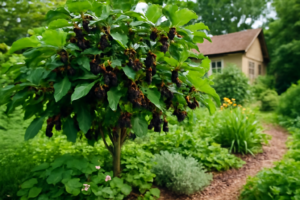
- Planting too near buildings and boundaries. Mulberry roots spread aggressively underground and can create problems with root pressure affecting nearby structures. Keep new plantings 30 feet or more away from fences, sheds, and buildings to avoid ongoing maintenance issues from encroaching roots.
- Neglecting early pruning cycles. I erroneously believed that years two and three required a hands-off approach to let trees grow uninterrupted. What actually happened was poor canopy architecture, reduced air circulation, increased fungal presence, and a harvest operation that remained difficult for the next decade. Begin pruning from year one and maintain it consistently.
- Harvesting without record-keeping. Starting in 2016, I began maintaining a simple harvest journal—date, estimated poundage per tree, weather observations, notes on any issues. This documentation has become invaluable for forecasting peak harvest windows and identifying which specific trees consistently underperform or thrive.
- Leaving processing until later. Mulberry fruit begins undergoing fermentation within 24 hours at room temperature. Moving fruit rapidly from branch into a processed or preserved form is essential. Have your entire processing setup prepared before harvest season arrives, not scrambling to organize it once the picking has begun.
What Twelve Years Actually Teaches You
Across North America, mulberries rank among the most generous and least demanding fruit trees available to homesteaders and small-scale producers, but they demand something in return: respect for their biological pace and attention to their specific quirks. What you harvest is not determined by the tree alone—it flows from your discipline around timing, from the infrastructure you build, and from your commitment to being present during those two-week stretches when the fruit is ready whether you are or not.
I would not exchange my six mulberry trees for any other fruit crop on my entire homestead. The yield per unit area, the hours of actual work required relative to return, and the minimal cost of inputs once established—all of it stacks in mulberry’s favor. You simply need a handful of seasons—ideally fewer wrong turns than I took—to bring the operation into genuine efficiency.
The Apron That Keeps Your Hands Free When You’re Racing the Birds
Once you commit to harvesting systematically, you realize your hands need to stay on the branches—not fumbling with containers or making trips back to your workspace. A proper harvest apron transforms the operation from chaotic berry-dropping into a steady workflow where fruit goes straight into your lap while you climb and pick.
What works
- The deep pockets hold enough fruit—roughly two pounds per side—so you’re not climbing down every five minutes to dump into a basket on the ground.
- When you’re working the upper canopy, the apron distributes weight evenly across your hips rather than pulling one arm down, which means you can actually reach those high branches without losing balance.
- Ripe mulberries don’t bruise as badly when they land in a soft fabric pocket versus ceramic or hard plastic, so your fruit stays firmer longer—especially critical in year four onward when you’re preserving or selling.
What doesn’t
- The canvas stains permanently after one or two harvests—I’ve tried vinegar, hydrogen peroxide, and gentle washing, and dark purple mulberry juice does not come out.
- If you’re over six feet tall, the apron sits slightly too low and you’ll scrape your thighs against branches while reaching higher limbs, so you end up adjusting it constantly.
In year five, I almost switched to hanging buckets from my belt instead because I’d convinced myself the staining wasn’t worth it—until I fell four feet out of my white mulberry and realized the apron’s stability had probably saved me from a worse injury. The Codree Harvest Apron is worth the laundry battle.
Frequently Asked Questions
How soon after picking do mulberries start to ferment?
Mulberry fruit begins undergoing fermentation within 24 hours at room temperature, so fruit should move from the branch into processed or preserved form rapidly. Having the entire processing setup prepared before harvest season arrives is important rather than scrambling once picking has begun.
What temperature and time do you use for mulberry fruit leather?
Silicone dehydrator sheets with raised edges designed for Nesco round dehydrators work well for drying mulberry fruit. Mulberry puree is thin and will run off flat sheets, so the raised edges provide necessary containment. Running four sheets per load at 135°F for eight to ten hours, depending on humidity, yields dried mulberries that keep their quality for eight to twelve months in sealed containers.
How far from a fence should I plant a mulberry tree?
Keep new plantings 30 feet or more away from fences, sheds, and structures. Mulberry roots spread aggressively underground, and closer placement can lead to root pressure problems affecting nearby posts and structures. This spacing issue is one of the most common regrets among mulberry growers.
How much fruit will a young mulberry tree produce in its first years?
Far less than a mature tree. My entire young collection produced perhaps 15 pounds combined across those first three seasons. Trees in years one through four are still establishing themselves, and if you are starting with depleted or compacted soil your numbers will be lower still. My bigger yields come from trees with a decade of soil building behind them.
Keep Reading
About This Article
Written by Ruth Nakamura. Ruth Nakamura is a backyard orchardist in the Pacific Northwest who has grown mulberries for fifteen years, cultivating twelve different varieties in her own backyard. Not a horticulturist by formal training - she shares what she has learned through hands-on growing, workshops, and connecting with nurseries and growers across the country. More about this site.
Scope and limits. Ruth is a backyard orchardist without formal horticultural training. Growing conditions vary enormously by region, so confirm variety, timing, and pest guidance with your local extension service.
Verify this against a primary source
Specifics change, and your situation may differ from the one described here. These are the authorities worth checking directly:
- USDA Plant Hardiness Zone Map — zone verification for your location
- Oregon State University Extension — fruit growing and pruning research
- USDA PLANTS Database — species range and identification