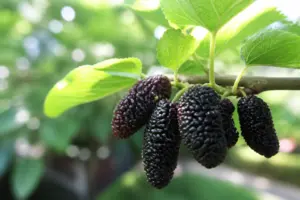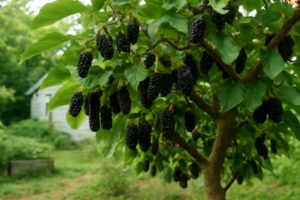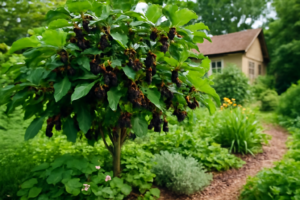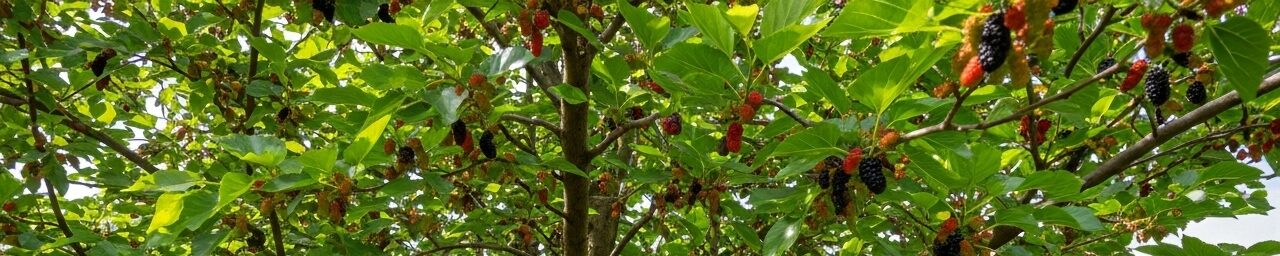
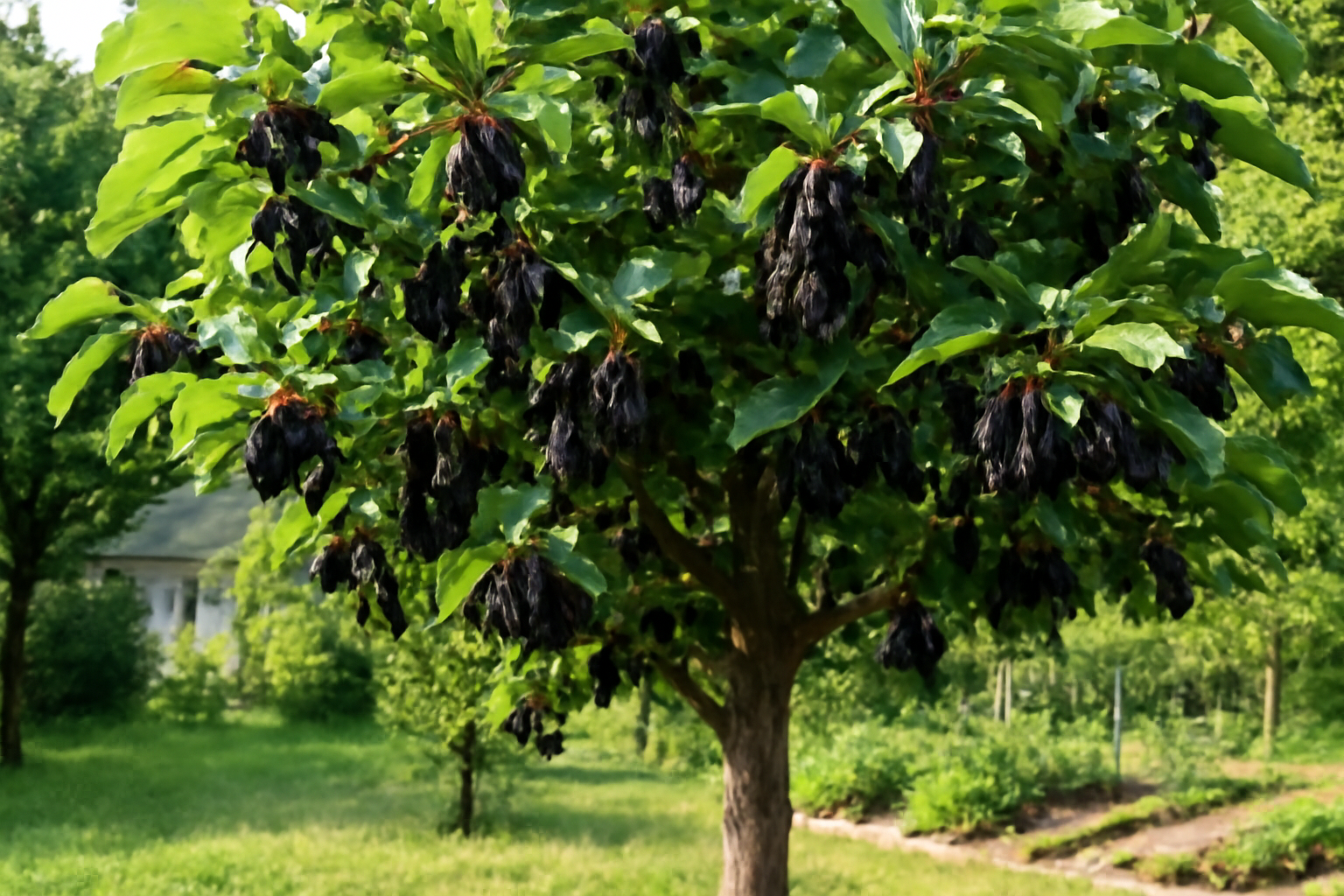
Growing mulberries in the Pacific Northwest offers rewarding opportunities for backyard orchardists. Popular cultivars like Black Beauty, Chinook, Illini Star, and Ozark Premier perform well in home gardens. Learning about mulberry cultivation involves reading, conversations with nursery contacts, attending workshops, and hands-on experience in the garden. Both abundant harvests and setbacks provide valuable lessons for improving growing practices.
You will encounter two competing pieces of advice online when you start researching mulberry placement: one camp says plant them fifteen to twenty feet away from structures, while another insists you can get away with closer spacing if you prune regularly. The second piece of advice is the problem — and mulberries are the reason why. Unlike ornamental trees or even many fruit trees, mulberries do not respond well to constant heavy pruning as a substitute for proper spacing. I learned this the hard way when my first-year planting decision became a four-year regret.
That March morning when I dug a hole eight feet from my back fence, I felt certain I had done adequate research. Eight feet seemed reasonable. Sensible, even. By year three, I was staring at root damage to a fence post I had replaced just months earlier, branches scraping against my chicken coop, and a canopy so thick that my vegetable beds were living in perpetual shade. The real cost was not just the fencing repairs or the pruning labor — it was losing three seasons of decent harvests because the tree was constantly stressed from the aggressive cutting I had to perform just to prevent it from taking over my entire yard.
Mulberry mistakes often arrive quietly. A single decision made in early spring may not reveal its full impact until several years later. Working with multiple cultivars and understanding what went wrong in early plantings—why it happens to many new growers, and how to establish trees that coexist well with the landscape rather than constantly working against it—can prevent costly delays in achieving productive growth.
That First Major Mistake: Underestimating How Far These Trees Actually Spread
Generic fruit-tree guides recommend planting mulberries fifteen to twenty feet away from structures. This advice is not entirely wrong, but it is dangerously incomplete — it creates a false confidence that will lull you into careless placement decisions. What those same guides often skip over is that a vigorous mulberry cultivar, especially red mulberry or Illinois Everbearing, does not behave like a typical fruit tree. It behaves like something that has spent millennia optimizing for survival and expansion. Shallow, extensive root systems. Canopy growth that follows those roots in all directions. The tree I planted eight feet from my fence eventually developed a canopy diameter of over thirty feet, with root reach extending far beyond that.
My current rule: take whatever spacing guideline you come across and add an additional ten feet to it. Then honestly assess whether you can live with a full-sized mature tree occupying that entire radius and affecting everything within it — fencing, perennial beds, sheds, drainage systems, and nearby plants. If that mental picture makes you uncomfortable, choose a different location and move on before you ever break ground.
Why This Blunder Catches Almost Everyone in Year One
When you are standing in front of a six-to-ten inch sapling, your brain cannot reliably process what two decades of maturation will actually look like. I have watched other homesteaders work through their first mulberry plantings, and what I consistently observe is them selecting a spot based on how the tiny tree currently appears at that location — not where it needs to be at full development. A small potted mulberry positioned beside a fence line appears neat and proportionate in that moment. That identical tree, twenty years later at full spread, becomes a problem you cannot ignore.
There is another reason this happens: mulberries expand in size far more quickly than most growers anticipate. We are not dealing with a leisurely apple tree that gives you a decade to course-correct. In my area — Zone 8b in the Pacific Northwest — a mulberry with good growing conditions will put on six to eight feet of new growth in just the first two or three seasons. Once you finally realize that your placement was miscalculated, the tree is already substantially invested in its current location, and attempting to move it becomes a dangerous proposition with a very real possibility of losing the entire tree.
The Second Major Problem: How Bad Placement Destroys Your Fruit Production
My placement error directly triggered a second problem that actually cost me fruit, and this is what I wish someone had explained to me upfront. My overcrowded tree — stuck between fence and coop — needed constant trimming just to remain manageable. The heavy cutting I performed in late winter, driven purely by necessity rather than any sound strategy, was cutting away the fruiting wood I needed. Mulberries do produce on new growth, yes, but they also require a solid framework of established branches to yield consistently year after year. Every single winter, I was disrupting that structure, and the outcome was unpredictable and disappointing harvests throughout years two, three, and four.
Everything shifted once I stopped reacting to overgrowth and instead adopted a thoughtful annual maintenance rhythm — minimal shaping cuts in late winter, nothing drastic or reactive. That single shift in approach produced a dramatic jump in what I was actually harvesting. When my two trees hit year eight, they pulled in just over two hundred pounds across the season. By year eleven, that same pair plus a third mature tree were delivering closer to four hundred pounds across a six-week harvest window. That level of increase had nothing to do with different fertilizer applications or more sophisticated irrigation. It was simply about leaving the trees alone to grow the way they wanted to grow.
How I Approach Site Selection Now: The Actual Process
When it came time to plant my second mulberry tree — the one I got right — I worked through a deliberate evaluation before the shovel ever left the shed:
- Distance from boundaries and utilities must be at least thirty feet; I personally use forty. Fences, structures, underground lines — you need that buffer zone all around.
- The location requires full sun exposure, minimum six hours of unobstructed direct light. You can grow a tree in less light. You will not grow a tree that produces meaningful quantities of fruit.
- Think about the terrain below and around your planting spot. When ripe mulberries drop — and they drop constantly — they will stain absolutely everything they land on. My second tree sits where falling fruit lands on a mowed grass area, not on walkways, outdoor living spaces, or vehicle access zones.
- Drainage quality matters far more than how rich the soil is. Mulberries can thrive in poor soil. Saturated, waterlogged roots will kill them. I learned this lesson through loss when a young tree sat in a drainage low spot and experienced pooling after heavy rainfall, year after year, until it finally died.
- Plan ahead for how you will actually access and harvest the tree. During peak ripeness, a full-size mulberry canopy demands that you spend considerable time working beneath and around it. You want adequate open ground surrounding the tree on every side so you can position harvest equipment and move freely without obstacles.
- Trees planted in adequate space develop symmetrical, well-structured canopies without needing heavy corrective pruning — this translates directly into consistent, abundant fruit production.
- Proper spacing means you can access the entire tree during harvest without working around obstacles or dealing with branches rubbing against structures and creating damage.
- A mulberry with room to grow becomes a resilient, long-lived part of your landscape rather than a source of constant friction and repair costs.
- Cramped trees demand aggressive pruning to remain controllable, which disrupts the woody structure required for reliable fruit production.
- Shallow-rooted mulberries in tight spaces will lift pavement, damage fencing, and invade utility lines year after year, creating an endless cycle of repairs.
- USDA Plant Hardiness Zone Map — zone verification for your location
- Oregon State University Extension — fruit growing and pruning research
- USDA PLANTS Database — species range and identification
Building Soil Foundation Before You Plant
Although mulberries are not particularly demanding when it comes to nutrient needs, establishing them in thoughtfully prepared soil pays benefits across decades of productive growth. Prioritizing soil biological activity rather than relying solely on synthetic fertilizer products is an impactful practice. Incorporating a humic acid-based soil conditioner at the moment of planting, then again each early spring, supports stronger root development in new plantings and better fruit formation in established trees. Research backs this approach: humic acids enhance the efficiency with which roots access nutrients and activate beneficial microbial communities in soil in ways that chemical fertilizers cannot achieve over extended periods.
The Seed-Versus-Nursery-Stock Question
I want to be direct with you about this choice: taking the seed route means accepting a longer waiting period before fruit production. Mulberries started from seed may take anywhere from five to ten years before they begin producing any significant quantity of berries. I have done this on my own property, and there is real satisfaction in the process, but I cannot recommend it if your primary goal is getting harvestable fruit quickly. A grafted or rooted cutting propagated from a proven productive cultivar will give you fruit much sooner and eliminate guesswork around berry characteristics, flavor profile, and ripening timeline.
Seed growing does have legitimate uses and appeal, particularly if you are establishing a protective tree screen, building up rootstock that you intend to graft onto later, or simply want the satisfaction of nurturing something from the very beginning. Just approach it with realistic expectations about how many years will pass before the tree reaches productive maturity.
What I Actually Purchase and Suggest for New Plantings
Here is what I have gravitated toward after more than a decade of experimentation and refinement as I have expanded my mulberry plantings:
For seed starting and long-term projects, I have used 20Pcs Mulberry Seeds for Planting-Non-GMO Heirloom Fruit Seeds Garden Outdoor-Grow Your Own Mulberry Trees. Non-GMO heirloom seed stock is the right starting point if you are going the seed route.
For anyone who wants to skip the multi-year wait and start with a tree that will produce on a reasonable timeline, the Illinois Everbearing Mulberry Tree 6-10″ Tall, Sweet Fruit to Enjoy Year After Year, Fruit Bearing Potted Plant is a solid choice. Illinois Everbearing is one of the best-performing varieties for home growers in a wide range of climates — long fruiting window, excellent flavor, reliable yields.
For soil preparation and ongoing tree health, I use Farmer’s Secret Soil Revitalizer (32oz) – Organic (OMRI Listed) Dirt Health Booster – Liquid Compost Soil Amendment – Activated Humic Acid – Great for Fall/Spring Application. OMRI Listed, liquid application, and the activated humic acid formula fits exactly the soil biology approach I have been using for the past four years with consistent results.
A Final Thought on Salvaging Less-Than-Perfect Placement
I want you to understand this clearly: established mulberry trees are surprisingly resilient and adaptable. If you have already made some of the placement or management errors I have described — and honestly, most of us have — you are not necessarily facing an unrecoverable situation. The tree I planted incorrectly all those years ago still produces ripe fruit. I have simply learned to work within its constraints rather than fighting against them every season. The reason I am laying all this out is not to inspire worry about achieving perfect conditions. It is to give you the concrete, practical information I desperately wanted to have back at the beginning so that your learning curve contains smaller problems than mine cost me.
Prioritize location before you break ground. Honor the growth potential of the species. Allow the tree adequate space to behave naturally. The rest will follow.
Moving Forward: Why Thoughtful Placement Beats Reactive Management Every Single Time
When I finally stopped trying to force my first tree into a space it was never meant to occupy, everything shifted. Getting placement right from the start eliminates years of stress pruning and unpredictable harvests. This is why I approach each new planting with the same deliberate site selection process I have outlined here.
Where this approach succeeds
Where placement mistakes create ongoing headaches
When growing mulberries from seed, planting extra seeds accounts for variable germination rates. 20Pcs Mulberry Seeds for Planting-Non-GMO Heirloom Fruit Seeds Garden Outdoor-Grow Your Own Mulberry Trees
Frequently Asked Questions
How much sun does a mulberry tree need for good fruit?
The site needs full sun exposure, a minimum of six hours of unobstructed direct light. You can grow a mulberry in less light, but you will not grow one that produces meaningful quantities of fruit. When I plan a new planting, checking light is one of the first things I do before the shovel ever leaves the shed.
Will waterlogged soil kill a young mulberry tree?
Yes, saturated and waterlogged roots will kill them. Drainage quality matters far more than how rich the soil is, since mulberries can thrive in poor soil. I learned this through loss: a young tree of mine sat in a drainage low spot that pooled after heavy rainfall, year after year, until it finally died.
How fast do mulberry trees grow in the Pacific Northwest?
In my area, Zone 8b in the Pacific Northwest, a mulberry with good growing conditions will put on six to eight feet of new growth in just the first two or three seasons. That speed is exactly why placement errors catch people out. You do not get a decade to course-correct like you would with a leisurely apple tree.
Does a humic acid soil conditioner actually help mulberries?
Incorporating a humic acid-based soil conditioner at planting time, then again each early spring, supports stronger root development on new plantings and better fruit formation on established trees. Humic acids improve how efficiently roots access nutrients and activate beneficial soil microbes.
Keep Reading
About This Article
Written by Ruth Nakamura. Ruth Nakamura is a backyard orchardist in the Pacific Northwest who has grown mulberries for fifteen years, cultivating twelve different varieties in her own backyard. Not a horticulturist by formal training - she shares what she has learned through hands-on growing, workshops, and connecting with nurseries and growers across the country. More about this site.
Scope and limits. Ruth is a backyard orchardist without formal horticultural training. Growing conditions vary enormously by region, so confirm variety, timing, and pest guidance with your local extension service.
Verify this against a primary source
Specifics change, and your situation may differ from the one described here. These are the authorities worth checking directly: