When a homeowner calls me about a mulberry tree that’s looking off — yellowing leaves, poor fruit set, unusual growth patterns — my first step is always a systematic inspection rather than a spray. Most of the problems I see are either nutrient-related, watering-related, or caused by a specific pest that has a specific, targeted solution. What I’ve also noticed, though, after years of variety trials and extension consultations, is that a surprising number of growers never get to fully enjoy their harvest because the harvesting process itself becomes the problem — bruised fruit, significant drop loss, and the kind of full-body staining that makes you question your life choices. The good news is that the right tools make mulberry harvesting genuinely efficient and fruit-quality-preserving, and I’ve tested enough of them across different tree forms and cultivars — from weeping Morus alba to vigorous Morus rubra selections — to tell you exactly what’s worth your money and what isn’t. This guide is what I wish someone had handed me before my first serious harvest season, and it’s built on real-world use, not manufacturer claims.
If you’ve harvested mulberries by hand — just grabbing berries one by one and dropping them into whatever container was closest — you already know the chaos I’m describing. Mulberries are gloriously, stubbornly juicy. They stain fast, they squish easily, and they ripen all at once in a way that makes you feel like you’re racing against nature herself. The good news? A little preparation and the right gear turns this whole ordeal into something genuinely enjoyable. Let me walk you through what actually works.
Why Mulberry Harvesting Gets Messy (And Why It Doesn’t Have To)
Back to that terrible, wonderful afternoon. I had decided — boldly, naively — that I would harvest the entire tree before dinner. I grabbed a plastic grocery bag (mistake number one), wore my favorite shirt (mistake number two), and attempted to pick berries directly off the branch with my bare hands while standing on my tiptoes (mistake number three through about eleven). Every berry I squeezed a little too hard became a tiny purple explosion. The bag tipped over twice. A branch whipped back and hit me square in the cheek, depositing a streak of juice I wouldn’t discover until the neighbor incident.
Here’s the thing about mulberries that makes them uniquely challenging compared to, say, blueberries or blackberries: they’re incredibly fragile once ripe. A fully ripe mulberry practically falls apart when you touch it. That’s what makes them so sweet and delicious — and so absolutely destructive to anything within a three-foot radius when you’re not prepared.
The solution isn’t to pick them more carefully. The solution is to work smarter with tools designed to handle delicate, high-volume berry harvesting without turning you into a crime scene.
The Best Mulberry Harvesting Tools (That Actually Work)
The Berry Picker That Finally Lets You Harvest Without Crushing Ripe Fruit
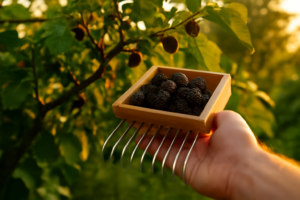
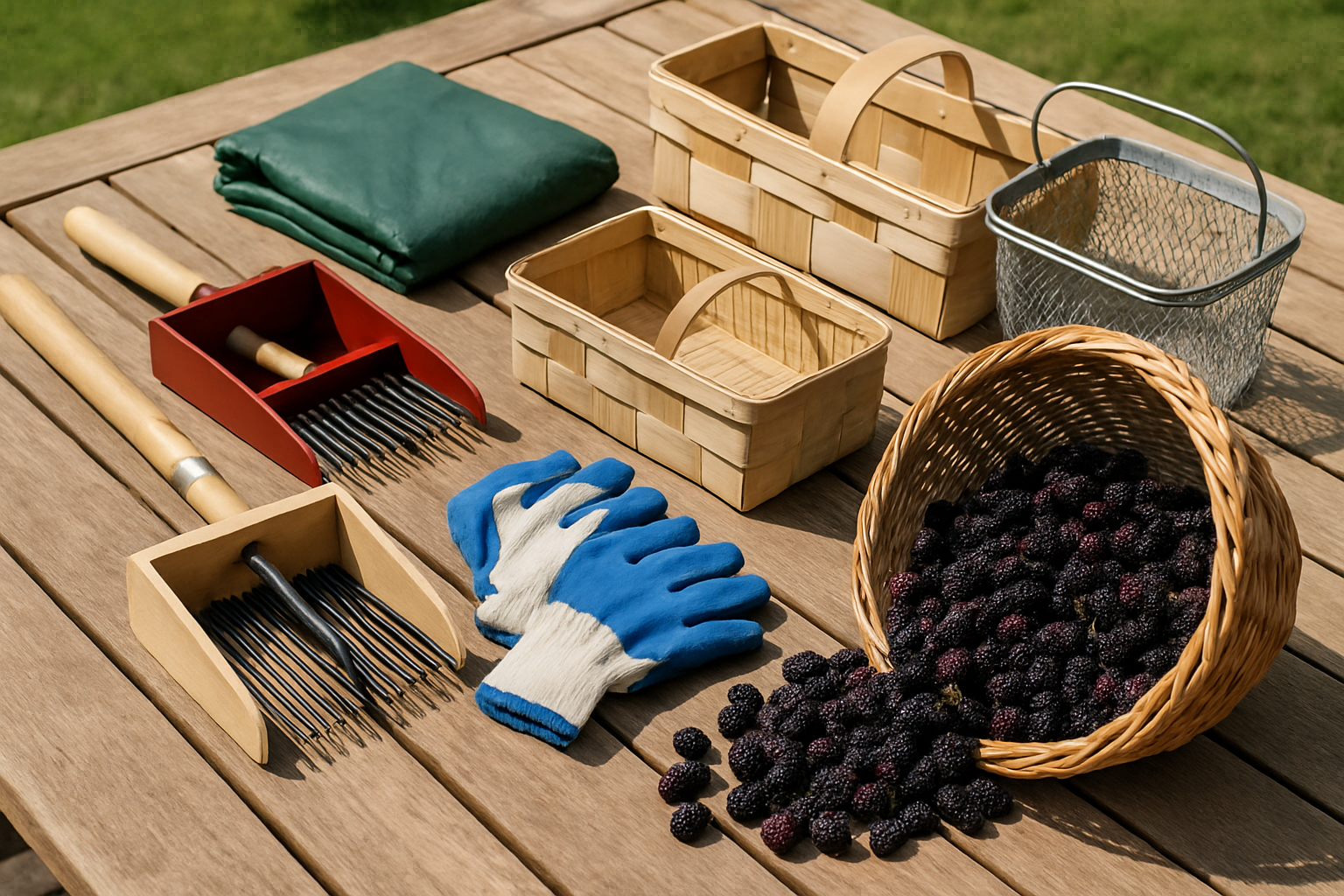
Hand-picking mulberries should be straightforward, but ripe fruit is so delicate that bare fingers often squash berries before they even hit the bucket. A proper berry picker with a comb mechanism does the work your hands can’t—gently separating ripe fruit from the stem without the bruising.
What works
- The metallic comb catches only the truly ripe berries and leaves immature ones behind, so you’re not wasting energy on fruit that isn’t ready.
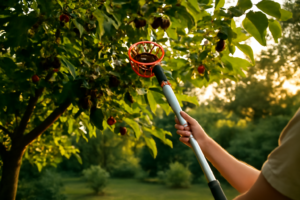
- The ergonomic handle means you can reach high branches without contorting your wrist or dropping the picker mid-harvest—critical when you’re working at full extension on a mature tree.
- Berries roll gently into the basket instead of getting mangled, which means less juice loss and fruit that holds up better during transport to the kitchen.
What doesn’t
- On heavily laden branches with overlapping fruit clusters, the comb sometimes catches on leaves or adjacent berries, forcing you to reposition and slow down your rhythm.
- The basket attachment is small enough that on peak harvest days you’re emptying it constantly, which defeats some of the time-savings if you’re working a large tree.
I initially doubted whether the comb was gentle enough after watching a few berries still split on the first try, but I realized I was twisting instead of rolling—once I adjusted my motion, bruising dropped to almost nothing. If you’re serious about actually *enjoying* your harvest instead of salvaging juice-stained fruit, grab a Berry Picker with Metallic Comb and Ergonomic Handle.
This post contains affiliate links. As an Amazon Associate, I earn from qualifying purchases at no extra cost to you.