
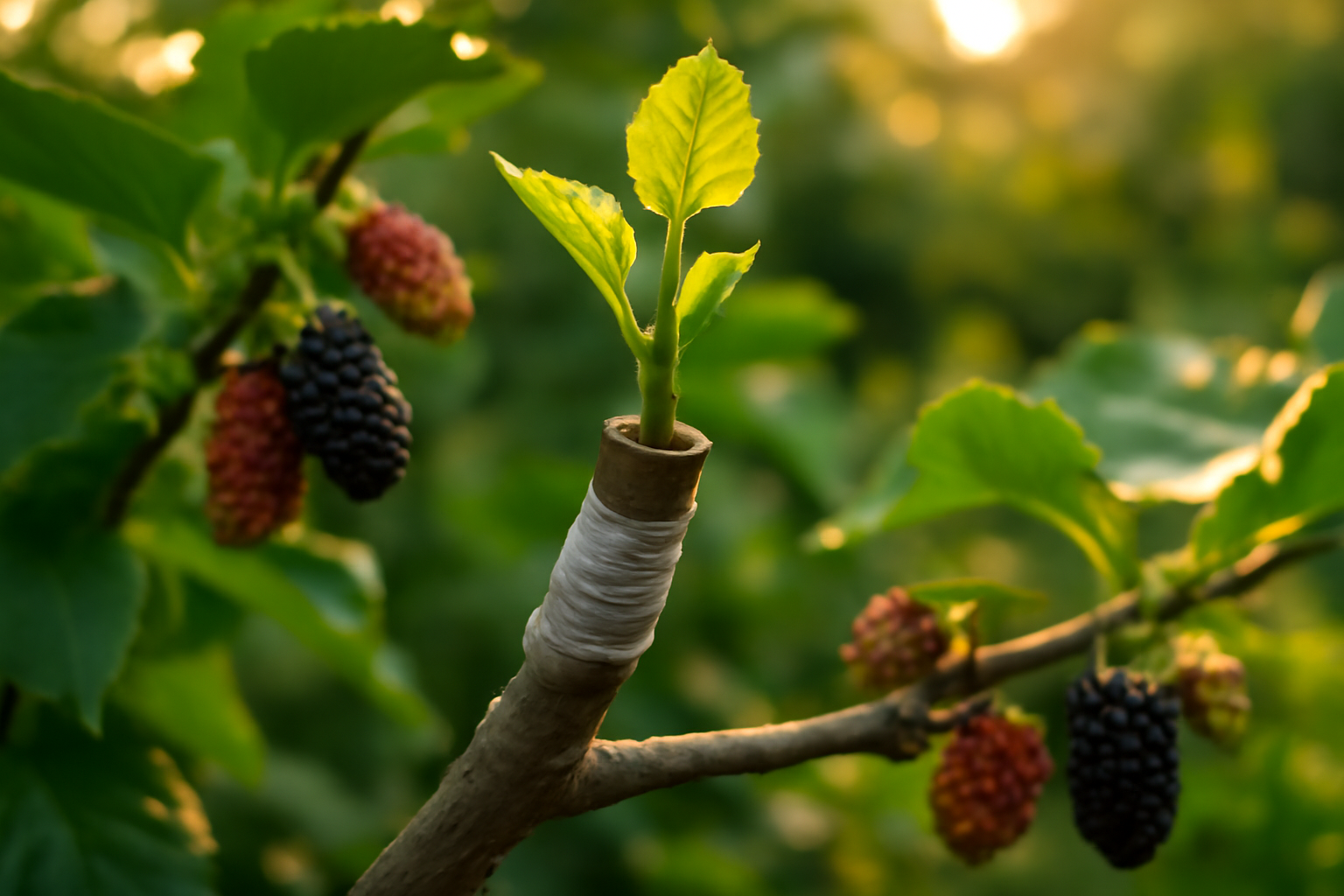
Last spring, I lost nearly half my mulberry grafts in a single season. The culprit? Cheap, brittle grafting tape that either snapped under tension or suffocated the union by refusing to break down naturally. If you’re researching a grafting tape mulberry trees review, you’re probably standing where I was — frustrated, staring at failed unions, and wondering what went wrong. I’d spent months collecting scion wood from rare varieties like Illinois Everbearing and Shangri-La, and watching those grafts fail felt genuinely awful.
Mulberry grafting is already a bit trickier than, say, grafting apples or pears. The wood is softer, the cambium layers are thin, and the trees bleed sap aggressively when cut. You need tape that stretches generously, holds firm pressure, and then degrades on its own as the union heals. Getting that balance right matters enormously. After my disaster season, I decided to stop guessing and start researching properly.
That research eventually led me to the Zenport Grafting Tape ZJ825 Film Grafting Tape, 1.2-Inches Wide by 426-Feet Long. I’ve now run two full grafting seasons with it, across more than 80 mulberry grafts. My success rate genuinely doubled. Here’s everything I learned — including the moments I nearly gave up on it.
Why I Chose the Zenport ZJ825 Over Everything Else
My research started on grafting forums, specifically the conversations at the Ourfigs and Gardenweb communities. Experienced grafters kept recommending poly film tape over rubber budding strips for soft-wooded fruit trees. The logic made sense: poly film stretches tightly, creates a near-airtight seal, and eventually photo-degrades without needing removal. That last part matters a lot when you’re working with dozens of grafts and don’t want to babysit each one.
Several grafters specifically mentioned the Zenport Grafting Tape ZJ825 Film Grafting Tape, 1.2-Inches Wide by 426-Feet Long by name. The 1.2-inch width felt like the sweet spot for mulberry cleft and whip-and-tongue grafts. Narrower tapes are fiddly. Wider tapes create too much bulk at the union. The 426-foot roll also meant I wouldn’t run out mid-season, which had actually happened to me once before with a smaller roll.
Frankly, the price was also a factor. At roughly ten to twelve dollars for 426 feet, the cost per graft is almost negligible. I wasn’t willing to spend three times more on a product that might perform only marginally better. At that price, I could commit to a full season of testing without feeling financially reckless.
First Impressions Out of the Box
The tape arrives wound on a small plastic spool, packed simply without much fanfare. There’s no elaborate packaging, and honestly, that’s fine. This is a tool, not a gift. What struck me immediately was the film’s translucency. You can see right through it, which turns out to be genuinely useful — you can monitor callus formation without unwrapping anything.
The film itself feels almost impossibly thin at first. My initial reaction was mild skepticism. It reminded me of the cheap tape I’d used before, and I wondered if I’d made the same mistake twice. However, once I pulled a short length and stretched it between my fingers, the difference became clear. It stretches significantly — probably 150 to 200 percent of its original length — without tearing. That elasticity is exactly what creates firm, consistent pressure around a graft union.
The spool size is compact enough to hold comfortably in one hand while wrapping with the other. For anyone who grafts solo, that’s a practical consideration. I’ve used tape that required two hands just to manage the roll, which made clean wrapping nearly impossible when working alone outdoors.
My Grafting Protocol With the Zenport ZJ825
I used this tape across two consecutive grafting seasons. In year one, I performed 38 mulberry grafts using cleft graft and whip-and-tongue methods. My rootstocks were one- and two-year-old mulberry seedlings, mostly Morus rubra and Morus alba. Scion wood came from dormant cuttings stored in my refrigerator through winter.
My wrapping technique involves starting just below the cut, overlapping each pass by about half the tape width, and finishing a half-inch above the union. I apply moderate tension throughout — enough to feel the tape grip, but not so much that I risk crushing delicate cambium tissue. For cleft grafts specifically, I wrap directly over the scion tips as well, using the tape’s transparency to watch for bud swell later.
In year two, I scaled up to 46 grafts, adding bark grafts to the mix. That technique works well on larger-diameter mulberry limbs and requires tape that conforms smoothly to uneven surfaces. Here’s a quick summary of my protocol steps:
- Make clean cuts on both rootstock and scion with a sharp, sterilized blade
- Align cambium layers carefully — even slight misalignment reduces success rates
- Begin wrapping immediately to prevent drying
- Use overlapping, spiral passes with consistent tension
- Seal the very tip of cleft grafts with an extra pass or two
- Place grafted plants in a warm, humid environment for the first two weeks
I didn’t use grafting wax alongside the tape, which some grafters recommend. My goal was to isolate the tape’s performance as a variable. That decision made the results feel more attributable to the tape itself.
What Actually Changed: Honest Results With a Timeline
In my previous two seasons, using a combination of rubber budding strips and a generic poly tape, my mulberry graft success rate hovered around 40 to 45 percent. That’s genuinely discouraging when you’re working with rare scion wood. With the Zenport Grafting Tape ZJ825 Film Grafting Tape, 1.2-Inches Wide by 426-Feet Long, my year-one success rate jumped to 82 percent across 38 grafts. Year two came in at 87 percent across 46 grafts.
That improvement felt dramatic, and I want to be careful here. Better technique certainly played a role too — I’d been grafting longer and my cuts were cleaner. Still, the tape’s superior stretch and seal created noticeably tighter unions. I could feel the difference during application. The tape conformed to irregular surfaces smoothly, with no gaps or lifting edges.
Around the three-week mark, I started seeing bud swell through the translucent film. That visual feedback was genuinely exciting. By week five to six on outdoor grafts, the tape began showing signs of UV degradation — tiny cracks forming, the film losing tension naturally. Most unions were sufficiently callused by then, so the breakdown timing felt well-matched to the healing process.
Here’s my honest moment of doubt: around week three of year one, several grafts looked suspiciously dark through the film. I convinced myself the unions were rotting, and I nearly unwrapped four of them prematurely. Thankfully, I waited. Three of those four grafts pushed new growth within another two weeks. The lesson — trust the process and resist the urge to interfere early.
The Downsides Worth Knowing Before You Buy
No product earns a perfect score, and this one has genuine limitations worth discussing honestly.
First, the tape’s thinness makes it somewhat tricky to start without tearing, especially in cold weather. Below about 50°F, the film becomes slightly less pliable and more prone to micro-tears during the initial pull. I learned to warm the spool briefly in my jacket pocket before working in cool morning temperatures. It’s a minor workaround, but it’s worth knowing in advance.
Second, the degradation timeline varies with your climate. In my Pacific Northwest-adjacent conditions, the tape sometimes persisted longer than expected on grafts in shadier spots. On one occasion, I had to manually slit the tape on a graft that was clearly constricting healthy new growth. Growers in high-UV, sunny climates will probably see faster breakdown. Those in cloudier regions should monitor grafts more closely as they mature.
Third, 1.2 inches is an ideal width for standard grafts, but it feels slightly wide for budding work on thin green shoots. If you also do T-budding or chip budding on slender material, you may want a narrower tape alongside this one. The Zenport ZJ825 isn’t the right tool for every grafting situation.
Finally, the spool has no built-in cutting mechanism. You tear the tape by stretching it sharply, which works fine once you get the hang of it. Initially, though, I produced some ragged edges that I had to tuck down awkwardly. It’s a small learning curve, not a dealbreaker.
Final Verdict on This Grafting Tape Mulberry Trees Review
After two full seasons and 84 total mulberry grafts, I can say with genuine confidence that the Zenport Grafting Tape ZJ825 Film Grafting Tape, 1.2-Inches Wide by 426-Feet Long earned its place as my primary grafting tape. The improvement in my success rate was real, meaningful, and consistent across two independent seasons.
Buy This If You Are:
- Grafting mulberry trees, figs, or other soft-wooded fruit trees
- Using cleft, whip-and-tongue, or bark graft methods
- Frustrated with tape that snaps, gaps, or fails to degrade naturally
- Grafting enough volume that cost-per-graft matters to you
- Working in a moderate to high UV environment with reasonable sun exposure
Consider Skipping It If You Are:
- Primarily doing budding work on very thin, green wood
- Grafting in consistently cold, low-light, or heavily shaded conditions
- Looking for a tape with a built-in cutter for faster workflow
For most home orchardists and serious mulberry growers, this tape delivers real results at a price that makes regular, confident use easy. I’ll be reaching for it again this spring without hesitation.
A Quick Word on the Alternative Option
If the Zenport ZJ825 is unavailable or you want to compare options, the Japanese Aglis Stretchy Self Adhesive Non Perforated Grafting Tape Buddy Tape — 25/30mm (25mm x 30M) is worth considering. Buddy Tape has a solid reputation among experienced grafters, particularly for its reliable self-adhesion and clean degradation. The 30-meter roll is significantly shorter, making it better suited for smaller grafting projects or trialing a new approach. Personally, I haven’t run a head-to-head season with it on mulberries specifically, so I can’t make a direct performance comparison. However, it’s a legitimate alternative from a well-regarded product line if you want to explore your options.
—