
This post contains affiliate links. As an Amazon Associate, I earn from qualifying purchases at no extra cost to you.

Last spring, I nearly lost two of my younger mulberry trees to inconsistent watering. I was hand-watering a small orchard of ten trees every other day, and honestly, life kept getting in the way. Finding the right drip irrigation kit for mulberry fruit trees became a genuine priority, not just a convenience upgrade. My trees were showing stress — slightly curled leaves, slower-than-expected new growth — and I knew the problem was uneven soil moisture, not disease or pests.
Mulberry trees are surprisingly forgiving once established, but young trees in their first two or three years need consistent moisture at the root zone. Sporadic deep watering followed by dry spells creates stress cycles that slow development. I needed something automated, reliable, and simple enough to set up without hiring a landscaper.
That frustration is what pushed me toward a proper drip system. After several weeks of research and a few false starts with manual soaker hoses, I landed on the Raindrip SDFSTH1P Automatic Drip Irrigation Watering Kit with Timer. Here is everything I learned after a full growing season with it.
Why I Chose the Raindrip SDFSTH1P Over Other Options
My initial shortlist included three different kits. Two were generic no-brand systems from overseas sellers. The third was the Raindrip. What separated it immediately was the integrated timer. Most budget kits require you to purchase a timer separately, which adds cost and introduces another potential failure point.
The Raindrip SDFSTH1P Automatic Drip Irrigation Watering Kit with Timer promised customizable scheduling, which mattered a lot for my situation. Mulberry trees in my zone (7b) need different watering frequencies in early spring versus the height of summer. A programmable timer meant I could adjust the schedule without rebuilding the whole system.
Additionally, the 2 GPH (gallons per hour) drippers felt appropriate for trees. Many flower-focused kits use 0.5 GPH emitters, which would take forever to deliver meaningful moisture to a root zone the size of a young mulberry’s. The specs matched my use case better than most alternatives I found.
Community forums for fruit tree growers also mentioned Raindrip positively for low-maintenance orchards. That informal social proof helped tip my decision. I also appreciated that the kit waters up to ten plants — exactly the number of mulberry trees in my orchard at the time.
First Impressions: Unboxing and Build Quality
The box arrived in good condition and felt substantial. Everything was organized in labeled compartments, which I genuinely appreciated. Too many irrigation kits arrive as a tangle of unlabeled tubing and mystery fittings.
Inside, I found:
- The digital timer unit with battery compartment
- Main supply tubing (half-inch diameter)
- Quarter-inch distribution tubing
- 2 GPH drip emitters
- Barbed fittings, end caps, and stakes
- A reasonably clear instruction booklet
The tubing felt flexible but not flimsy. I have handled cheap irrigation kits where the tubing kinks the moment you bend it around a corner. This held its shape better and seated firmly onto the barbed fittings without leaking on my first test run.
The timer was my biggest curiosity. It felt solid in hand — not a toy-grade plastic, but definitely consumer-grade rather than commercial. The display was readable in daylight. Programming it required consulting the manual, but once I figured out the button sequence, it was straightforward.
My one initial hesitation was the battery-operated timer. I worried about batteries dying mid-summer without my noticing. That concern turned out to be partly valid, but more on that later.
My Testing Protocol: Setting It Up Across Ten Mulberry Trees
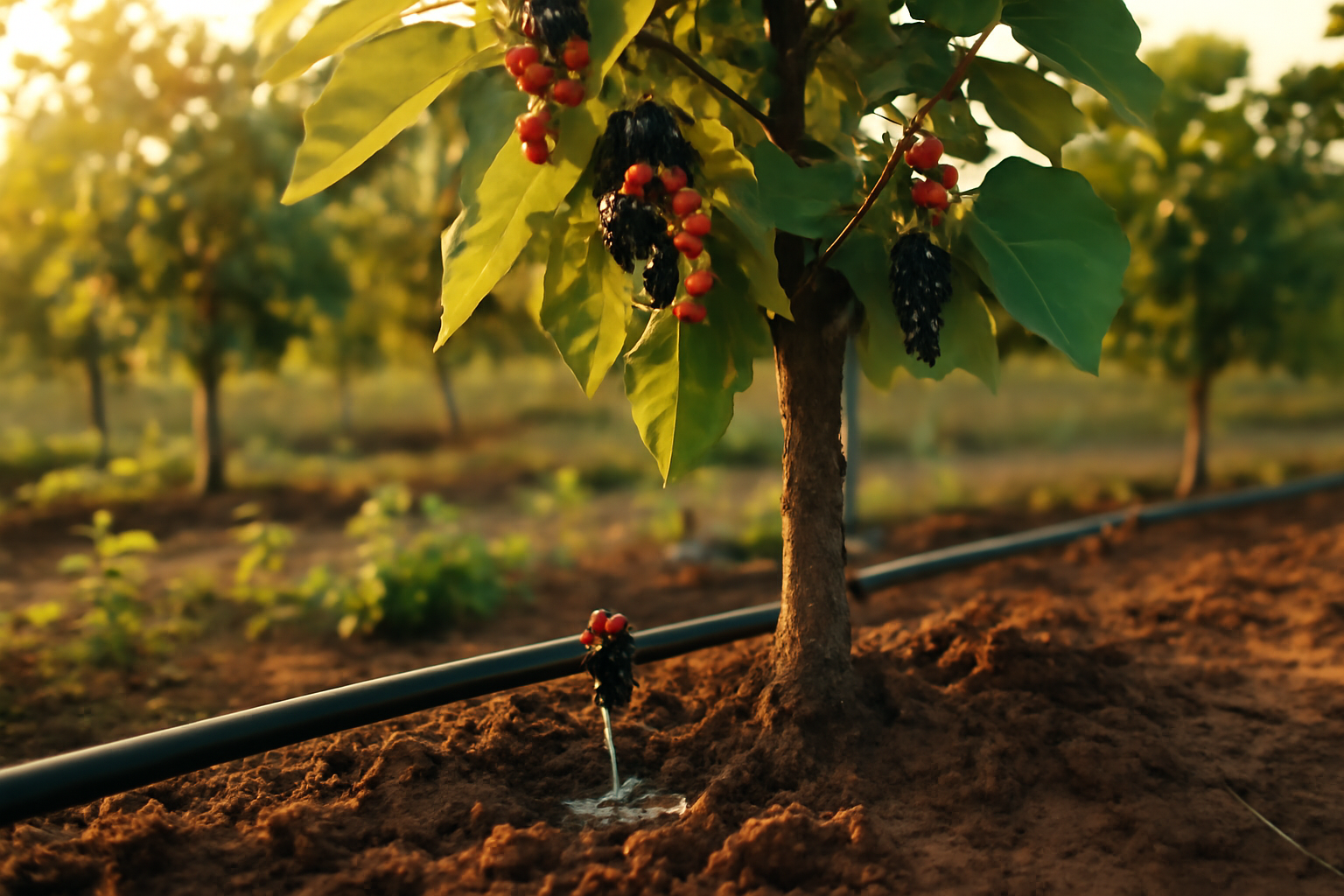
Installation took me about three hours spread across a Saturday morning. My orchard is laid out in two rows of five trees, with roughly eight feet between each tree. The main line ran down the center of each row, and I used the quarter-inch tubing to branch out to each tree’s base.
Each mulberry tree received one 2 GPH emitter placed approximately six to eight inches from the trunk — close enough to water the root zone, far enough to avoid crown rot concerns. I staked the tubing down at regular intervals so it stayed tidy and didn’t shift during mowing.
I programmed the timer to run for 45 minutes every two days during the first month, then adjusted to 30 minutes every three days once the trees showed healthy new growth. That flexibility was exactly what I needed. Summer heat pushed me back to daily short cycles in July and August.
Throughout the season, I checked the emitters weekly. I also occasionally dug down an inch or two near the drip zone to confirm the soil was actually moist at root level rather than just at the surface.
Monitoring and Adjustments
One thing I started doing after the first month was marking watering days on a simple calendar. This helped me correlate tree behavior — leaf color, growth rate, fruit set — with watering frequency. It gave me confidence that the system was actually running on schedule and helped me catch one instance where a fitting had worked itself loose.
I ran the system continuously from late April through mid-October. That is roughly six months of real-world use through varying conditions, including a stretch of 95°F+ days in July.
What Actually Changed: Honest Results After a Full Season
The most noticeable change came within the first three weeks. The two trees that had shown leaf stress bounced back with fresh, healthy-looking growth. Leaf curl disappeared, and both trees put on several new inches of growth by late May.
By mid-summer, I had stopped thinking about watering entirely. That mental offload was significant. I travel occasionally for work, and knowing the system was running on schedule removed a major source of anxiety about my trees.
Fruit set on my two established trees (a Illinois Everbearing and a Pakistan variety) was noticeably better than the prior year. I cannot attribute that entirely to the drip system — other factors like pruning and fertilization also changed — but consistent soil moisture during flowering and fruit development almost certainly played a role.
Root zone moisture stayed surprisingly even. On the occasions I dug down to check, the soil was reliably moist several inches deep after each watering cycle. That consistency is something hand-watering simply cannot replicate without enormous time investment.
A Moment of Real Doubt
About eight weeks in, I noticed one tree wasn’t looking as vigorous as the others. My immediate worry was that its emitter had failed. I checked the fitting and found it had partially unseated from the main line, reducing flow significantly. The fix took two minutes, but it reminded me that physical inspections still matter. Automated systems are not entirely hands-off. That said, every other emitter ran flawlessly for the full season.
The Downsides: What the Raindrip Kit Does Not Do Perfectly
Honesty matters here, especially for anyone making a purchasing decision based on this review. The Raindrip SDFSTH1P Automatic Drip Irrigation Watering Kit with Timer has real limitations worth knowing upfront.
Battery dependency. The timer runs on two AA batteries. Mine lasted the full season, but I checked them every six weeks out of caution. If the batteries die without warning, your trees stop getting water. A solar-powered backup would make this much more reliable.
Limited coverage for larger orchards. The kit is designed for up to ten plants. My ten-tree orchard fit exactly, but there was no room to expand. If you have fifteen or twenty trees, you will need a second kit or a more robust system entirely.
No rain sensor. The timer does not skip a cycle when it rains. During a wet week in June, my trees received more water than they needed. I adapted by manually pausing the timer during rainy periods, which somewhat defeats the automation benefit.
Fitting durability over time. A few of the barbed fittings felt slightly less secure by October than they did in April. UV exposure and soil movement probably contributed. This is not unusual for consumer-grade irrigation components, but plan to inspect fittings at the start of each season.
The instruction booklet. It is functional but not particularly clear for first-time drip system users. I referenced a YouTube tutorial for the timer programming, which helped more than the printed guide.
Final Verdict: The Best Drip Irrigation Kit for Mulberry Fruit Trees at This Price Point?
After a full growing season, I believe the Raindrip SDFSTH1P Automatic Drip Irrigation Watering Kit with Timer delivers genuine value for small home orchards. It solved the problem I had, it ran reliably for six months, and my trees showed measurable improvement in health and growth. As a drip irrigation kit for mulberry fruit trees, it hits the right balance of simplicity, automation, and appropriate flow rate for young to mid-size trees.
Buy this kit if:
- You have ten or fewer trees or shrubs to water
- You want an all-in-one solution with a built-in timer
- You value simplicity over high-end customization
- You are comfortable doing brief seasonal inspections
- Your water source is a standard outdoor hose bib
Skip this kit if:
- You are watering more than ten trees
- You need a rain sensor for hands-off operation
- You want a commercial-grade system that will last a decade without replacement
- You have low water pressure (check the product specs against your supply)
For the price point, the value is hard to argue with. It is not perfect, but it does what it promises with reasonable reliability.
A Note on the Alternative: Individual Drip Emitters
If you already own tubing or want to expand an existing system, the Garden Irrigation System 20Pcs 90-Degree Drip Emitters with Ground Insert are worth considering. These quarter-inch emitters insert directly into existing drip line and use a plunger design to help resist clogging. They work well as replacement emitters or for expanding a current layout around more trees. However, they do not include tubing, a timer, or fittings — so they are best suited as a supplement, not a standalone solution for someone starting from scratch.