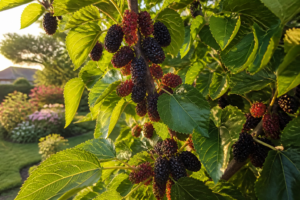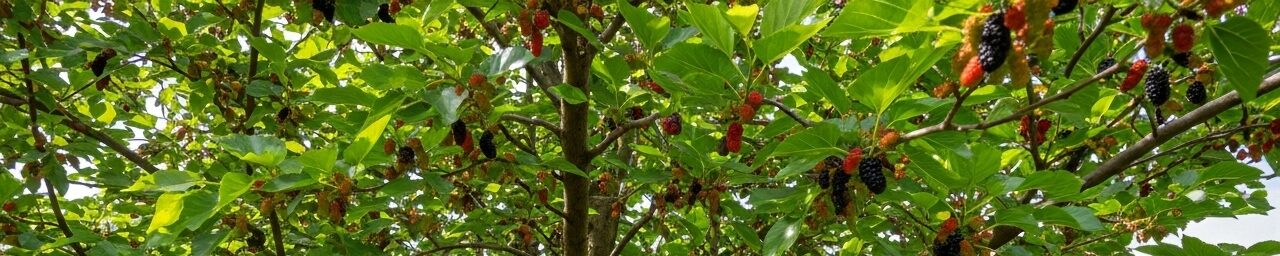

It was an unusually dry spell that May — the kind that catches you off-guard in the Pacific Northwest — and I found myself watering my young white mulberry more frequently than usual. As I worked through the canopy one afternoon, refilling the soaker hose, I stopped cold. The leaves staring back at me seemed to belong to three entirely different plants. One section showed me simple, rounded hearts. A foot away on the same branch, leaves had sprouted with a pronounced thumb-like lobe jutting out sideways. And at the very tip of the newest growth, the foliage had turned so intricately divided it genuinely resembled something you’d find on a fig tree. I stood there, dripping hose in hand, wondering if the nursery had somehow deceived me — or if my own understanding of what a mulberry leaf should be was fundamentally incomplete.
That’s when I realized I needed answers, fast.
What I discovered over the following months, after consulting borrowed reference books and logging countless observations across my own yard, fundamentally changed how I think about mulberry trees. The truth wasn’t that I’d been sold a mixed planting. The truth was far stranger — and far more beautiful.
Let me walk you through what I’ve learned.
The Mystery of Polymorphic Leaves
That bewildering display of leaf shapes all around me has an actual name in botanical circles: polymorphism. It translates to “many forms,” and it describes exactly what was happening on my tree — the capacity to produce multiple distinct leaf morphologies from a single genetic individual. In the mulberry world, especially among vigorous young white varieties and trees that are actively regrowing after heavy pruning, this trait becomes almost a defining characteristic. You’ll encounter leaves ranging from the simplest, unlobed heart shape all the way to intricately divided forms that could genuinely pass for entirely different species.
The mechanism behind this transformation caught my attention as much as the leaves themselves.
Through watching my own trees year after year, I’ve documented a consistent pattern: the most aggressive, newly emerging growth always produces the most dramatically lobed and divided foliage. Established wood from previous seasons, by contrast, tends to generate simpler, less divided leaf forms. It’s as though the tree is expressing vigor through leaf architecture — elaborate and experimental during periods of explosive growth, more conservative and streamlined as growth rate slows. Once this relationship between developmental vigor and leaf morphology clicked into place for me, the entire polymorphism question shifted from frustrating to absolutely logical.
How Each Species Expresses Its Own Leaf Character
The mulberry genus isn’t monolithic, and the three main species you’re likely to encounter have wildly different approaches to leaf presentation and consistency. Grasping these distinctions transforms mulberry leaf identification from a guessing game into something you can approach with real confidence.
White Mulberry (Morus alba) functions as the genus’s most theatrical performer. Leaf length typically spans anywhere from 5 to 15 centimeters, and the upper surface exhibits a striking glossiness that becomes almost luminous in bright afternoon light. This particular species represents the extreme end of polymorphic behavior — expecting radical shape variation is entirely reasonable. Its horticultural significance stretches back roughly 5,000 years, during which time it became the foundational food source for silkworm cultivation (Bombyx mori feeds almost exclusively on alba foliage), a relationship that shaped entire economies and trade routes. For most backyard orchardists just beginning their mulberry journey, white mulberry stands as the most accessible and frequently available option.
Red Mulberry (Morus rubra) operates under a completely different philosophy. Its leaves run substantially larger — frequently between 10 and 25 centimeters in length — and they abandon glossiness in favor of a distinctly rough, almost gritty texture across the upper side. The underside bristles with visible hair. This species resists the extreme shape-shifting that characterizes its white relatives, making identification considerably more straightforward. Once you’ve held a red mulberry leaf in your hand, its characteristic roughness becomes nearly impossible to forget.
Black Mulberry (Morus nigra) epitomizes horticultural restraint. Its foliage displays a reliably thick, emphatically heart-shaped form with roughened texture throughout. You won’t encounter those wildly lobed forms sprouting from black mulberry branches — its leaf architecture remains fundamentally conservative. This species also grows more gradually and achieves a longer lifespan than either alba or rubra, reinforcing the impression of steadfast permanence and botanical dependability.
The Three Foolproof Identifiers Present on Every Mulberry Leaf
Regardless of how radically a mulberry’s leaves might vary in shape — from simple to wildly lobed, from glossy to textured, from compact to sprawling — every single leaf produced by every mulberry tree carries three consistent, definitive characteristics. These markers work as a botanical fingerprint, allowing you to distinguish genuine mulberries from any plausible imposter you might encounter.
- Finely serrated margins: Every mulberry leaf edge displays minute, tooth-like projections. These aren’t smooth undulations or wavy borders — they’re definitively saw-toothed. This single feature eliminates a remarkable percentage of potential confusion with other species.
- Sequential opposite positioning along stems: Mulberry foliage emerges in an alternating sequence rather than in opposing pairs. As your eye travels up any given stem, leaves appear first on the left side, then the right, then left again. This alternating pattern functions as a reliable mulberry signature.
- Pale latex exudate from broken stems: This marks the decisive test. When you carefully rupture a petiole (leaf stalk), a creamy white liquid beads at the fracture point. This characteristic latex connects mulberries to the broader Moraceae family, which encompasses figs and other relatives. If no sap appears, or if the sap runs clear, you’re handling a different plant entirely.
I stumbled onto the sap verification technique through that borrowed botany text, and it remains perhaps the single most dependable identification tool in my arsenal. Whenever hesitation creeps in, I pinch a leaf stem and examine the milky residue. It has never steered me wrong across fifteen seasons of observation.
Sidestepping Confusion With Common Imposters
In my experience, two particular species generate the overwhelming majority of misidentification moments, and both involve foliage that shares at least superficial commonalities with genuine mulberries.
Sassafras represents the first source of confusion. Sassafras produces mitten-shaped leaves with pronounced character, and this distinctiveness occasionally triggers mulberry comparisons. However, the distinctions are substantial once you know where to look. Sassafras leaf margins are entirely smooth and untoothed — no saw-like dentition whatsoever. Crushing a sassafras leaf releases an unmistakable root-beer fragrance that dominates the olfactory experience. Perform this same action on a mulberry leaf, and the aroma remains unremarkable — merely the generic smell of crushed vegetation. Additionally, sassafras completely lacks that diagnostic milky latex.
Paper Mulberry (Broussonetia papyrifera) presents a trickier challenge, partly because it genuinely belongs to the broader mulberry family. Paper mulberry foliage displays a noticeable fuzziness and gray-green coloration across both surfaces, whereas genuine white mulberry produces that characteristically smooth, shiny upper face. Paper mulberry exhibits significantly less polymorphic variation compared to Morus alba, and its fuzzy surface quality persists consistently. The resemblance may be closer than with sassafras, but careful observation of texture reveals the truth.
Why Identifying Your Mulberry Leaves Opens Different Possibilities
Becoming skilled at recognizing mulberry foliage transcends mere botanical categorization — it unlocks access to one of the tree’s most compelling practical applications. Mulberry leaves have sustained human consumption across Asian cultures for countless centuries, most characteristically as the foundation for traditional leaf-based beverages. Confident identification capability grants you permission to harvest your own foliage for culinary or wellness purposes.
For those interested in pursuing this avenue further, I’ve documented comprehensive guides covering the technique of preparing mulberry leaf tea using freshly harvested material alongside home-drying methods and seven significant applications and usage approaches for mulberry foliage. If your research interests lean toward evidence-based claims, my thoroughly referenced exploration of mulberry leaf tea’s substantiated benefits assembles the scientific literature backing traditional usage.
The practical consequence of reliable identification extends to safety and purity — you’ll never accidentally incorporate material from paper mulberry or contaminate your personal supply with sassafras. Correct botanical knowledge safeguards both your harvesting practices and your finished product.
Products I Recommend
If you’re ready to grow your own mulberry tree and experience this leaf polymorphism firsthand, a healthy young specimen is a good starting point. The Illinois Everbearing Mulberry Tree — 6–10″ Tall Live Plant is an excellent choice for beginners. It’s cold-hardy, productive, and will give you plenty of opportunities to observe leaf shape variation as it grows.
Once your tree is established, you might want to explore mulberry leaves in culinary form. FullChea USDA Organic White Mulberry Leaf Tea — 100 Bags offers a convenient way to experience the benefits without harvesting and drying your own (though I do recommend trying that eventually — it’s deeply satisfying). For those interested in powdered forms, the ONDAMGO Korean Mulberry Leaf Powder for Teas, Smoothies & Culinary Use — 200g brings versatility to your kitchen, blending beautifully into beverages and recipes.
Moving Forward With Your Own Mulberry Observations
White mulberries continue producing their bewildering array of leaf configurations with each passing season. Rather than viewing this polymorphic exuberance as a problem to solve, it can be understood as evidence of botanical health and vigor — a sign that the tree is growing enthusiastically and expressing its genetic potential across multiple developmental stages simultaneously.
You won’t require formal training or specialized credentials to achieve competency with mulberry leaf identification. The three defining traits — toothed margins, alternating leaf arrangement, and diagnostic milky sap — function as reliable verification for any observer willing to look carefully. Watch your own trees as the seasons progress, notice how vigorously expanding growth consistently produces more elaborately lobed foliage while slower wood settles into simpler configurations, and you’ll cultivate an intuitive recognition that comes from genuine observation rather than memorization.
Right now represents an excellent moment to deepen your engagement with these phenomena. Whether you’re in the process of establishing your first specimen, examining the foliage on an established tree, or simply expanding your understanding of mulberry biology and behavior, lean into the polymorphism rather than fighting it. This capacity for morphological variation isn’t a manufacturing error or nursery deception — it stands as one of the most captivating signatures of a thriving, robust mulberry tree in full expression of its biological potential.
Have you encountered mulberry leaf identification challenges in your backyard? Or have you experienced that wonderful revelation of discovering a “mixed planting” was actually a single, morphologically diverse specimen? Share your observations in the comments section — let’s continue learning from each other’s experiences.
Frequently Asked Questions
Why does my mulberry tree have different shaped leaves?
Your mulberry tree is exhibiting polymorphism—the ability to produce multiple distinct leaf shapes from a single plant. Vigorous, newly emerging growth produces the most dramatically lobed and divided foliage, while established wood from previous seasons generates simpler, less divided leaf forms. This is normal and indicates botanical health and vigor.
How do I identify if a leaf is actually from a mulberry?
Check for three definitive characteristics present on every mulberry leaf: finely serrated, saw-toothed margins; alternating leaf positioning along stems rather than opposing pairs; and pale latex exudate when you break the stem. These three markers work as a botanical fingerprint to distinguish genuine mulberries from imposters.
What is the difference between white and red mulberry leaves?
White mulberry leaves typically span 5 to 15 centimeters and display striking glossiness on the upper surface, with extreme polymorphic behavior producing radical shape variation. Red mulberry leaves are substantially larger, frequently between 10 and 25 centimeters, with rough, gritty texture and visible hair on the underside, resisting extreme shape-shifting.
Is paper mulberry the same as mulberry?
No. Paper mulberry belongs to the broader mulberry family but differs from genuine Morus species. Paper mulberry foliage displays noticeable fuzziness and gray-green coloration across both surfaces, whereas white mulberry produces a characteristically smooth, shiny upper face and exhibits significantly more polymorphic variation.
Keep Reading
About This Article
Written by Ruth Nakamura. Ruth Nakamura is a backyard orchardist in the Pacific Northwest who has grown mulberries for fifteen years, cultivating twelve different varieties in her own backyard. Not a horticulturist by formal training - she shares what she has learned through hands-on growing, workshops, and connecting with nurseries and growers across the country. More about this site.
Scope and limits. Ruth is a backyard orchardist without formal horticultural training. Growing conditions vary enormously by region, so confirm variety, timing, and pest guidance with your local extension service.
Verify this against a primary source
Specifics change, and your situation may differ from the one described here. These are the authorities worth checking directly:
- USDA Plant Hardiness Zone Map — zone verification for your location
- Oregon State University Extension — fruit growing and pruning research
- USDA PLANTS Database — species range and identification