The third week of April found me standing beneath my oldest mulberry, secateurs in hand, surrounded by the explosive flush of springtime growth that happens every year without fail. Branches were sprawling in directions I hadn’t intended, reaching past the fence line and into territory that wasn’t theirs. As I worked through the tangle, snipping and reshaping, I suddenly became aware of something: the ground around my feet had disappeared under a carpet of freshly severed leaves — dozens and dozens of them, tender and bright green, heading straight for the compost bin.
For the better part of two years, I’d maintained a standing order with an online supplier. Tea bags arrived monthly in cardboard boxes, each one containing a handful of dried mulberry leaves sealed in paper. I’d steep them in the afternoons, sip slowly, and toss the spent leaves. And there I was, literally discarding the raw material — the unprocessed, untouched ingredient — in armload quantities.
The question hit me with sudden clarity: was there any reason I couldn’t turn these fresh leaves into tea myself? Did this actually require anything more than what was already in my hands?
The answer turned out to be straightforward — not just yes, but enthusiastically yes. What began as an idle thought on a spring afternoon has evolved into something I genuinely look forward to each year. There’s an undeniable satisfaction in holding a cup of tea that traveled from your own tree to your own hands, processed in your own kitchen, without any intermediary at all. It tastes different when you know the entire journey. And remarkably, the process itself isn’t complicated. Let me show you the exact steps I’ve settled on after several seasons of trial.
Why Mulberry Leaf Tea Is Worth Making Yourself
Let’s establish some context before diving into technique. Mulberry foliage has been steeped as a beverage for more than two millennia, particularly within the practices of Traditional Chinese Medicine, where it carries the name Sang Ye. The species Morus alba L. — the white mulberry — produces the tender spring leaves most commonly associated with this tradition, though the red and black varieties yield equally usable leaf material.
The chemical composition of mulberry leaves includes substantial amounts of rutin, quercetin, and chlorogenic acid — all members of the flavonoid family, recognized by researchers for their antioxidant and anti-inflammatory activity. When you prepare mulberry leaf tea beginning with fresh leaves you’ve harvested yourself, you’re capturing these beneficial compounds at their most concentrated point. You’re also eliminating all the packaging materials and supply-chain delays that come with commercial orders.
There’s also something else worth acknowledging: the inherent reward of closing a loop. You grew the source material. You transformed it through your own effort. You consumed the finished product. That’s a completeness most food rarely offers.
Making Mulberry Leaf Tea from Fresh Leaves: A Step-by-Step Guide
The process mirrors what traditional green tea producers do, which shouldn’t be surprising — you’re essentially crafting a homemade leaf-based infusion. Four distinct phases make up the transformation: collecting leaves, wilting them down, applying heat to stop oxidation, and bringing them to complete dryness.
I’ll walk through each phase in detail.
Step 1: Collect Your Leaves
Targeting the right moment makes a significant difference. Look for the uppermost, least-hardened leaves — typically the topmost 2–3 leaves on any given shoot. These positions guarantee superior taste and the most delicate structure. Spring represents the optimal window (for me, this means late April), though the harvest window extends through the earliest weeks of summer.
Head out to your tree in the early hours, once morning condensation has burned off but before temperatures climb. Use scissors or your fingers, working with patience and care. You’re not stripping the plant bare — this is the same selective harvesting you’d do while maintaining the tree’s shape and health. A standard bowl’s worth of fresh material gives you enough dried product for months of regular brewing.
Give them a quick cold-water rinse if dust or debris has accumulated on the surface, then blot them dry using a clean cloth.
Step 2: Begin the Wilting Phase (4–6 Hours)
Lay your cleaned, dampened leaves across a cloth or absorbent paper in a location that’s warm and has good air movement — a sunlit window, an outdoor shelf, or a greenhouse bench all serve this purpose well. The goal isn’t complete moisture removal at this stage — you’re starting the softening process and beginning to reduce surface moisture.
Four to six hours represents the typical duration. Watch the transformation as the leaves lose their rigid quality and become more flexible in your hands. This is precisely the condition you’re seeking. I typically arrange mine early in the morning and assess them during the afternoon hours.
Step 3: Apply Heat to Stop Oxidation (10–12 Minutes)
At this juncture, a controlled application of heat becomes essential. It arrests the oxidation cascade and preserves the fresh, verdant flavor profile characteristic of green tea.
Two techniques work equally well:
- Skillet approach: Bring a large, ungreased pan to medium temperature. Work through your wilted material in portions, continuously agitating as each batch rests in the heated pan for 3–5 minutes. The target is noticeable warmth without any charring or darkening. You’re aiming for a subtle roasted character.
- Oven approach: Distribute wilted leaves evenly across a sheet pan and expose them to 180°F for 10–12 minutes. This method keeps temperature predictable and works reliably regardless of batch size.
As the heat does its work, the leaf color will shift incrementally toward a darker shade and a gentle herbaceous fragrance will emerge. This signals you’ve achieved the right outcome.
Step 4: Complete the Drying Process (1–3 Weeks or 4–8 Hours)
Your heat-treated leaves now require complete moisture removal until they’re brittle and break into fragments. Duration fluctuates based on your chosen approach.
- Ambient drying method: Distribute heat-treated leaves across cloth or mesh screen in a space that’s cool, arid, and permits consistent air circulation. A bedroom closet shelf, a pantry corner, or covered outdoor bench will all work. Expect 1–3 weeks of drying time depending on local climate and humidity. Rotating and redistributing leaves every couple of days promotes even dehydration.
- Electric dehydrator method: Configure your machine to 95–115°F (35–45°C), arrange the heat-treated leaves on the trays with spacing, and plan for 4–8 hours until complete crispness. This lower temperature range actually retains more of the fleeting aromatic compounds and active substances, particularly 1-deoxynojirimycin (DNJ), that higher temperatures would compromise.
Completion arrives when the leaves disintegrate readily between your thumb and forefinger and exhibit zero residual dampness.
Preservation and Storage of Homemade Mulberry Leaf Tea
After complete desiccation is achieved, move your leaves into a sealed glass vessel — a mason jar with a tight-fitting lid serves this purpose ideally. Position your storage location in conditions that are cool, obscure, and moisture-free, away from any exposure to natural light. Mulberry leaves that have been properly desiccated remain shelf-stable for the span of a full year without degradation. I keep mine in a labeled mason jar residing on my pantry shelf, where it’s simple to access whenever an afternoon tea craving emerges.
For maximum flavor intensity and optimal preservation of those antioxidant compounds, consume your batch within a 6–8 month window.
Brewing Instructions for Your Homemade Mulberry Leaf Tea
A frequent mistake I notice involves using water that has reached a rolling boil. Resist this instinct. Extremely hot water can break down certain of the more fragile polyphenol structures in the leaves you’ve invested time in preserving.
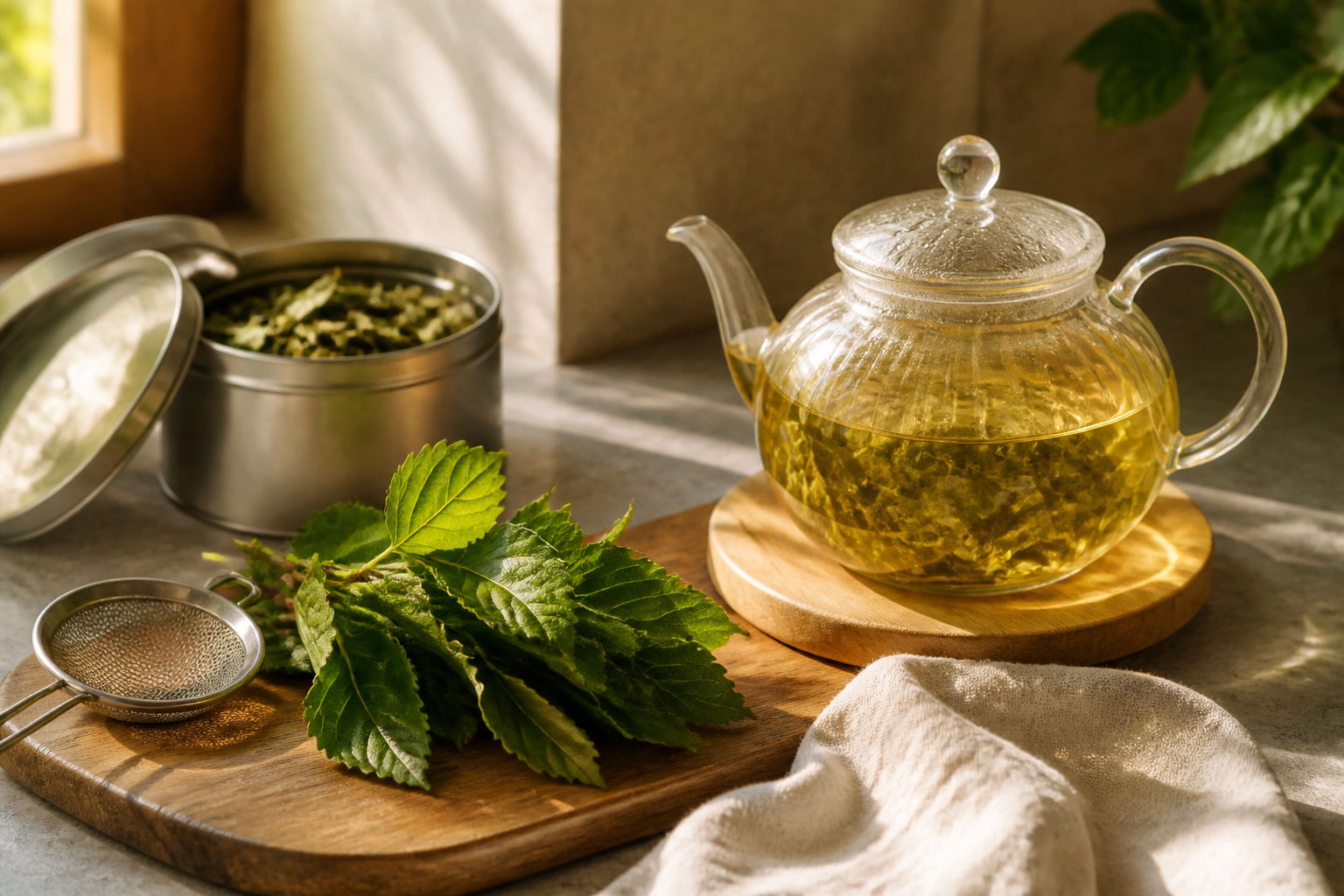
Rather, target a water temperature between 175–185°F — in the vicinity of boiling but not quite there. No thermometer at hand? Simply remove your water from the heat source and allow it to cool for roughly five minutes. Combine approximately one teaspoon of dried leaves per eight ounces of water, let them infuse for three to five minutes, then pass through a strainer.
What results is a delicate, subtly sweet, grassy infusion with a clean, refreshing finish. The character is understated and nuanced — utterly different from an over-brewed, astringent cup created by boiling water or extended steeping periods.
Choosing a Drying Rack for Substantial Leaf Harvests
When you’re working with multiple pounds of fresh mulberry leaves from a spring pruning session, you require a drying infrastructure that prevents mold development, ensures uniform moisture reduction, and keeps the material organized — not scattered across kitchen surfaces. A hanging rack featuring multiple shelves maintains consistent airflow across all surfaces while consuming virtually no horizontal floor or counter space.
Practical benefits
- The stacked-shelf configuration can accelerate drying — hang-drying in a warm garage typically takes 5–7 days, versus closer to 14 days when using a single flat surface.
- Surrounding airflow at every tier — underneath and along the sides — eliminates the stale, mildew odor that develops when leaves remain piled or compressed together.
- The footprint stays minimal and the setup suspends from a ceiling hook, which prevents the explosion of leaf-covered workspace mess that happens during extended curing periods.
Limitations to anticipate
- The mesh openings release tiny leaf particles continuously as material dries, resulting in debris accumulation on the floor area beneath — positioning a cloth or drop sheet underneath handles this effectively.
- The construction anticipates lightweight herbal material, not substantial fruit-harvest volumes; excessive loading with wet mulberry leaves will create sag in the shelving structure and substantially extend drying duration.
I almost gave up and bought a dehydrator after the first batch started to clump on day three, but I realized I’d crammed it too full—spreading the leaves thinner fixed it completely. If you’re serious about processing your spring pruning into drinkable tea, grab the SVRSD Herb Drying Rack 3-Tier Hanging mesh Dry Rack.
Frequently Asked Questions
When should I harvest mulberry leaves for tea?
Harvest in spring, typically late April through the earliest weeks of summer. Pick the uppermost 2–3 leaves on any shoot for the most delicate structure and superior taste. Collect in early morning after condensation burns off but before temperatures climb.
What temperature should mulberry leaf tea water be?
Use water between 175–185°F, not a rolling boil. If you don’t have a thermometer, remove water from heat and let it cool for roughly five minutes. This preserves the delicate polyphenol structures in your leaves and prevents an astringent, over-brewed cup.
How long do dried mulberry leaves stay fresh?
Properly dried mulberry leaves remain shelf-stable for a full year. For maximum flavor and optimal preservation of antioxidant compounds, consume your batch within 6–8 months. Store in a sealed glass mason jar in a cool, dark, moisture-free location.
Can I use a drying rack instead of a dehydrator?
Yes. A hanging mesh rack cuts curing time to 5–7 days versus 14 days on a flat surface, and prevents mold by maintaining airflow at every tier. Spread leaves thinly to avoid clumping, and position a cloth underneath to catch debris as material dries.
Keep Reading
About This Article

Written by Ruth Nakamura. Ruth Nakamura is a backyard orchardist in the Pacific Northwest who has grown mulberries for fifteen years, cultivating twelve different varieties in her own backyard. Not a horticulturist by formal training - she shares what she has learned through hands-on growing, workshops, and connecting with nurseries and growers across the country. More about this site.
Scope and limits. Ruth is a backyard orchardist without formal horticultural training. Growing conditions vary enormously by region, so confirm variety, timing, and pest guidance with your local extension service.
Verify this against a primary source
Specifics change, and your situation may differ from the one described here. These are the authorities worth checking directly:
- USDA Plant Hardiness Zone Map — zone verification for your location
- Oregon State University Extension — fruit growing and pruning research
- USDA PLANTS Database — species range and identification