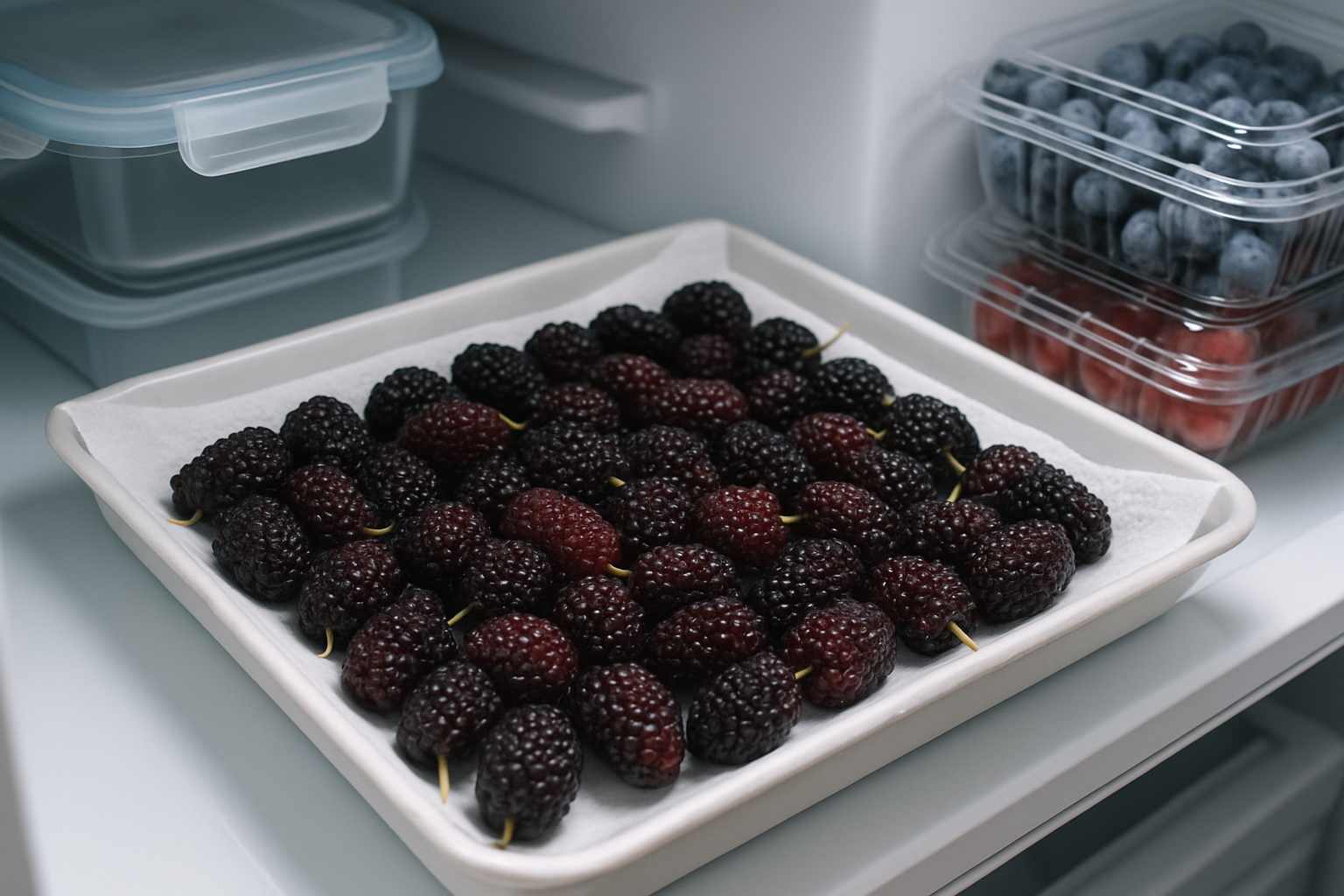
- Sort berries, remove any damaged ones, and gently rinse under cool water.
- Spread them in a single layer on a parchment-lined baking sheet — make sure they’re not touching each other.
- Freeze flat for two to three hours until the berries are individually frozen solid.
- Transfer to labeled freezer bags or airtight containers, removing as much air as possible.
- Use within eight to
I stood at my kitchen counter last July staring at an entire colander of mulberries — deep, wine-dark, perfectly ripe mulberries I had spent two hours picking in the summer heat — and watched them turn to mush right in front of me. Not the next day. That same afternoon. I had no idea how to store fresh mulberries properly, and I paid for that ignorance with a full season’s best harvest and a lot of frustrated tears.
This post contains affiliate links. As an Amazon Associate, I earn from qualifying purchases.
If you’ve grown mulberries for any length of time, you already know the painful truth: these berries are nothing like the ones you buy at the grocery store. They’re soft, deeply juicy, and incredibly fragile. The clock starts ticking the moment they drop from the branch. But here’s what I’ve learned since that heartbreaking July afternoon — with the right approach, you can absolutely keep fresh mulberries tasting beautiful for four to six days in the refrigerator, or preserve them for months in the freezer. Let me show you exactly how.
Why Mulberries Go Bad So Fast (And What’s Actually Happening)
Before we talk solutions, it helps to understand the problem. Mulberries are an exceptionally high-moisture fruit with very thin, delicate skin. Unlike blueberries or strawberries, they have almost no protective waxy coating, which means moisture escapes — and bacteria enters — almost immediately after harvest. They also bruise at the slightest pressure, and any bruised spot becomes a gateway to rapid mold growth.
On top of that, mulberries continue to ripen after picking. The sugars keep breaking down, the flesh keeps softening, and what was firm and gorgeous at 10 AM can be a weeping, fermented mess by dinnertime if you leave it sitting in a bowl on the counter. Trust me. I know this from experience.
The two biggest enemies of fresh mulberries are moisture on the berry’s surface and warm temperatures. Address both of those, and you’re already most of the way to success.
How to Store Fresh Mulberries in the Refrigerator the Right Way
Step 1: Don’t Wash Them Until You’re Ready to Eat
This is the rule that changed everything for me. I used to rinse my berries the moment I brought them inside — it felt like the responsible, clean thing to do. But surface moisture is the fast lane to mold. Instead, sort through your berries right away and gently remove any that are already overripe, leaking, or showing any fuzz. These will contaminate the healthy ones shockingly quickly.
Step 2: Let Them Dry Completely Before Refrigerating
If your mulberries got wet during harvest (morning dew, a light rain, or an accidental splash), spread them in a single layer on a clean kitchen towel or paper towels and let them air dry for 20 to 30 minutes. A little patience here adds days to their life.
Step 3: Use a Container With a Colander Insert
This is genuinely the most important tool upgrade you can make. A container with a built-in colander or raised basket lifts the berries up off any collected moisture at the bottom, which is what typically causes that slimy, mold-covered bottom layer. A paper towel placed in the base of the container before the colander insert adds extra moisture absorption.
Here are the containers I personally recommend and use:
- 5 Pcs Fruit Storage Containers For Fridge with Removable Colander and Handle Lid — These are fantastic for mulberries specifically because the colander insert keeps berries elevated and airflow is excellent. The airtight lid helps maintain just the right humidity level without letting moisture pool.
- BOICHU Fruit Storage Containers for Fridge – 5 Size Berry Containers — I love that this set comes in multiple sizes, because mulberry harvests are never the same volume twice. The vent handle lids allow just enough airflow to prevent condensation buildup.
- 5 PCS Large Fruit Containers for Fridge – Leakproof with Removable Colander — Great for bumper harvest days. The leakproof design is a lifesaver when mulberries release juice, and the large size means you’re not overcrowding the berries, which matters a lot.
- OXO Good Grips GreenSaver Produce Keeper — This one uses an activated carbon filter to absorb ethylene gas (which speeds ripening), and it’s a great choice if your fridge tends to run on the warmer side or you’re storing alongside other fruit.
- Prep Solutions by Progressive Lettuce Keeper Produce Storage Container — Don’t let the “lettuce keeper” name fool you. The elevated basket and ventilated lid system work beautifully for mulberries, and the 4.7-quart capacity handles a solid harvest with room to spare.
Step 4: Store in the Coldest Part of Your Fridge
The back of the bottom shelf is typically the coldest and most consistent spot in most refrigerators. Aim for a temperature between 32°F and 34°F. At this range, you can realistically expect your mulberries to stay fresh for four to six days — a huge improvement over that two-day window most people experience by default.
Freezing Mulberries for Long-Term Storage
When the harvest is truly abundant — and if you have a productive tree, there will be weeks where it absolutely is — freezing is your best friend. Mulberries freeze beautifully and retain their flavor, color, and nutrition remarkably well.
Here’s the method that works best:
- Sort berries, remove any damaged ones, and gently rinse under cool water.
- Spread them in a single layer on a parchment-lined baking sheet — make sure they’re not touching each other.
- Freeze flat for two to three hours until the berries are individually frozen solid.
- Transfer to labeled freezer bags or airtight containers, removing as much air as possible.
- Use within eight to