I have a photograph on my phone I took last July: my concrete patio stained in a splotchy purple pattern that looks like modern art. Those aren’t paint accidents — they’re the ghost marks of what happens when you hand-pick mulberries one at a time and let the juice run everywhere. That image is proof that my old harvest routine was a wreck. It’s also what made me finally stop and figure out a smarter way to work with my trees, because no amount of aesthetic damage to the patio was worth the hours I was losing to inefficient picking. What I’ve since learned — through actual trial, actual failure, and actual stains on actual things — is that there’s a method that changes everything: the sheet harvest. And once I cracked this technique, something unexpected happened. Suddenly I had enough extra time and energy that I could start thinking about the leaves my mulberries were producing, the fermentation possibilities, the dried fruit projects — all the parts of the plant I’d been letting disappear into the compost heap without a second thought. This post walks through exactly how to make the sheet method work on your own tree, with the kind of specifics that matter when you’re standing under branches holding a heavy piece of plastic.
Why the Mulberry Harvest Sheet Method Changed Everything for Me
In the years before I discovered this approach, harvesting looked like standing under the tree for what felt like forever, plucking berries by hand, sneaking tastes as I went, and walking away with a measly four or five pounds after sixty minutes of work. The ground underneath always told the real story: ripe fruit scattered everywhere, falling to waste, getting trampled or eaten by birds. It felt inefficient and honestly kind of pointless. I knew there had to be a way to change the equation — a way that didn’t leave my fingers permanently stained and my patience completely worn out.
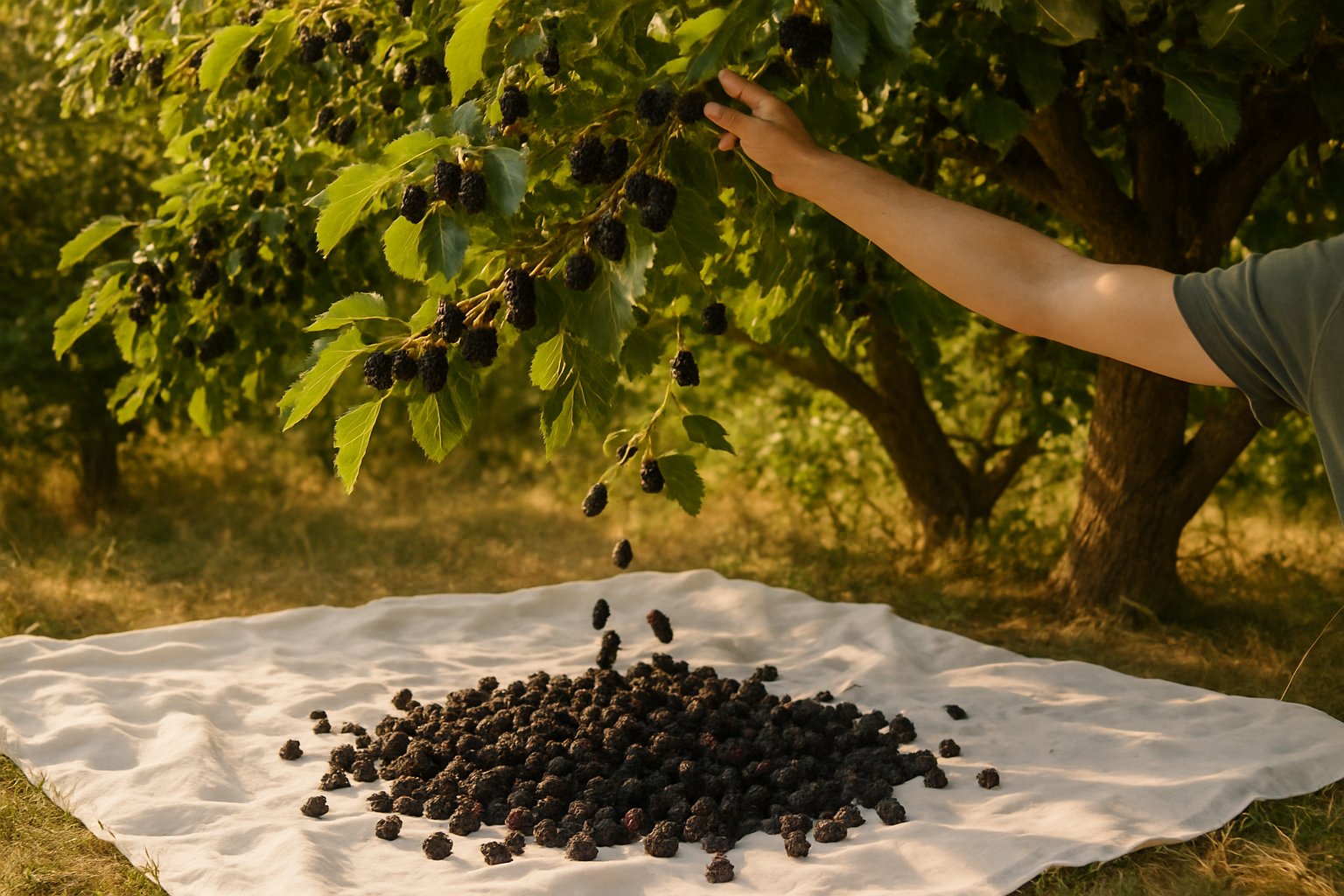
The magic comes down to a principle so straightforward it almost sounds ridiculous: lay down a large sheet or tarp beneath your tree, shake the branches firmly, and let gravity take over. Only berries at peak ripeness will drop freely — the ones that aren’t ready will stay attached to the branches. This creates a built-in sorting system where the harvest basically pre-filters itself. You gather what falls, empty it into containers, and repeat as needed. Under the right conditions with a productive tree at its prime, pulling in twenty pounds in less than sixty minutes stops being a wild claim and becomes ordinary reality. I’ve actually done it.
Making the Sheet Method Work: The Practical Details That Actually Matter
Getting the Timing Right
Success with this approach hinges on catching your tree at exactly the right window — that moment when berries are dropping freely even from the gentlest wind. Early morning is your sweet spot because the fruit is still cool and holds up better to the impact of falling. If you wait until the heat of the day builds, the berries turn soft and pulpy and create more of a mashed mess than a harvest. Watch your tree closely as ripeness develops, and mark your calendar for a harvesting day when you’re already noticing natural fruit on the ground beneath the canopy.
Picking Your Sheet Material Matters More Than You’d Think
This is where I made my worst mistake in the early days. A regular bedsheet seemed like the obvious choice — it sounded nice, felt practical. What actually happened was the mulberry juice soaked directly into the fabric fibers and never, truly never washed out. My husband still brings up the expensive Egyptian cotton pillowcases I ruined that way. You need a surface that’s smooth and impenetrable, something that sheds juice and lets you wipe it clean. Heavy plastic sheeting is what actually gets the job done.
Choosing a Tarp That Survives the Weight and Force of a Full Mulberry Shake
The entire method collapses if your tarp can’t handle thousands of berries hitting it at once, or if the material splits apart when tree branches snap back up after you’re done shaking. Cheap plastic disintegrates immediately — I learned that on my second harvest when thin sheeting tore in multiple places. You need something engineered to actually last.
Materials and specs that perform
- A tarp rated at 16 mil thickness provides enough durability to withstand repeated contact from branches and twigs without puncturing — I’ve rotated the same one through three seasons without any damage appearing.
- Transparent plastic lets you scan across the entire surface and see where berries have rolled, so nothing gets left behind in shadowed corners, plus you can spot debris like sticks, loose leaves, or animal waste before you start collecting.
- A footprint of 10 feet by 20 feet provides adequate coverage for a fully mature tree without requiring you to layer multiple sheets on top of each other, which eliminates gaps between sections where berries can escape.
The drawbacks that show up in practice
- Spreading and securing a heavy tarp solo turns into a wind-wrestling situation where the plastic catches air before you can get it anchored down — I’ve pursued my tarp across the yard multiple times when conditions get breezy.
- Once you finish harvesting, rolling up a wet tarp covered in stuck foliage and dried berry residue becomes a heavy, awkward job that requires serious muscle, and storing it wet without creating mold and mildew spots takes real planning.
Positioning tarps solo in windy conditions can be challenging, but the sheet method works well with a second person assisting. Consider using a 16 Mil Greenhouse Cover Clear Plastic Tarp (10x20FT) for reliable harvesting support.
Frequently Asked Questions
How much faster is the sheet method than picking mulberries by hand?
Hand-picking typically yields only four or five pounds after sixty minutes, with ripe fruit scattered and wasted on the ground underneath. Using a tarp laid down and shaking the branches can pull in around 20 pounds in less than sixty minutes from a productive tree at its prime. The difference in efficiency is dramatic.
Do unripe mulberries fall off when you shake the branches?
No, and that’s the beauty of it. Only berries at peak ripeness drop freely when you shake; the ones that aren’t ready stay attached to the branches. The harvest basically pre-filters itself, so you gather what falls, empty it into containers, and repeat as needed without sorting green fruit out later.
Why use a clear tarp instead of a colored one for mulberries?
Transparent plastic lets me scan across the whole surface and see where berries have rolled, so nothing gets left behind in shadowed corners. It also lets me spot debris like sticks, loose leaves, or animal waste before I start collecting. On an opaque tarp, all of that blends in and gets missed.
What’s the hardest part of using a big tarp under a mulberry tree?
Handling it alone. Spreading and securing a heavy tarp solo turns into a wind-wrestling situation, and I’ve chased mine across the yard more than once. Rolling up a wet tarp covered in stuck foliage and dried berry residue is heavy, awkward work, and storing it wet without mold and mildew takes planning.
Keep Reading
About This Article

Written by Ruth Nakamura. Ruth Nakamura is a backyard orchardist in the Pacific Northwest who has grown mulberries for fifteen years, cultivating twelve different varieties in her own backyard. Not a horticulturist by formal training - she shares what she has learned through hands-on growing, workshops, and connecting with nurseries and growers across the country. More about this site.
Scope and limits. Ruth is a backyard orchardist without formal horticultural training. Growing conditions vary enormously by region, so confirm variety, timing, and pest guidance with your local extension service.
Verify this against a primary source
Specifics change, and your situation may differ from the one described here. These are the authorities worth checking directly:
- USDA Plant Hardiness Zone Map — zone verification for your location
- Oregon State University Extension — fruit growing and pruning research
- USDA PLANTS Database — species range and identification