I once spent an entire Saturday making what I was absolutely convinced was going to be the most gorgeous mulberry jelly of my life — only to open my pot the next morning and find a purple, jiggly disaster that looked more like a fruit leather lasagna than anything spreadable. Turns out I had skipped straining the pulp entirely, added too much pectin, and then — bless my heart — stirred it while it was setting. I had essentially made a chunky, rubbery mulberry slab. My family was very kind about it. My husband ate a piece with a fork and called it “adventurous.” That catastrophic Saturday was actually how I got obsessed with understanding the real difference between mulberry jelly vs jam, and now I am genuinely passionate about helping you skip straight to the good stuff.
This post contains affiliate links. As an Amazon Associate, I earn from qualifying purchases. This means if you click a link and make a purchase, I may earn a small commission at no extra cost to you. I only recommend products I actually use and love in my own kitchen.
Mulberry Jelly vs Jam: What Is Actually the Difference?
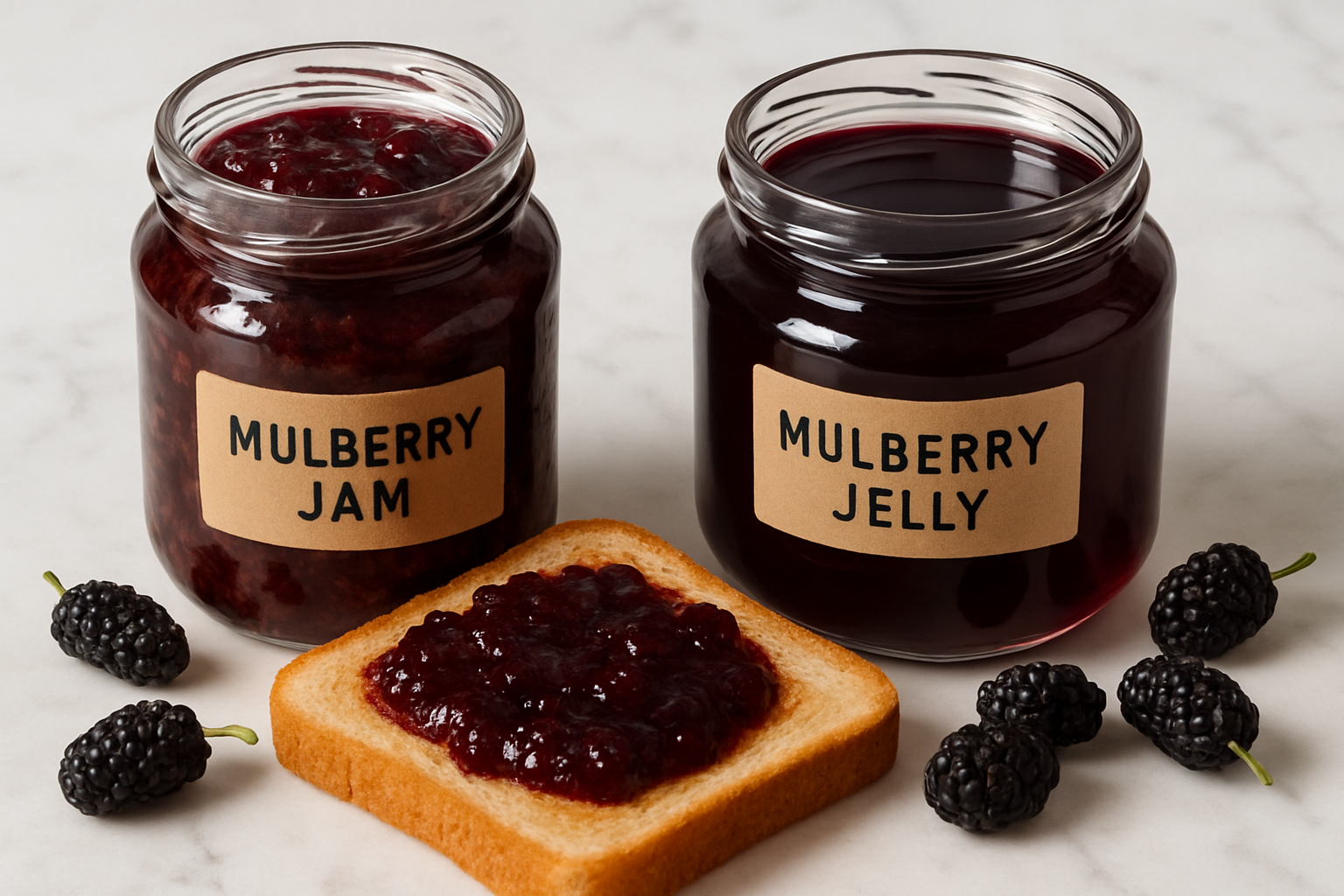
Let’s clear this up simply, because I spent way too long being fuzzy on it. Jam is made from crushed or pureed whole fruit — seeds, pulp, and all. It has a thick, spreadable texture with some body and visible fruit pieces. Jelly is made exclusively from strained fruit juice. No pulp, no seeds, no chunks. The result is a smooth, jewel-clear spread that is absolutely stunning in a jar when done right.
With mulberries specifically, this distinction matters more than it does with most fruits. Mulberries have tiny, soft seeds throughout the berry that are completely harmless but do create a slightly gritty texture in jam. For most people, that texture is totally fine — even pleasant. But if you or someone in your family is sensitive to seeds, or if you just want that gorgeous, translucent purple jelly wobbling on your toast, going the jelly route is absolutely worth the extra straining step.
When to Choose Jam (and Why It Is My Personal Favorite)
Mulberry jam is faster, more forgiving, and honestly delivers a deeper, more complex mulberry flavor because you are keeping all of the fruit’s natural body in the mix. Here is when I recommend going the jam route:
- You have a big harvest and want to process it quickly without an overnight straining step
- You love a rustic, full-flavored spread with visible fruit texture
- You are new to preserving and want a more forgiving first project
- You plan to use it in baked goods, smoothies, or sauces where texture doesn’t matter
For a basic mulberry jam, crush about four cups of ripe mulberries, add three cups of sugar and a tablespoon of lemon juice, and cook it down until it reaches 220°F on a candy thermometer. Skim the foam, ladle into sterilized jars, and process in a water bath for ten minutes. Simple, beautiful, and deeply satisfying.
When to Choose Jelly (and How to Actually Nail the Straining Step)
Here is where things get a little more involved — and where I made my spectacular mistake. Mulberry jelly requires you to extract just the juice from the berries, which means proper straining is non-negotiable. This is the step I rushed past on my infamous Saturday, and it is the step that makes or breaks your jelly.
The right approach: simmer your mulberries gently with a small amount of water until they completely break down, then let the juice drip through a cheesecloth or jelly bag for several hours — ideally overnight. Do not squeeze the bag. I know it is tempting. I know you want to speed things up. But squeezing forces the pulp through and clouds your jelly. Patience is the ingredient that actually makes jelly work.
Once you have your clear juice, the ratio is approximately three-quarters cup of sugar per cup of juice, plus lemon juice for acidity and pectin if your mulberries are on the ripe side (very ripe mulberries are lower in natural pectin). Cook to 220°F, skim well, and jar it up.
Tools That Help (Seriously, These Make the Difference)
After my rubber-slab incident, I invested in proper straining equipment and it genuinely changed everything. Here is what I now use and recommend:
For straining jelly juice, a good cheesecloth bag is essential. I love the Cotton Farm Nut Milk Bag & Cheese Cloth Bag (Ultra Dense), XL 14×14 Inch — the extra-large size is perfect for mulberry batches, and the ultra-dense weave keeps all that pulp out where it belongs. It is also washable and reusable, which I deeply appreciate.
If you want to do hands-free overnight dripping without rigging something up with a bowl and a coat hanger (yes, I have done this), the Norpro Strainer Stand is a genuine game-changer. It holds your bag over a bowl at the perfect height and keeps everything stable while gravity does the work.
For smaller batches or a backup option, I also keep a set of the Unbleached Cotton Reusable Cheesecloth Strainer Bags (3-pack, 12×12 inch) on hand. They are great for jam-making days when I want to strain out just the seeds for a smoother texture without going full jelly.
And for jars — because you will absolutely want more jars than you think you need — both the 6-Pack 16 oz. Regular-Mouth Glass Mason Jars and the Ball Regular Mouth Pint Mason Jars (8 Count) are my go-to options. Pint jars are ideal for mulberry preserves — the right size for gifting and for personal use before things start to crystallize.
My Mulberry Jelly Redemption Arc (and What I Actually Learned)
The following summer after my rubbery disaster, I tried again. I picked eight cups of ripe mulberries from our backyard tree on a cool July morning, simmered them gently, and suspended my cheesecloth bag over a bowl before I went to bed. I woke up to two cups of the most gorgeous, deep-purple juice I had ever seen — and I did not squeeze the bag once, even though every impatient bone in my body screamed at me to. I cooked the jelly carefully, skimmed it thoroughly,