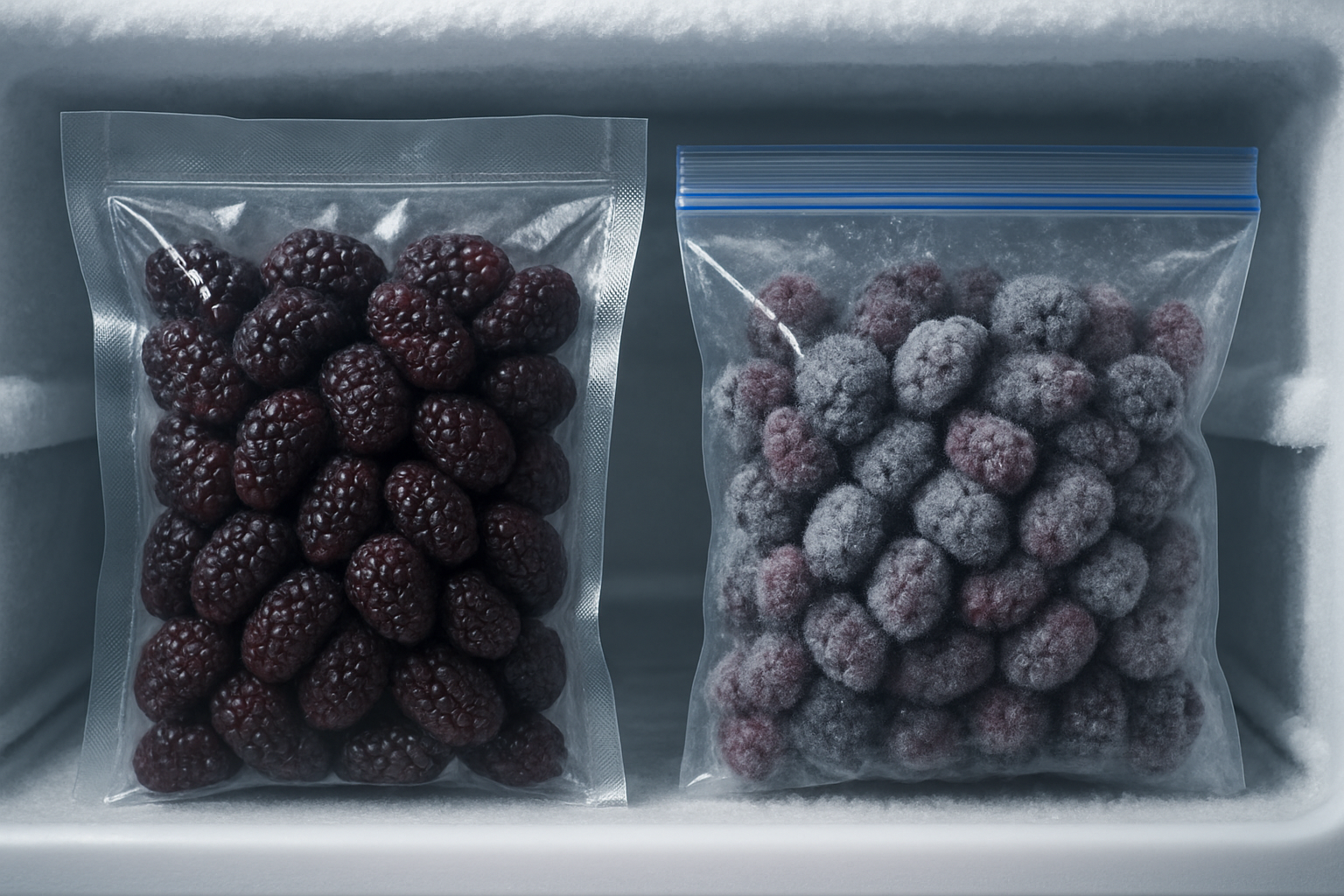
- Standard freezer bags: Good for up to 2 months, low cost, no equipment needed, higher risk of freezer burn over time
- Vacuum-sealed bags: Good for 12–24 months, upfront equipment cost, minimal freezer burn, preserves flavor and texture beautifully
- Best use for freezer bags: Short-term storage if you know you’ll use berries quickly
- Best use
I still remember opening my freezer in late October and feeling my stomach drop. Three pounds of mulberries I’d hand-picked from our backyard tree in June — gone. Well, not gone exactly. They were still there, locked in their zip-lock bags, but completely destroyed by freezer burn. Icy, shriveled, tasteless. I’d spent an entire Saturday harvesting, washing, and carefully bagging them, and now they were headed straight for the compost bin. That’s the moment I got serious about vacuum sealing mulberries, and I haven’t looked back since.
This post contains affiliate links. As an Amazon Associate, I earn from qualifying purchases. This means I may earn a small commission if you click through and make a purchase, at no extra cost to you. I only recommend products I genuinely use and trust.
Why Freezer Bags Kept Failing Me (And Probably You Too)
After that heartbreaking October discovery, I did some digging. The problem wasn’t my freezer. It wasn’t even the bags themselves — I was using decent gallon-sized zip-lock bags. The issue was air. Mulberries are incredibly delicate, high-moisture fruits. Even a small pocket of trapped air accelerates freezer burn, and no matter how carefully I pressed the air out by hand, I was never getting a truly airtight seal. Over four to six months, that residual air was slowly degrading every berry in the bag.
Standard freezer bags are honestly fine for short-term storage — think one to two months. If you’re planning to use your mulberries by August or September of the same year you picked them, you’ll likely be okay. But mulberry season is generous and fleeting, and I want to be making mulberry crumbles and smoothies in February. For anything longer than a couple of months, regular freezer bags are a gamble I’m no longer willing to take.
Vacuum Sealing Mulberries: The Game-Changing Method
Here’s what changed everything for me. Vacuum sealing removes nearly all the oxygen from the bag before it’s sealed, which dramatically slows down both freezer burn and oxidation. Properly vacuum-sealed mulberries can last 12 to 24 months in the freezer while still tasting like summer. That’s not an exaggeration — I pulled out a bag of vacuum-sealed mulberries from last June just recently and they were absolutely perfect. Plump, deeply colored, and bursting with that sweet-tart flavor we all love about them.
There is one important step you absolutely cannot skip with mulberries specifically, and that’s flash freezing before vacuum sealing. Mulberries are soft and juicy, and if you try to vacuum seal them fresh, the suction will crush them into a purple, pulpy mess. Here’s what to do instead:
- Wash your mulberries gently and pat them completely dry — moisture is the enemy here
- Spread them in a single layer on a parchment-lined baking sheet
- Freeze the tray for 2 to 4 hours until each berry is individually frozen solid
- Transfer them quickly into your vacuum sealer bags and seal immediately
- Work in small batches so the berries don’t start thawing before you seal
This flash-freeze method keeps every berry intact and free-flowing so you can scoop out exactly what you need without defrosting the whole bag. It’s a small extra step that makes an enormous difference.
Tools That Help: My Recommended Vacuum Sealers and Bags
You don’t need to spend a fortune to get excellent results. Here are the machines and bags I genuinely recommend for home mulberry preservation:
Vacuum Sealer Machines
The Bonsenkitchen Vacuum Sealer Machine is a fantastic compact option that doesn’t take up much counter space. It has multiple sealing modes, which is helpful because mulberries — being moist — benefit from the moist food setting. It comes with five starter bags so you can try it right away.
If you want a few more features, the Vacuum Sealer Machine with 6-in-1 Dry/Moist Modes and Digital Timer is a brilliant choice. The digital timer gives you precise control over seal time, and the built-in bag cutter means you can customize bag sizes to avoid wasting material. It pulls 75KPa of suction, which is impressively strong for a compact machine.
For anyone who wants the simplest possible experience, the FRESKO Vacuum Sealer with Automatic Bag Detection is wonderfully beginner-friendly. It detects the bag automatically and does most of the work for you. The widened heating strip creates a really secure seal, which I love for anything I’m storing long-term.
Vacuum Sealer Bags
Having a good supply of bags on hand is essential during harvest season when you’re processing fruit in large batches. The Syntus Vacuum Sealer Bags (100-pack in gallon and quart sizes) are BPA-free, commercial grade, and work beautifully for mulberries. I tend to use the quart-size bags for smaller two-cup portions — perfect for a single batch of muffins or a smoothie week.
If you go through bags quickly or want even more size options, the Moretoes 150-piece Vacuum Sealer Bag Set comes in pint, quart, and gallon sizes. The pint bags are wonderful for small berry portions and fit easily into any corner of the freezer.
Vacuum Sealing vs Freezer Bags: The Honest Comparison
Let me break this down simply so you can make the right call for your situation:
- Standard freezer bags: Good for up to 2 months, low cost, no equipment needed, higher risk of freezer burn over time
- Vacuum-sealed bags: Good for 12–24 months, upfront equipment cost, minimal freezer burn, preserves flavor and texture beautifully
- Best use for freezer bags: Short-term storage if you know you’ll use berries quickly
- Best use