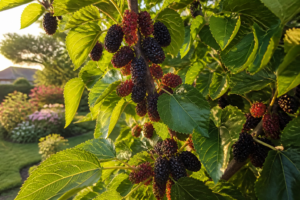
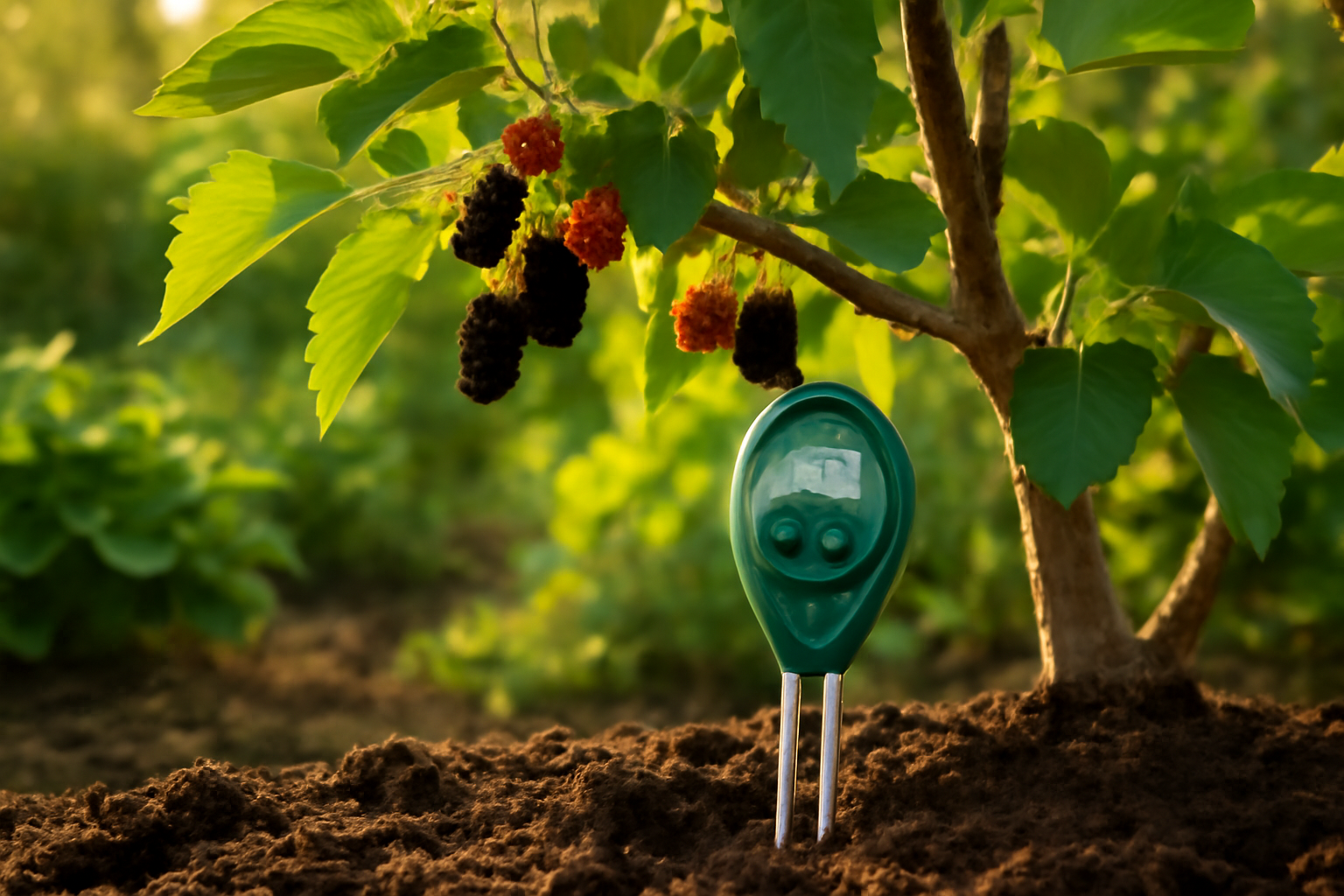

Last spring, three of my established mulberry trees started showing pale, yellowing leaves despite regular feeding. I’d been growing mulberries for over six years, and something was clearly off. After ruling out pests and overwatering, I started suspecting my soil chemistry. That suspicion sent me down a rabbit hole of reading every soil pH meter mulberry tree review I could find. Eventually, I landed on a simple $15 tool that changed how I manage every single one of my beds.
Mulberries are generally forgiving trees. Most varieties thrive in a pH range of 5.5 to 7.0, and they tolerate a lot of neglect. But even forgiving plants have limits. When the pH drifts too far outside that range, nutrient uptake slows down — especially for iron and manganese. My chlorotic leaves were a textbook symptom, and I had no idea what my actual soil pH was because I’d never bothered testing it properly.
I’d been eyeballing my amendments for years. Occasionally I’d throw down some sulfur or lime based on guesswork and hope for the best. That approach clearly wasn’t working anymore. So I decided to actually measure what was happening in the soil before adding anything else. Spending $15 felt a lot smarter than continuing to guess.
The $15 Meter That Finally Explained Why My Mulberries Were Starving
When your mulberry leaves turn pale yellow despite feeding schedules and watering routines, the culprit is often soil pH—and you can’t fix what you can’t measure. A simple pH meter cuts through the guessing and tells you exactly whether your soil is locking up nutrients your trees desperately need.
What works
- Probe goes straight into the soil bed and gives you a reading in seconds—no waiting for lab results, no second-guessing whether you collected the sample right.
- The moisture and light sensors on the same tool mean you’re not fumbling with three different gadgets; I now check all three metrics in one walk around my beds.
- Once I saw my pH was running 7.8 (too alkaline for mulberries), I could actually fix it with sulfur instead of just throwing more fertilizer at the problem.
What doesn’t
- The needle gets dull after heavy clay soil use; mine started giving inconsistent readings after about eighteen months of regular testing in my compacted beds.
- You have to keep the probe clean and calibrate it occasionally, or you’ll chase phantom pH problems that don’t actually exist.
I almost threw this thing out after my first three readings contradicted each other—until I realized I hadn’t rinsed the probe between tests. A quick dunk in distilled water fixed it. For the price, the SONKIR Soil pH Meter, MS02 3-in-1 Soil Moisture/Light/pH Tester Gardening Tool Kits for Plant Care, Great for Garden, Lawn, Farm, Indoor & Outdoor Use (Green) has saved me from years of wasted fertilizer and guesswork.
SONKIR Soil pH Meter, MS02 3-in-1 Soil Moisture/Light/pH
I checked my mulberry beds’ actual pH instead of assuming, then fixed the real problem.
Check Price on Amazon →This post contains affiliate links. As an Amazon Associate, I earn from qualifying purchases at no extra cost to you.