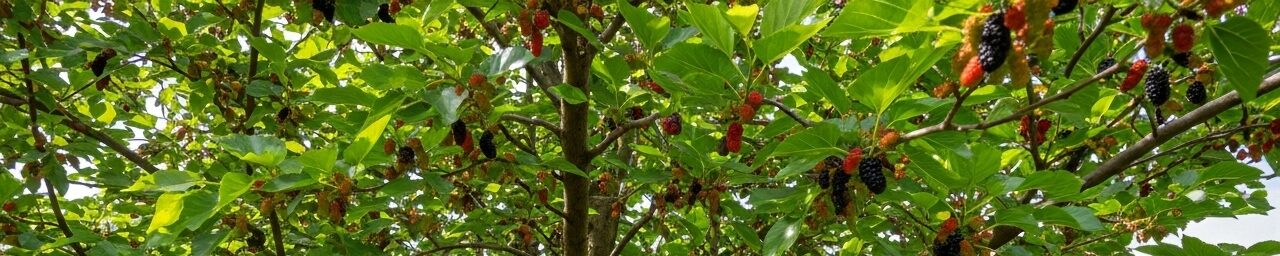
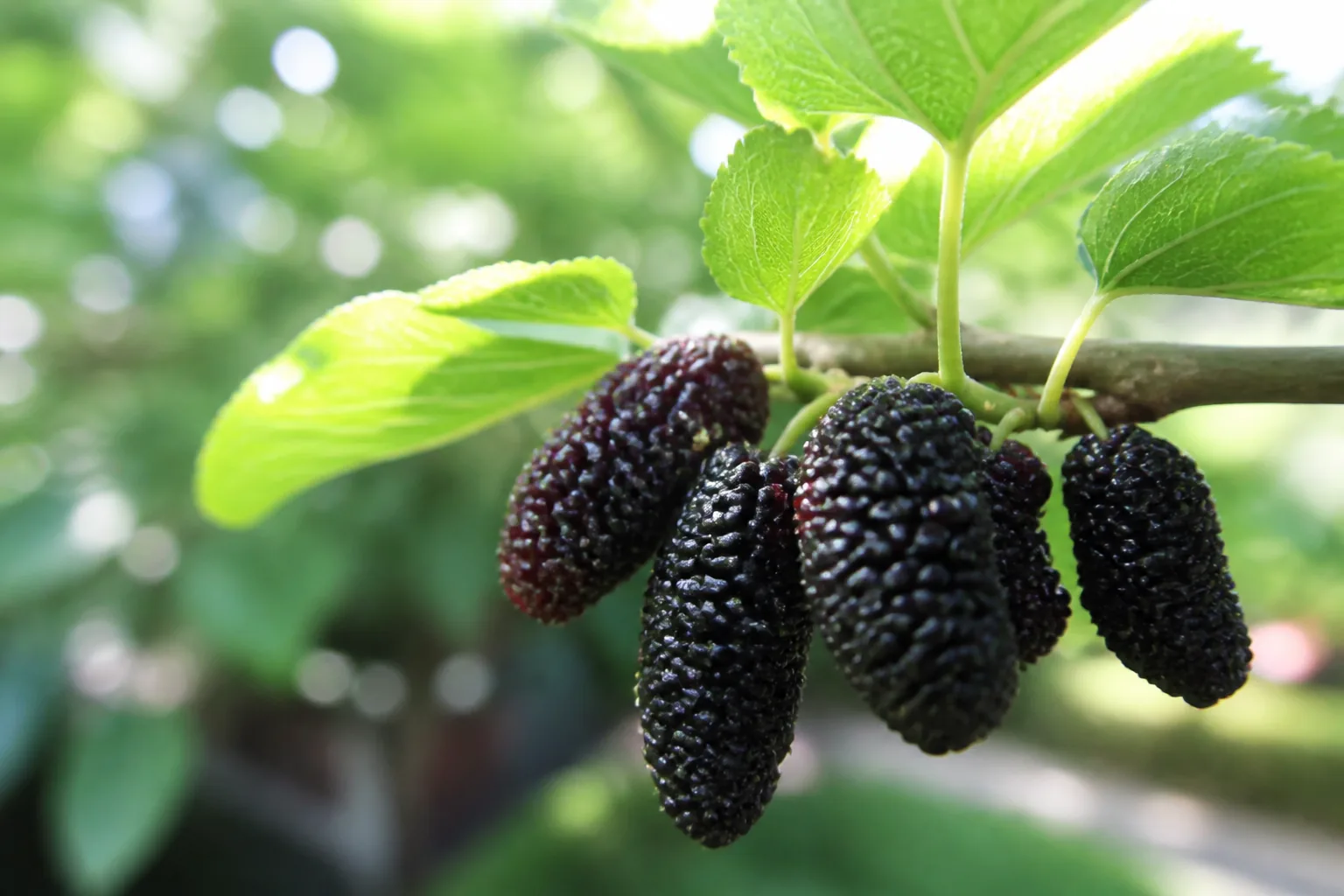
If you’re looking for a complete guide to mulberry trees, you’ve found it. I’ve spent over a decade growing 12 different mulberry cultivars in my backyard, and I still remember the moment I first tasted a sun-warmed black mulberry straight off the branch. That single berry changed everything. I ripped out a struggling apple tree the following spring and planted two mulberries in its place. That decision launched an obsession I’ve never regretted.
The problem is that mulberries get almost no attention compared to apples, peaches, or blueberries. Nurseries rarely stock them. Garden centers don’t know how to sell them. Most people only know mulberries from the nursery rhyme. That’s a tragedy, because these trees are among the most productive, low-maintenance, and delicious fruit trees you can grow. My most prolific tree — a ‘Illinois Everbearing’ — produces over 30 pounds of fruit every season with almost no intervention from me.
This guide covers everything: the three main species, how to choose the right variety, planting and care, pruning, pests, harvesting, and how to actually use the fruit in your kitchen. Whether you’re a complete beginner or you already have a tree and want to get more from it, bookmark this page. I update it regularly as I learn more from my own orchard.
The Three Main Species of Mulberry Trees
Most people don’t realize there are multiple mulberry species, each with distinct characteristics. Understanding the differences will save you from making the wrong choice for your climate or goals. I’ve grown all three, and each one has earned its place in my orchard for different reasons.
Black Mulberry (Morus nigra)
Black mulberry is the flavor champion. The berries are deeply complex — sweet, tart, and almost wine-like. They’re native to western Asia and prefer warm, sheltered spots. However, they are slow to establish, often taking 5–10 years to fruit heavily. My ‘Chelsea’ black mulberry took seven years before it produced a meaningful harvest. The wait was absolutely worth it. These trees are also long-lived; well-tended specimens can survive for centuries.
White Mulberry (Morus alba)
White mulberry is the fastest-growing and most cold-hardy of the three. It’s native to China and was historically cultivated to feed silkworms. The fruit ranges from white to pale pink to deep purple depending on the cultivar. Flavor is milder and sweeter than black mulberry — pleasant, but less complex. That said, white mulberry trees are incredibly adaptable. They tolerate poor soils, drought, and cold down to USDA Zone 4. If you’re in a challenging climate, white mulberry is almost always the right answer.
Red Mulberry (Morus rubra)
Red mulberry is the only mulberry species native to North America. It produces large, dark berries with good flavor — somewhere between white and black in intensity. In my experience, red mulberry is underutilized by home growers. It’s hardy to Zone 4, handles humidity well, and produces reliably. The main drawback is that pure red mulberry can be difficult to source because it hybridizes freely with white mulberry. Many trees sold as “red mulberry” are actually hybrids. Ask your nursery specifically about the plant’s origin before buying.
Choosing the Best Mulberry Variety for Your Garden
Species is just the starting point. Within each species, named cultivars vary enormously in size, flavor, fruiting season, and tree habit. Choosing the right variety upfront prevents years of disappointment. Here are the cultivars I’ve grown and recommend most often.
Top Cultivars Worth Growing
- ‘Illinois Everbearing’ — A Morus alba × rubra hybrid. Massive crops over a 4–6 week window. Excellent for fresh eating and preserving. My top recommendation for beginners.
- ‘Oscar’ — Large, sweet red-to-black berries on a compact tree. Fruits in its second or third year. Great for smaller gardens.
- ‘Chelsea’ — A classic black mulberry. Slow to fruit but exceptional flavor. Best in Zone 6 and warmer.
- ‘Kokuso’ — A Korean white mulberry cultivar. Very productive, long fruiting season, and cold-hardy to Zone 5.
- ‘Gerardi Dwarf’ — A white mulberry that stays under 6 feet tall. Perfect for container growing or very small spaces.
- ‘Pakistan’ — Produces extraordinarily long berries (up to 3 inches). Rich flavor. Suited to Zone 7 and warmer; needs heat to perform well.
[INTERNAL LINK: mulberry varieties comparison guide] covers each of these cultivars in much more depth, including side-by-side flavor notes from my own tastings.
Fruitless vs. Fruiting Varieties
One important note: fruitless mulberry trees exist and are widely sold as ornamentals or shade trees. They produce no fruit and no staining mess. If someone recommends a “mulberry tree” without specifying fruiting, confirm it’s not a fruitless variety. For our purposes here, we’re talking entirely about fruiting mulberries.
How to Plant a Mulberry Tree
Mulberries are forgiving plants. They’re not as demanding as stone fruits or finicky like figs can be in marginal climates. That said, getting the planting right sets the tree up for decades of success. I’ve planted trees both well and poorly, and the difference in establishment speed is significant.
Site Selection
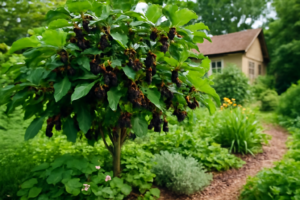
Choose a location with full sun — at least 6–8 hours of direct sunlight daily. Mulberries will grow in partial shade, but fruit production drops noticeably. More critically, think about mess. Ripe mulberries fall constantly during harvest season. They stain concrete, patios, and clothing a deep purple. Plant at least 15–20 feet from any hard surface you care about. I learned this the hard way with my first tree, planted 8 feet from a paved path. Scrubbing that path every June is a summer ritual I could live without.
Soil and Drainage
Mulberries tolerate a wide range of soils, from sandy to clay. However, they do not tolerate waterlogged roots. Good drainage is the one non-negotiable. If your soil is heavy clay, plant on a slight mound or raised area to encourage drainage. Soil pH between 5.5 and 7.0 is ideal. Most garden soils fall within this range naturally, so you likely don’t need to amend.
Planting Steps
- Dig a hole two to three times the width of the root ball, and the same depth.
- Place the tree so the root flare sits at or just above soil level — never bury the flare.
- Backfill with the original soil. Avoid adding compost to the planting hole; it can create drainage problems.
- Water slowly and deeply immediately after planting — approximately 10–15 gallons for a standard container-grown tree.
- Apply a 3-inch layer of wood chip mulch in a 3-foot radius, keeping mulch 3 inches away from the trunk.
Bare-root trees should be planted in early spring before bud break. Container-grown trees can go in the ground from spring through early fall, though spring planting gives the best establishment results.
Mulberry Tree Care: Water, Fertilizer, and Ongoing Maintenance
Once established, mulberry trees are genuinely low-maintenance. During the first two years, however, consistent care makes a real difference. A well-established mulberry can handle drought, neglect, and poor soil. A newly planted one cannot.
Watering
Water newly planted trees deeply once or twice a week for the first growing season, depending on rainfall and temperature. After establishment — typically in year two — most mulberry trees need little to no supplemental irrigation in average climates. During prolonged drought, a deep watering every two to three weeks prevents stress. Overwatering is a more common mistake than underwatering with established mulberries.
Fertilizing
Mulberries are light feeders. In most home garden soils, additional fertilizer is unnecessary once the tree is established. For young trees, a balanced fertilizer (such as a 10-10-10 formula) applied in early spring — roughly 1 pound per inch of trunk diameter — supports healthy growth. Avoid heavy nitrogen applications, which push excessive leafy growth at the expense of fruit. In my orchard, I now rely almost entirely on annual wood chip mulch to slowly feed my trees, and the results are excellent.
Pruning Mulberry Trees
Pruning mulberries is simpler than most fruit trees. The primary goal is to establish a good structure in the first three years. After that, annual maintenance pruning keeps the tree manageable and productive. The best time to prune is late winter or early spring, just before bud break, when the tree is still dormant.
Remove crossing branches, dead wood, and any shoots growing toward the center of the canopy. Aim for an open vase shape that allows light and air into the canopy. Mulberries bleed sap heavily when pruned in late spring or summer — this isn’t fatal to the tree, but it’s messy and weakening. Stick to dormant-season pruning whenever possible. [INTERNAL LINK: how to prune mulberry trees] has a full step-by-step walkthrough with photos from my own trees.
Common Mulberry Pests and Diseases
One of the reasons I love mulberries is their relative toughness. They don’t suffer from the laundry list of pest and disease problems that plague apples or cherries. That said, a few issues are worth knowing about so you can catch them early.
Birds
Birds are by far the most significant “pest” you’ll face at harvest. They compete aggressively for ripe fruit. Netting is the most effective solution for smaller trees. For larger trees — mine reach 15–20 feet — full netting is impractical. In my experience, the best strategy is simply to harvest frequently and plant more trees than you think you need. There’s usually enough fruit for everyone.
Fungal Issues
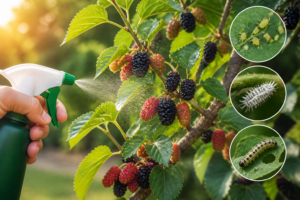
Mulberries can develop popcorn disease (caused by the fungus Ciboria carunculoides), which causes fruit to swell grotesquely and fail to develop normally. It’s more common in wet, humid climates. The affected fruits look puffy and discolored and should be removed and disposed of — not composted. Improving air circulation through pruning significantly reduces the incidence of this and other fungal issues.
Scale Insects and Whitefly
Scale insects occasionally colonize mulberry branches, appearing as small brown bumps along the bark. Heavy infestations weaken the tree and reduce fruit production. A dormant-season horticultural oil spray is the standard treatment and is highly effective when applied correctly. Whitefly can affect trees in warm, sheltered locations but rarely causes serious damage on healthy, well-maintained trees.
Harvesting Mulberries: Timing, Techniques, and Storage
Harvesting mulberries is unlike harvesting almost any other fruit. You don’t pick mulberries one by one — you shake them. This changes everything about how you plan and manage harvest season.
When Are Mulberries Ripe?
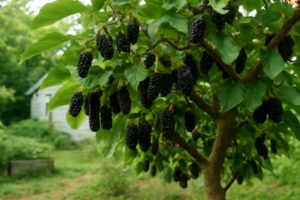
Timing varies by species and cultivar. White and red mulberry hybrids like ‘Illinois Everbearing’ typically ripen from late May through July in temperate climates. Black mulberries ripen later, often from July into August. A ripe berry releases from the stem with almost no resistance and has full, deep color. Tasting is the most reliable test — a ripe mulberry is sweet, soft, and intensely flavored. An unripe one is tart and slightly astringent.
The Tarp Method
Spread a large sheet or tarp beneath the tree and gently shake the branches. Ripe berries fall freely. Unripe ones stay put. This is the most efficient harvest method for medium to large trees. Collect berries from the tarp, transfer them to a bowl, and sort out any debris. I can harvest 5–8 pounds from a mature tree in under 30 minutes using this method. It’s one of my favorite mornings of the entire year.
Storing Fresh Mulberries
Fresh mulberries are highly perishable. They last only 2–3 days in the refrigerator, even when handled carefully. Spread them in a single layer on a baking sheet and freeze them individually for 2 hours before transferring to freezer bags. Frozen mulberries keep for up to 12 months and retain excellent flavor. For long-term preservation, I make mulberry jam, syrup, and wine every summer. [INTERNAL LINK: mulberry recipes and preservation guide] has everything I’ve developed over a decade of abundance.
Culinary Uses: What to Do With All Those Mulberries
The first year my ‘Illinois Everbearing’ matured fully, I harvested over 30 pounds of fruit in six weeks. That’s a lot of mulberries. Quickly, I learned to think creatively. Mulberries are versatile — sweeter and less acidic than blackberries, which makes them adaptable in both sweet and savory contexts.
Fresh Eating and Simple Preparations
The simplest use is also the best: eat them fresh, straight from the tree. Beyond that, mulberries shine in smoothies, yogurt, oatmeal, and fruit salads. A mulberry compote takes 10 minutes to make and elevates pancakes, ice cream, or cheese boards dramatically. Because of their natural sweetness, mulberries often need less added sugar than other berries in recipes.
Preservation and Pantry Uses
Mulberry jam is my single most-gifted preserve — everyone loves it. The berries are naturally high in pectin, which means jam sets reliably without added pectin in many recipes. Mulberry syrup (simply berries, sugar, and water, reduced down) lasts several weeks in the fridge and works beautifully in cocktails, lemonade, or drizzled over desserts. For a more ambitious project, mulberry wine is genuinely excellent — deep, ruby-colored, and richly flavored.
Dried Mulberries
White mulberries dry exceptionally well and have a caramel-like sweetness when dried. Use a food dehydrator at 135°F for 10–14 hours, or dry them in a low oven (150°F) with the door slightly ajar. Dried mulberries are excellent in granola, trail mix, and baked goods. They’re also one of the few mulberry products available commercially, which gives you a useful flavor reference point.
Common Mistakes and Beginner Questions
Mistake #1: Planting Too Close to Structures
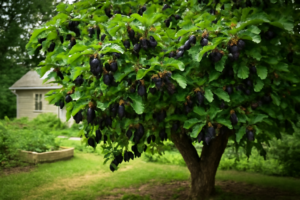
Mature mulberry trees can reach 30–50 feet tall and wide, depending on the variety. Many beginners underestimate this and plant too close to fences, walls, or other trees. Give standard varieties at least 15–20 feet of clearance in all directions. For compact cultivars like ‘Gerardi Dwarf,’ 6–8 feet is sufficient. Getting this wrong means difficult decisions later — either aggressive pruning or removal.
Mistake #2: Expecting Fast Fruit from Black Mulberry
Black mulberry trees are slow to bear. Many gardeners plant one, wait two or three years, see no fruit, and assume something is wrong. Nothing is wrong. Black mulberries simply take time — often 5–10 years from planting to meaningful production. If you want fruit quickly, start with ‘Illinois Everbearing’ or ‘Oscar.’ Plant your black mulberry alongside it for future reward. Patience pays off enormously with this species.
Mistake #3: Ignoring the Staining Risk
Mulberry juice stains almost everything permanently. Wear clothes you don’t care about during harvest. Use stainless steel or glass bowls — not plastic, which absorbs the color. Concrete and paving stones under the tree will stain over time. Some growers lay down annual bark mulch beneath the canopy to absorb fallen fruit and reduce staining on hard surfaces. Plan for this before you plant, not after.
FAQ: Do Mulberries Need a Pollinator?
Most mulberry cultivars are self-fertile — one tree is enough for a full harvest. However, some cultivars produce better fruit set with a second tree nearby. ‘Illinois Everbearing’ and most white mulberry cultivars are reliably self-fertile. If you have space for two trees, plant two. Production almost always improves. That said, a single well-chosen mulberry tree will still produce abundantly on its own.
FAQ: Are Mulberries Safe to Eat?
Ripe mulberries are completely safe and nutritious for humans and most animals. However, unripe white mulberries contain compounds that can cause nausea and mild hallucinations in large quantities. This is rarely a practical concern — unripe mulberries taste terrible and no one eats them willingly. Fully ripe mulberries have no such issues. As always, if you’re foraging mulberries from an unknown tree, confirm the identification before eating in quantity.
Final Thoughts: Your Complete Guide to Mulberry Trees Starts Here
This complete guide to mulberry trees is the foundation of everything I write on this site. But a guide only goes so far. At some point, you have to plant the tree. I promise you: a well-chosen mulberry in the right spot will become one of the most rewarding plants in your entire garden. Mine have outlasted vegetable beds, perennial borders, and a lot of trendy “superfoods” that never lived up to their promise.
The key takeaway is this: choose your variety carefully based on your climate and space, plant in full sun with good drainage, give it time to establish, and then mostly leave it alone. The tree will do the rest. For most people, that’s ‘Illinois Everbearing’ as their first tree — productive fast, reliably delicious, and adaptable to a wide range of conditions.
I’ve grown 12 cultivars across a decade. Some disappointed me. Most exceeded my expectations. All of them taught me something. Start with one good tree, watch it grow, taste the fruit, and I’d wager you’ll be planning a second before the first harvest is over. Welcome to the world of mulberries. You’re going to love it here.