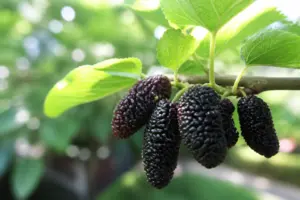
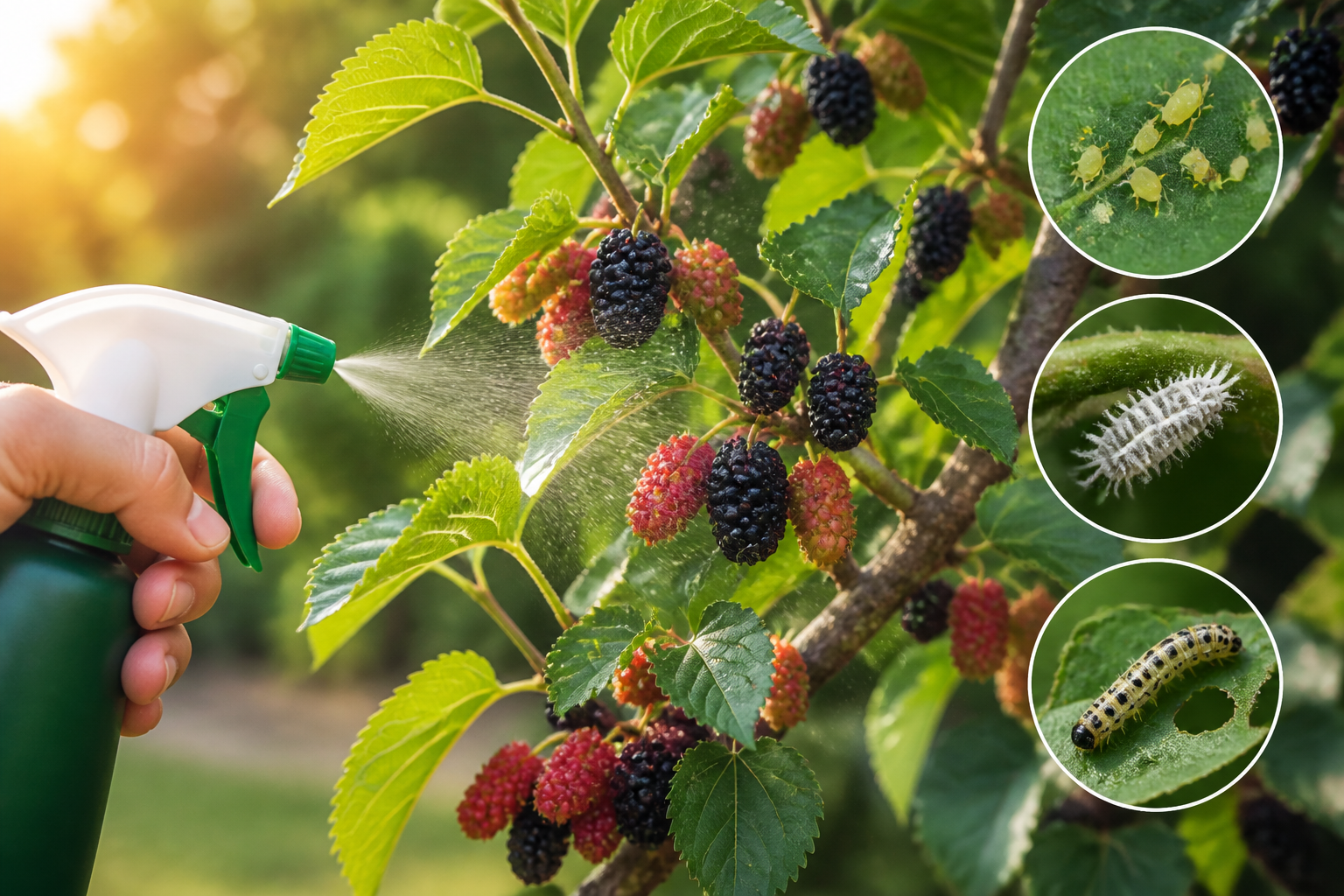
Stickiness is frequently your first clue. A glossy coating of honeydew settles across the foliage hanging below an infested section, dark sooty mold begins spreading over the stems, and tucked somewhere in that mess you’ll discover either hard, bumpy protrusions or fluffy white waxy clusters fastened to the branches. This constellation of signs points to mulberry’s primary sap-feeding pests — scale insects, whiteflies, and mealybugs. All three operate identically (using needle-like mouthparts to extract plant fluids straight from the vascular tissue), leave behind the same sticky honeydew and black fungal coating, and react favorably to nearly identical control approaches, which is why discussing them as a group makes practical sense.
This differs significantly from a mulberry borer, which chews tunnels through the interior wood and generates sawdust-textured frass in place of honeydew (check our dedicated borer guide if that matches what you’re observing). It’s also distinct from spider mites, which create delicate webbing and produce a parched, speckled rust-colored appearance rather than a sticky residue — those warrant their own seasonal spider mite guide.
Recognizing the Warning Signs Early
A stressed mulberry communicates its problems clearly. Telltale indicators of a sap-feeding infestation comprise yellowed foliage, a tacky substance coating the twigs and leaves positioned below, a charcoal-colored film across the branch surface, and delayed development of emerging shoots. Beyond that, you may spot leaves that fold inward or shed prematurely from the canopy.

These warning signs don’t necessarily point to a single culprit, so pinpointing which pest you’re confronting matters before selecting a course of action. Take your time examining the affected tree — focus on the bottom surface of leaves, where branch stems intersect, and inside bark fissures, because all three congregate in those protected spots.
Scale Insects: Hard Shells That Masquerade as Bark
Scale insects employ remarkable camouflage. Source They lock themselves into one location on branches and resemble crusty bumps in shades of brown, grey, or off-white far more than they resemble actual living insects — that unusual whitish crust adhering to a stem is frequently the feature that catches a gardener’s eye initially, and it’s deceptively easy to dismiss as normal bark texture before you pry one loose and realize what’s underneath. Recognition frequently comes only after considerable damage has accumulated.
Beneath that protective shell, scale insects withdraw sap from the tree’s internal transport system, robbing foliage of its normal vibrant coloring and leaving it pallid and sickly. Comparable to mealybugs, they generate honeydew, which accumulates on leaves and wood and welcomes black sooty fungus — an unwelcome secondary infection that additionally interferes with light absorption and intensifies the tree’s overall strain. Scale problems escalate under warm, arid weather patterns, and even properly irrigated trees can become colonized when infested neighboring vegetation is nearby.
Whiteflies: Diminutive in Size, Substantial in Impact
Whiteflies appear deceptively innocuous. Source They’re minute, pale-winged invertebrates that erupt in a swarm when you jostle the vegetation — witnessing that swarm confirms your suspicion. Differing from scale, they retain mobility and disperse rapidly between surrounding plants, so taking action on an affected limb sooner rather than later holds particular importance in this scenario.
Direct your inspection toward the leaf undersides first. Whitefly eggs, immature stages, and mature forms all amass in that sheltered location, protected from bright light — you’ll normally observe minuscule cream-colored egg clusters set in orderly round configurations, with juvenile stages displaying a flat, armor-like body shape before their wings develop. The black sooty residue you notice on the top of leaves frequently signals the presence of whiteflies before you actually spot the bugs.
Begin management by directing a forceful stream of water across the foliage using a garden hose, executing this twice weekly, to forcibly remove mature insects and nymphs. Welcome natural predators including ladybugs and lacewings into your space, since these creatures consume enormous quantities of whiteflies. When pesticide treatment becomes necessary, coat the undersides of leaves thoroughly with insecticidal soap or neem oil, applying at daybreak or dusk to protect helpful creatures and avoid scorching the foliage in intense warmth. Sticky cards positioned near troubled limbs assist in tracking adult numbers without jeopardizing predatory species.
Mealybugs: Identifying and Controlling This Persistent Threat
Mealybugs resemble minuscule wool tufts or patches of ivory fuzz adhering to wood surfaces and fork-shaped branch joints. Within that protective waxy exterior resides a tender-bodied creature actively extracting your tree’s fluids. They seem harmless because of their sluggish, unhurried movement, yet their tendency to gather in dense groups actually permits prompt discovery when you’re conducting routine examinations.
Prime Inspection Locations
Examine these vulnerable zones diligently when performing routine assessments:
- Junctions and angles where branches split and connect together
- The lower face of foliage positioned along the central leaf vein
- Areas where fruit attaches to the branch stem
- Tender shoot tips rising from the canopy, which present accessible feeding positions
Female mealybugs produce dozens or hundreds of offspring within a protective fluffy covering. Source Juvenile individuals, referred to as crawlers, subsequently migrate throughout the plant, establishing feeding territories at fresh locations. That fluffy, whitish waxy layer is highly recognizable, and it simultaneously serves as a protective barrier, deflecting water-soluble treatments efficiently.
The Challenge With Conventional Treatments
The majority of contact pesticides merely slide across the protective wax coating. As a result, plant-derived oils or solvent-based treatments permeate the layer more dependably. Neem oil combined with a spreading agent dissolves the wax layer with greater success. Therefore, sequential applications spaced seven to ten days apart prove essential. For smaller infestations, applying rubbing alcohol with a cotton pad directly to identifiable patches liquefies the waxy armor and destroys the creature underneath — this technique performs particularly well on reachable limbs and emerging foliage.
The Symbiotic Relationship Between Ants and Mealybugs
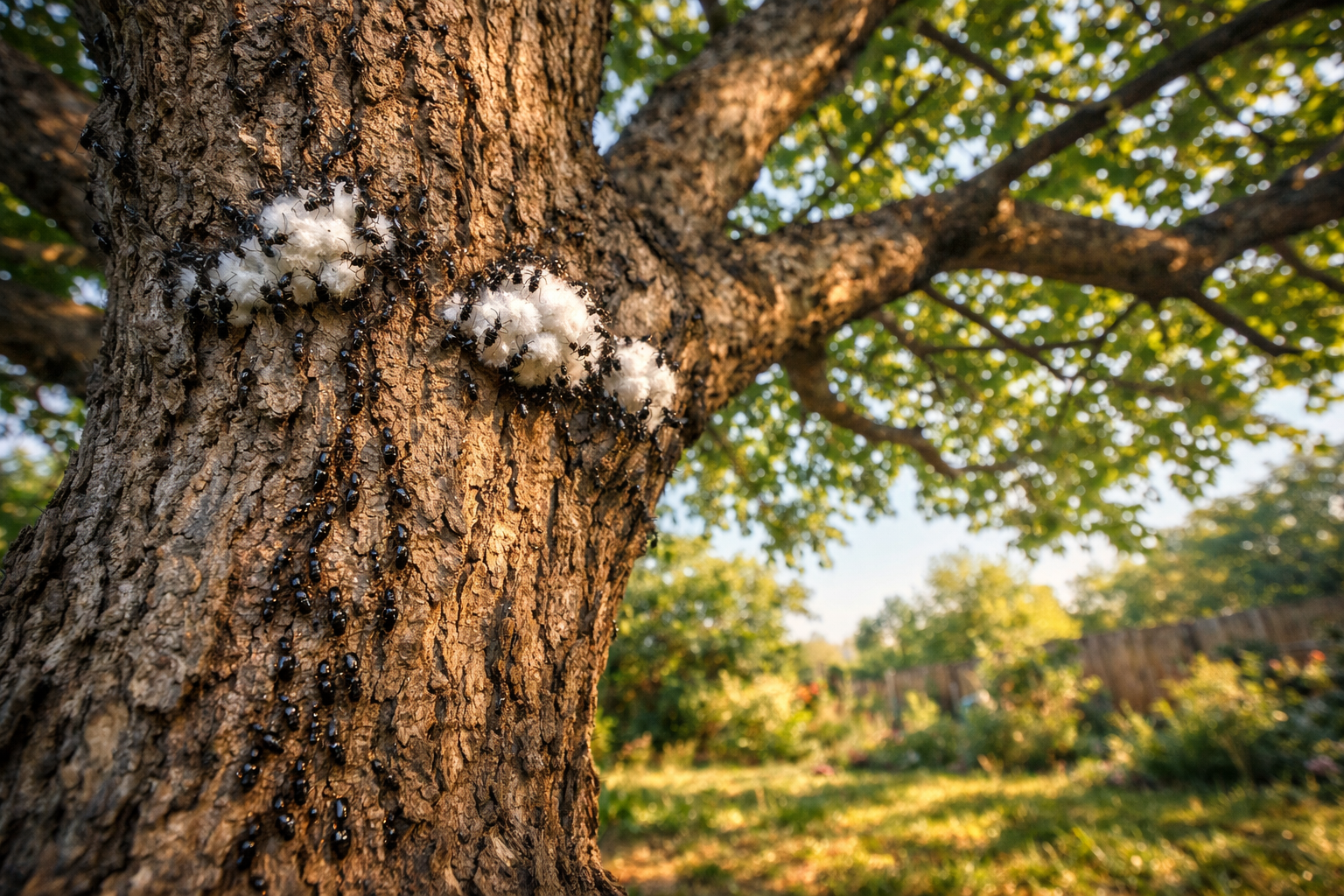
This alliance genuinely makes intervention strategies considerably more difficult. Honeydew produced by mealybugs attracts ants, which actively shield mealybug families from beneficial predators in return for consuming the sugar-rich secretion they generate. Ant colonies specifically:
- Repel and eliminate beetles and tiny parasitoid insects
- Relocate mealybug families to new feeding regions
- Respond rapidly to any disturbance to the colony
Addressing the ant problem first produces dramatically better results when relying on predatory insects for control. Create a sticky band encircling the trunk to prevent ants from ascending. One neighbor confided in me that he wraps the lower stem with a petroleum jelly barrier each spring — he maintained this approach outperformed any liquid solution he experimented with.
Predatory Insects for Control
Consider purchasing and releasing mealybug predatory beetles (Cryptolaemus montrouzieri). These specialized ladybug cousins pursue mealybugs with remarkable aggression. A friend reported that introducing merely fifty of these beetles addressed a severe infestation in her tree within approximately three weeks. Source them from trusted beneficial insect providers, and discharge them throughout the cooler portions of morning for maximum survival probability.
Effective Treatment Choices You Can Use Now
Plant-Based Oils and Soap Sprays
Against scale infestations, whiteflies, and mealybugs simultaneously, plant-derived oils and soap-based sprays demonstrate outstanding performance. Source These substances function by enveloping the pest’s exoskeleton and disrupting oxygen exchange. Spray comprehensively, reaching underneath foliage and into branch junctions where infestations are concentrated, during early morning or twilight hours to reduce leaf injury under warm sunlight. Execute repeated treatments at intervals of seven to ten days until populations disappear entirely — thorough coverage carries enormous significance, as incomplete applications allow surviving individuals to rebuild colonies rapidly.
Neem-Based Treatments
Neem delivers a robust, organic option that interrupts the life stages of damaging insects. It functions via direct contact elimination and also interferes with feeding and reproduction cycles, producing simultaneous effectiveness against all three categories of sap-extracting pests. Be cautious with beneficial organisms, however — limit application during hours when pollinators are most active and direct treatment toward infested regions only.
Hand-Applied Methods and Severe Situations
Visible clusters of mealybugs or scale respond surprisingly effectively to physical removal — scrub branches using a cloth or delicate brush wetted with alcohol, and use a pressurized water spray to detach whitefly colonies. In instances where problems are extreme and earlier approaches have disappointed, systemic pesticides containing imidacloprid become available, though application must adhere strictly to package guidelines. Save this approach for documented serious circumstances; for the vast majority of sap-sucker situations, regular applications of oils and soaps prove adequate.
Strategies for Keeping These Pests From Returning
Support Naturally Occurring Predators
Beetles, lacewings, and parasitoid wasps provide natural suppression of scale, whiteflies, and mealybugs. Source Building populations of these allies requires reducing reliance on broad-spectrum pesticides and sowing nectar-producing plants like dill, fennel, and yarrow in neighboring spaces. Restrict chemical spray use when flowering is occurring to safeguard the insects that supply critical pollination throughout your backyard ecosystem.
Keep Your Mulberry Trees Vigorous
Robust trees deflect pest pressures substantially more effectively compared to weakened specimens. Emphasize reliable water delivery, supply appropriate nutritional resources, and execute thoughtful pruning to maximize circulation within the branch structure. Particularly, restrain nitrogen-heavy fertilizer applications — tender, fast-growing branches are the preferred feeding substrate for mealybugs and other sap-feeders.
Schedule Frequent Observation Sessions
Routine examinations executed each week across the productive season capture problems in their initial phases. Persistently examine the underside of foliage, where scale, whiteflies, and juvenile mealybugs congregate out of sight. Maintain a straightforward log documenting inspection dates, the organisms you encounter, how serious the population appears, and what action you selected — after successive seasons, recurring patterns surface, for instance scale arriving consistently during June following spring periods of warmth and little precipitation, equipping you to anticipate seasonal threats.
A 10x Magnifier Transformed How I Spot Tiny Pests Before They Wreck My Leaves
Once your mulberry foliage becomes thin and translucent with holes throughout, determining precisely which organism is causing damage represents fifty percent of fixing it—and attempting to distinguish small creatures by eye alone during intense midday brightness simply won’t succeed. An affordable magnifying lens converts those “practically invisible” creatures into obvious targets, allowing you to respond strategically rather than blindly.
Where it delivers
- Made visible tiny spider mites and beetles I couldn’t distinguish from arm’s length, even in direct sunlight—the magnified view rendered them unmistakable and confirmed what I was dealing with.
- Provided me with detection windows before entire limbs were rendered skeletal, delivering a 2–3 week window for action instead of noticing only after extensive damage had occurred.
- Stays portable in a shirt pocket and expenses under the price of one spray application, so I had it on hand throughout my daily inspection walks—zero obstacles to checking pest conditions.
Its constraints
- Bright conditions create excessive reflection inside the lens, reducing clarity; I discovered that examining the lower surface of leaves during morning or evening yields sharper, clearer views.
- Doesn’t allow for total certainty in distinguishing between different pest categories—I required internet photo comparison to differentiate between insects with soft coverings and hard shells, though magnification at minimum informed me of which category I occupied.
I almost skipped buying one because I thought I could just “look closer,” but that delay cost me two weeks of undetected mite damage on a young tree. mulberry tree pest
Frequently Asked Questions
How do I tell spider mites from mulberry sap-sucking pests?
Spider mites create delicate webbing and a parched, speckled rust-colored appearance rather than a sticky residue, while scale, whiteflies, and mealybugs all leave honeydew and black sooty mold. Borers are different again — they chew tunnels through interior wood and produce sawdust-textured frass instead of honeydew. I’d check the dedicated borer and spider mite guides if either description matches.
Does nitrogen fertilizer make mulberry mealybug problems worse?
Heavy nitrogen applications do work against you, so I restrain them — tender, fast-growing branches are the preferred feeding substrate for mealybugs and other sap-feeders. I put the effort into reliable water delivery, appropriate nutritional resources, and thoughtful pruning that maximizes circulation through the branch structure, since robust trees deflect pest pressure far better than weakened ones.
Can rubbing alcohol kill mealybugs on mulberry branches?
Rubbing alcohol works well on smaller infestations. Applied with a cotton pad directly to identifiable patches, it liquefies the waxy armor and destroys the creature underneath, which is useful on reachable limbs and emerging foliage. For visible clusters of mealybugs or scale, I scrub the branches with a cloth or delicate brush wetted with alcohol.
What flowers should I plant to attract beneficial insects near mulberries?
Nectar-producing plants such as dill, fennel, and yarrow sown in neighboring spaces help build populations of beetles, lacewings, and parasitoid wasps, which naturally suppress scale, whiteflies, and mealybugs. Building those allies also means reducing reliance on broad-spectrum pesticides and restricting chemical spray use while flowering is occurring, so the pollinators in your backyard stay safe.
Keep Reading
About This Article

Written by Ruth Nakamura. Ruth Nakamura is a backyard orchardist in the Pacific Northwest who has grown mulberries for fifteen years, cultivating twelve different varieties in her own backyard. Not a horticulturist by formal training - she shares what she has learned through hands-on growing, workshops, and connecting with nurseries and growers across the country. More about this site.
Scope and limits. Ruth is a backyard orchardist without formal horticultural training. Growing conditions vary enormously by region, so confirm variety, timing, and pest guidance with your local extension service.
Verify this against a primary source
Specifics change, and your situation may differ from the one described here. These are the authorities worth checking directly:
- USDA Plant Hardiness Zone Map — zone verification for your location
- Oregon State University Extension — fruit growing and pruning research
- USDA PLANTS Database — species range and identification