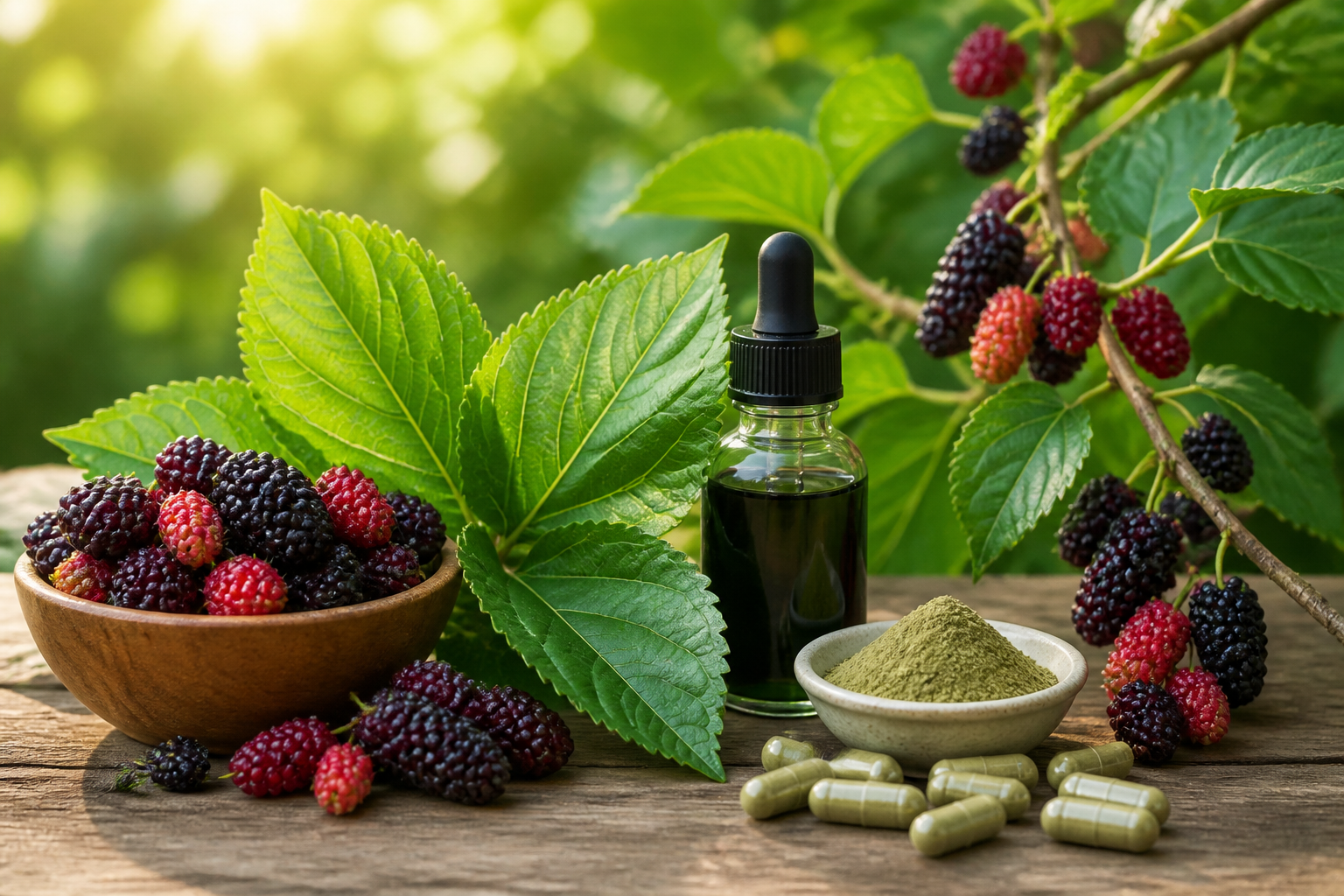
Unexpected temperature swings — warm spells followed by hard freezes — can stress fruit trees and their early leafing cycles. Mulberry leaves often show resilience in these conditions, which connects to the broader value of mulberry leaf compounds documented in research. Mulberry leaf extract represents the concentrated essence of what makes those leaves genuinely useful — and the research behind it is far more substantial than most casual growers realize. Whether you’re exploring capsules, powders, liquid concentrates, or steeped leaf preparations, the documented mulberry leaf extract benefits range from stabilizing glucose responses to providing antioxidant defense and much more.
I need to be clear about my limitations from the start: I’m not a medical professional, and nothing in this post functions as medical advice or treatment guidance. What I’m equipped to offer is a careful examination of what controlled studies have actually revealed about mulberry leaf extract, informed by decades spent growing and harvesting from these trees myself. If you’d benefit from foundational context first, my article covering the top 7 benefits of mulberry leaves may be a good starting point.
What Is Mulberry Leaf Extract?
Mulberry leaf extract originates as a concentrated preparation made from foliage harvested from the Morus alba (white mulberry), though leaves from Morus rubra and Morus nigra contain many overlapping bioactive constituents. The extraction methodology isolates and concentrates the biologically active components — chiefly 1-deoxynojirimycin (DNJ), chlorogenic acid, flavonoid compounds, and an array of polyphenolic substances — transforming them into a format that permits reliable, reproducible dosing compared to working with whole leaves or steeped leaf beverages.
The market offers mulberry leaf extract in several delivery formats: encapsulated forms, liquid alcohol-based tinctures, standardized powder blends, and concentrated aqueous extracts designed for brewing. The fundamental distinction separating a cup of mulberry leaf tea from a bottled extract supplement hinges on strength and dosage consistency. A capsule formulated to guarantee a particular DNJ concentration ensures you receive the same quantity with each dose, whereas brewing tea creates variability based on when the leaves were harvested, how long the leaves steeped, and water temperature during preparation.
Blood Sugar Regulation: The Headline Benefit
The mulberry leaf extract benefit receiving the most rigorous scientific investigation concerns glucose management in the bloodstream. The DNJ molecule found abundantly in mulberry leaves functions as an alpha-glucosidase inhibitor — stated simply, it decelerates the digestive breakdown of starches and disaccharides within your small intestine, allowing sugar to gradually permeate into circulation after consuming a carb-containing meal. Numerous controlled human studies have confirmed measurable changes in both healthy individuals and patients diagnosed with type 2 diabetes.
In 2017, a peer-reviewed investigation published in PLOS ONE allocated mulberry leaf extract or placebo to participants immediately before they consumed carbohydrates, then measured the resulting blood glucose and insulin trajectories. The extract-treated group demonstrated notably diminished spikes compared to the control condition. Separately, Japanese research documented a roughly 23 percent decrease in glucose elevation following meals when subjects took mulberry extract. I wanted to see these effects firsthand, so I documented a personal ninety-day trial using commercial mulberry capsules — my personal experience aligned with published observations.
It’s important to contextualize the magnitude of this effect: it operates optimally when ingested somewhere between 15 and 30 minutes before eating carbs, and the strength of response differs substantially from one individual to another. Yet for those seeking plant-derived glucose stabilization alongside behavioral modifications to diet and activity, the data merits genuine attention and consideration.
Antioxidant and Anti-Inflammatory Activity
Moving beyond glucose management, mulberry leaf extract concentrates substantial amounts of polyphenolic and flavonoid substances functioning as cellular protectants. Quercetin, kaempferol, and chlorogenic acid all exist in noteworthy concentrations throughout mulberry foliage. These molecules work by scavenging free radicals — unpaired, reactive atoms that drive cellular deterioration, persistent immune activation, and cumulative age-related decline.
Researchers examining extracts in the Journal of Agricultural and Food Chemistry discovered that mulberry leaf samples demonstrated antioxidant capacity matching celebrated botanical sources such as green tea extracts. The inflammation-reduction dimension proves equally compelling: controlled laboratory and animal research has recorded decreased blood concentrations of inflammatory markers including TNF-alpha and interleukin-6 when subjects received mulberry extract. While human-based clinical evidence remains incomplete, the accumulating data from laboratory and animal models consistently points toward protective effects.
Cholesterol and Heart Health Support
Researchers have conducted multiple investigations into whether health benefits of mulberry leaf extract might favorably shift cholesterol numbers. A trial published during 2013 in the Journal of Clinical Biochemistry and Nutrition observed participants consuming mulberry leaf extract across a twelve-week window and found modest declines in circulating LDL cholesterol and serum triglyceride levels. The underlying mechanism appears connected to the DNJ fraction alongside the flavonoid population, which might reduce how much dietary cholesterol your intestines absorb and transport.
It’s worth noting the realistic scope here — study participants typically witnessed reductions spanning 5 to 15 percent, which constitutes a genuine but modest shift. Mulberry leaf extract might complement a person’s current cholesterol management regimen involving dietary adjustments and physical activity. If you’re currently taking cholesterol-altering pharmaceuticals, consulting your medical provider before starting mulberry supplementation remains prudent, since potential drug-supplement interactions exist. More complete information on this topic can be found in resources on mulberry tea side effects and warnings.
Weight Management Support
The body weight aspect connects back to the glucose-regulation mechanism I described earlier. Maintaining steadier blood sugar after eating ordinarily reduces the subsequent energy dips and secondary hunger signals that typically drive excessive food intake between meals. Some investigations have additionally proposed that mulberry leaf extract might modestly impair dietary fat absorption in your digestive system, although this particular pathway hasn’t received as thorough scientific examination as the carbohydrate-related findings.
During 2018, investigators conducted a randomized, controlled ninety-day intervention where overweight adults received either mulberry leaf extract capsules or inert capsules while maintaining their customary eating behaviors. The mulberry-supplemented participants dropped approximately 2.3 additional pounds in comparison to those receiving placebo — a statistically detectable but unspectacular difference. This suggests mulberry extract functions as one element within a comprehensive weight-management program rather than operating as an independent remedy. If you want additional perspective, I’ve written extensively about mulberry tea for weight loss.
Liver Protection
One lesser-known mulberry leaf extract benefit involves safeguarding your liver from damage — what researchers term hepatoprotection. Studies conducted in animal models have demonstrated that mulberry leaf extract diminishes markers indicating liver tissue damage that results from consuming high-fat meals and experiencing oxidative stress. The polyphenol compounds seem to enhance liver cells’ ability to neutralize toxins and minimize pathological lipid deposition inside hepatic tissue.
The picture with human subjects remains incomplete at this stage, though the promising laboratory and animal findings have motivated multiple human clinical investigations currently underway. For individuals contending with nonalcoholic fatty liver alongside metabolic dysfunction, this represents a benefit category deserving attention as the scientific literature continues expanding.
Skin Health and Anti-Aging Properties
The polyphenol and antioxidant composition of mulberry leaf extract translates into measurable dermatological advantages. Substances like resveratrol and distinct flavonoid varieties safeguard skin against photodamage from solar radiation, diminish the appearance of dark patches and discoloration, and encourage the body’s production of structural collagen fibers. Companies manufacturing skincare products in Korea and Japan have integrated mulberry extract formulations, specifically focusing on its capacity to inhibit tyrosinase — the enzyme orchestrating melanin synthesis — offering potential improvement to hyperpigmentation and uneven complexion.
Whether consumed orally as a dietary supplement or placed directly on the skin topically, evidence supports the notion that mulberry leaf extract produces noticeable dermatological improvements. My own engagement with this angle comes from oral supplementation, which I’m most comfortable discussing; nonetheless, several individuals in my local orchardist network have described noticing clearer, more even skin tone after adding mulberry leaf preparations to their daily regimens.
The Capsule Form That Actually Delivers Consistent Leaf Dosing Without the Prep Work
Somewhere along my journey of manually harvesting, air-drying, grinding, and weighing out my own pulverized foliage, I realized that the processing consumed significantly more hours than reading and evaluating what happened when I actually consumed the material. Purchasing pre-made capsules freed me from acting as a personal supplement manufacturer, permitting my attention to concentrate on understanding the research and tracking tangible outcomes.
What works
- Individual capsules contain a fixed 1000mg quantity—you bypass the ambiguity of whether this particular batch of homemade powder contains more concentrated compounds than your previous preparation
- The extract source is white mulberry species, which corresponds with my own observations showing this cultivar produces more robust effects on postprandial glucose compared to other Morus types I’ve cultivated
- Capsule delivery eliminates the earthy, somewhat assertive flavor profile that causes regular tea drinkers to skip doses or abandon the regimen entirely
What doesn’t
- The experiential dimension — hand-selecting ripe foliage and transforming it into usable form — vanishes when you swap that work for commercially manufactured tablets, and something meaningful gets lost in translation
- Price per unit rises substantially compared to what you’d spend producing your own dried leaf material from established trees, negating part of the financial advantage that home cultivation originally offered
I was skeptical the first month—wondered if a commercial capsule could match the potency I felt from my own concentrated preparations—but tracking my morning blood sugar readings showed the same steadying effect. If you want to experience mulberry leaf extract benefits without the equipment and time investment, We Like Vitamins White Mulberry 1000mg capsules is the form I reach for.
Sources and Citations
The health claims discussed on this page come from published research. Every study below has been checked against its PubMed or PubMed Central record, and each entry links to the source so you can read it yourself.
- Lown M et al. (2017) — “Mulberry-extract improves glucose tolerance and decreases insulin concentrations in normoglycaemic adults: Results of a randomised double-blind placebo-controlled study.” PLoS One, 12(2), e0172239. (randomised controlled trial) PMC5321430 →
Double-blind randomised crossover trial in 37 normoglycaemic adults. Taken with 50 g of maltodextrin, mulberry leaf extract cut the glucose rise by 14% at the normal dose and 22% at double dose versus placebo, following a clear dose-response curve. One author was an officer of the company that developed the extract. - Cui W et al. (2023) — “Effect of mulberry leaf or mulberry leaf extract on glycemic traits: a systematic review and meta-analysis.” Food Funct, 14(3), 1277-1289. (meta-analysis) PubMed 36644880 →
Meta-analysis of 12 clinical trials (615 participants). Mulberry leaf or extract reduced fasting glucose by 0.47 mmol/L, HbA1c by 2.92 mmol/mol and fasting insulin, with larger effects after 8 or more weeks and in people who were not metabolically healthy at baseline. - Kojima Y et al. (2010) — “Effects of mulberry leaf extract rich in 1-deoxynojirimycin on blood lipid profiles in humans.” J Clin Biochem Nutr, 47(2), 155-61. PMC2935155 →
Open-label, single-group study in only 10 people with triglycerides of 200 mg/dL or higher, taking 12 mg of DNJ-rich extract three times daily for 12 weeks. Triglycerides decreased modestly. There was no control group, so treat this as preliminary. - Asai A et al. (2011) — “Effect of mulberry leaf extract with enriched 1-deoxynojirimycin content on postprandial glycemic control in subjects with impaired glucose metabolism.” J Diabetes Investig, 2(4), 318-23. PMC4014974 →
Two trials in one paper: single doses of 3, 6 or 9 mg DNJ in 12 people with impaired fasting glucose (dose-dependent effect on post-meal glucose), and 6 mg DNJ three times daily for 12 weeks in 76 people. The acute dose-response is the most useful published guide to how much DNJ actually matters before a meal.
Note: study results are not guaranteed for individual users. Dose, preparation method, and individual physiology all affect outcomes, and most of these trials are small. Consult your healthcare provider before making changes to your treatment plan.
Frequently Asked Questions
How much mulberry leaf extract should I take daily?
Consistent 1000mg doses in capsule form are commonly used, with many commercial extracts such as We Like Vitamins White Mulberry capsules providing this fixed quantity. The extract works optimally when ingested somewhere between 15 and 30 minutes before eating carbs, though individual response differs substantially from person to person.
What’s the difference between mulberry tea and extract?
A capsule formulated to guarantee a particular DNJ concentration ensures you receive the same quantity with each dose, whereas brewing tea creates variability based on when the leaves were harvested, how long the leaves steeped, and water temperature. Extract also eliminates the earthy flavor that causes tea drinkers to skip doses.
Did mulberry extract help you lose weight personally?
A 2018 randomized controlled trial found overweight adults taking mulberry leaf extract capsules dropped approximately 2.3 additional pounds compared to placebo over ninety days. This suggests mulberry extract functions as one element within a comprehensive weight-management program rather than operating as an independent remedy.
Can mulberry leaf extract lower blood sugar naturally?
Yes—research shows measurable changes in glucose management. A 2017 PLOS ONE study found extract-treated groups demonstrated notably diminished blood sugar spikes, and Japanese research documented a roughly 23 percent decrease in glucose elevation following meals when subjects took mulberry extract.
Keep Reading
About This Article

Written by Ruth Nakamura. Ruth Nakamura is a backyard orchardist in the Pacific Northwest who has grown mulberries for fifteen years, cultivating twelve different varieties in her own backyard. Not a horticulturist by formal training - she shares what she has learned through hands-on growing, workshops, and connecting with nurseries and growers across the country. More about this site.
Scope and limits. Ruth is a backyard orchardist without formal horticultural training. Growing conditions vary enormously by region, so confirm variety, timing, and pest guidance with your local extension service.
Verify this against a primary source
Specifics change, and your situation may differ from the one described here. These are the authorities worth checking directly:
- USDA Plant Hardiness Zone Map — zone verification for your location
- Oregon State University Extension — fruit growing and pruning research
- USDA PLANTS Database — species range and identification