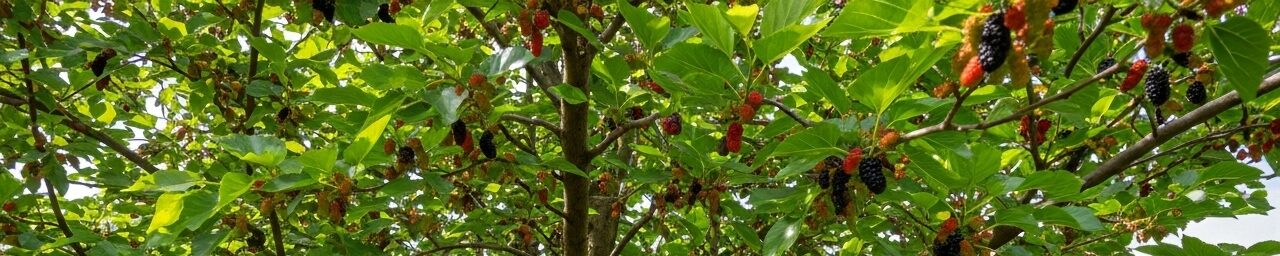

I’ll never forget the afternoon last spring when Margaret from my garden club stood beneath my young white mulberry and delivered the news with absolute certainty: the nursery had sold me three trees in one pot. She walked me slowly around the trunk, pointing at the leaves like a prosecutor presenting evidence. Here was a plain, heart-shaped leaf. There, a few inches higher, a mitten-shaped leaf with one distinct thumb. And just above that, something so deeply lobed and divided it could genuinely pass for a fig leaf. My mulberry leaf identification skills were about to be seriously tested.
“Look,” she said kindly, “they’ve done it before.”
I bet her a jar of my homemade mulberry jam that every single leaf on that tree came from the same roots. It took a borrowed botany book, a snapped leaf stem that beaded with milky white sap, and one slightly reluctant handshake, but I won my jam that day. And more importantly, I gained a question that has followed me to every garden club meeting since: “Clara, why do my mulberry leaves all look so different?”
Today, I’m giving you the full answer — once and for all.
The Mystery of Polymorphic Leaves
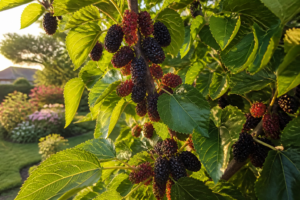
What Margaret witnessed that spring afternoon is one of the most charming peculiarities of mulberry trees, and it’s called polymorphism. This fancy botanical term simply means “many forms.” Unlike most trees, which produce leaves of a consistent shape throughout their lifetime, mulberries — particularly young white mulberries and vigorously regrowing specimens — are notorious shape-shifters. A single branch can carry heart-shaped leaves, mitten-shaped leaves, and leaves so deeply lobed they belong in a botanical oddity collection.
The reason? It all comes down to how hard the tree is growing.
My experience and years of observation have taught me this reliable pattern: young growth and fast-growing shoots produce the most elaborate, deeply lobed leaves. Meanwhile, mature, slower wood tends toward those simpler, unlobed heart-shaped forms. Think of it as the tree’s way of expressing itself — wild and experimental when it’s young and vigorous, more settled as it matures. Once you understand this relationship between growth speed and leaf shape, mulberry leaf identification becomes far less mystifying.
Three Species, Three Distinct Personalities
Not all mulberries are created equal, and their leaves tell very different stories depending on which species you’re growing. Understanding these differences is essential for proper mulberry leaf identification and care.
White Mulberry (Morus alba) is the polymorphic poster child — the show-off of the mulberry world. Its leaves typically measure 5 to 15 centimeters long, with a glossy, smooth upper surface that practically gleams in sunlight. This is the species most likely to give you a leaf shape identity crisis. White mulberry has been cultivated worldwide for roughly 5,000 years, primarily because silkworms (Bombyx mori) feed almost exclusively on its leaves, making it the backbone of the sericulture industry. If you’re new to mulberry growing, white mulberry is your most likely starting point.
Red Mulberry (Morus rubra) is the opposite: bold and consistent. Its leaves are noticeably larger — often 10 to 25 centimeters — with a dull, rough, sandpapery texture on the upper surface and a distinctly hairy underside. Red mulberries are less prone to the extreme polymorphism of their white cousins, and their rougher texture makes them instantly recognizable once you’ve seen one in person.
Black Mulberry (Morus nigra) is the reliable classical form. Its leaves are thick, distinctly heart-shaped, and rough-textured throughout. Black mulberries rarely produce those deeply lobed leaves you see on white mulberries, which makes them far easier to identify with confidence. They’re also slower-growing and longer-lived than their relatives, lending them an air of permanent stability.
The Three Universal Mulberry Identifiers
Despite all their shape-shifting, every mulberry leaf — whether it’s simple or deeply lobed, glossy or rough, large or small — carries three reliable identifying features. Once you know these, you can confidently distinguish a mulberry from any look-alike, no matter which species you’re growing.
- Toothed (serrated) margins: Run your finger along any mulberry leaf edge, and you’ll feel tiny teeth. These aren’t smooth, wavy edges — they’re distinctly saw-like. This alone rules out many potential imposters.
- Alternate leaf arrangement: Mulberry leaves don’t grow opposite each other along the branch. Instead, they alternate sides as you move up the stem — one left, one right, one left. This alternating pattern is a telltale mulberry signature.
- Milky white sap: This is the showstopper test. Gently snap a leaf stem, and a bead of milky white latex will form at the break. This signature sap is a hallmark of the entire fig family (Moraceae), to which mulberries belong. No sap, or clear sap? You’ve got the wrong tree.
I learned the sap test from that same botany book that saved my mulberry jam, and it has never failed me. On any day of doubt, I snap a leaf stem and look for that telltale milk. It’s reliable, quick, and absolutely conclusive.
Avoiding the Common Look-Alikes
The most frequent mix-ups happen with two very different trees, and both involve leaves that superficially resemble mulberries.
Sassafras is the first imposter. Sassafras leaves are also mitten-shaped and distinctive, which is why gardeners sometimes mistake them for white mulberry. The differences, though, are dramatic once you know what to look for. Sassafras leaves have smooth, untoothed margins — no saw-like teeth at all. More charmingly, crushing a sassafras leaf releases a strong root-beer scent. Do this test with a mulberry leaf, and you get nothing but mild greenness. And that milky sap? Sassafras doesn’t have it.
Paper Mulberry (Broussonetia papyrifera) is a different challenge. It’s actually a relative of the true mulberry, so the resemblance is closer. However, paper mulberry leaves are noticeably fuzzy and gray-green on both surfaces, whereas white mulberry leaves have that distinctive glossy, smooth upper surface. Paper mulberry also lacks the pronounced polymorphism of Morus alba, and its fuzzy texture is consistent throughout.
Why Mulberry Leaves Matter Beyond Identification
Understanding mulberry leaf identification isn’t just an academic exercise — it opens the door to one of the tree’s most exciting uses. Mulberry leaves are edible for humans and have been traditionally dried for tea throughout Asia for centuries. Once you can confidently identify your mulberry leaves, you can harvest them for personal use.
If you’re interested in exploring this further, I’ve written detailed guides on how to make mulberry leaf tea from fresh leaves and the top 7 benefits of mulberry leaves. For those looking for deeper research-backed information, my complete evidence-based guide to mulberry leaf tea benefits offers comprehensive, science-supported details on why these leaves have been valued for millennia.
Knowing your leaves also means you’ll never accidentally harvest from a paper mulberry or contaminate your tea with sassafras. Proper identification ensures safety and quality.
Products I Recommend
If you’re ready to grow your own mulberry tree and experience this leaf polymorphism firsthand, I recommend starting with a healthy young specimen. The Illinois Everbearing Mulberry Tree — 6–10″ Tall Live Plant is an excellent choice for beginners. It’s cold-hardy, productive, and will give you plenty of opportunities to observe leaf shape variation as it grows.
Once your tree is established, you might want to explore mulberry leaves in culinary form. FullChea USDA Organic White Mulberry Leaf Tea — 100 Bags offers a convenient way to experience the benefits without harvesting and drying your own (though I do recommend trying that eventually — it’s deeply satisfying). For those interested in powdered forms, the ONDAMGO Korean Mulberry Leaf Powder for Teas, Smoothies & Culinary Use — 200g brings versatility to your kitchen, blending beautifully into beverages and recipes.
Your Mulberry Leaf Identification Journey
Margaret returned to my garden the following spring, jar of my jam safely in hand, and we stood under that same young white mulberry together. She’s learned to spot the leaf variations now, even expects them, and last month she planted her own tree. I like to think that one “impossible” leaf identification challenge turned into a genuine passion for mulberry growing.
You don’t need a botany degree or a skeptical garden club member to master mulberry leaf identification. You just need to remember those three universal markers — the toothed margins, the alternate arrangement, and that magical milky sap. Observe your tree through its seasons, notice how fast-growing shoots produce wild, lobed leaves while mature wood settles into simpler forms, and you’ll develop an intuition that even seasoned gardeners will admire.
Now is the perfect time to start. Whether you’re planting your first tree, examining the leaves on an existing specimen, or simply deepening your understanding of these remarkable plants, embrace the polymorphism. It’s not a flaw or a nursery mistake — it’s one of the most wonderful signatures of a healthy, vigorous mulberry tree.
Do you have mulberry leaf identification questions? Or have you experienced that delightful moment of realizing your “three different trees” were actually one shape-shifting wonder? I’d love to hear your story in the comments below. Let’s grow together.
This post contains affiliate links. As an Amazon Associate I earn from qualifying purchases at no extra cost to you.