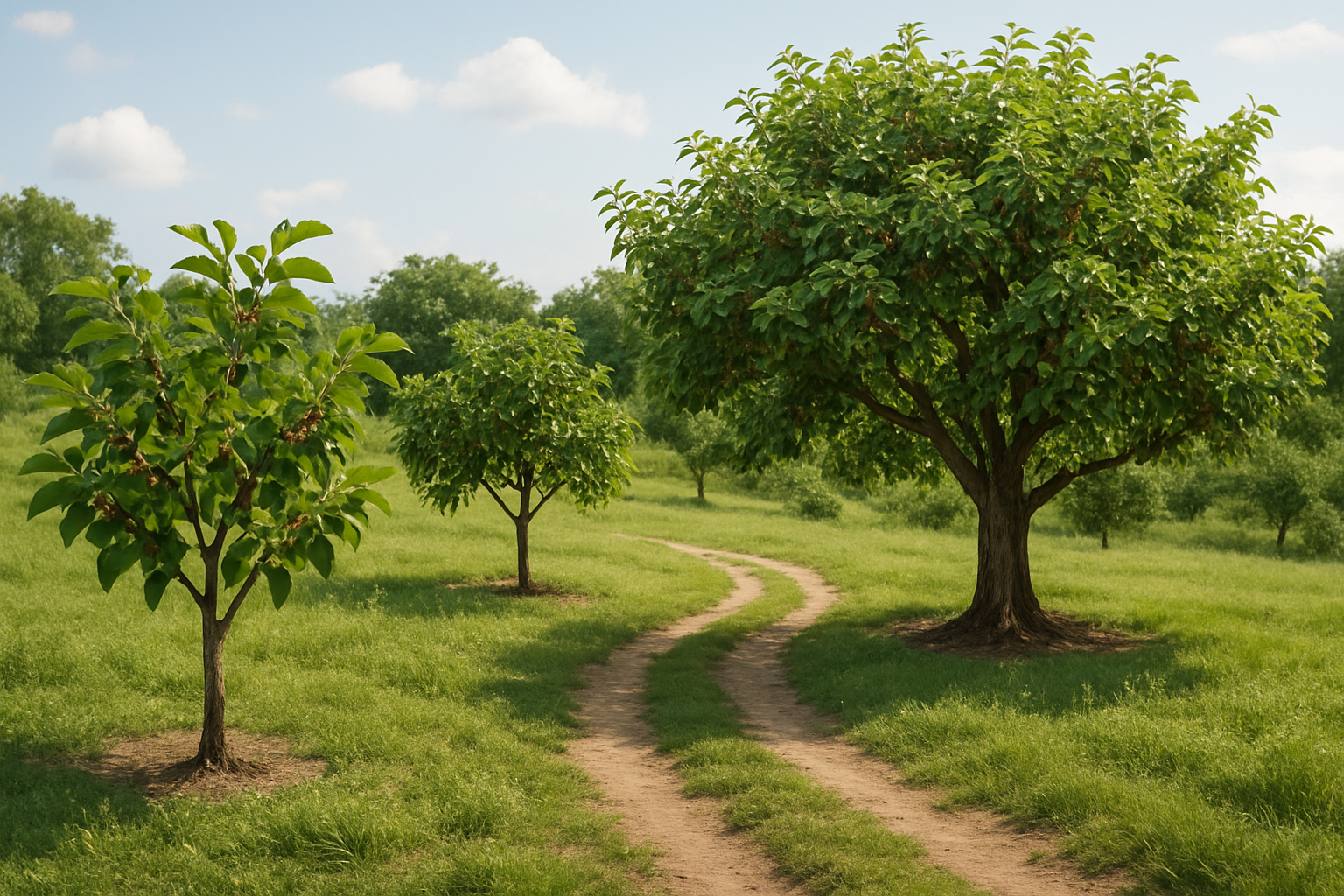
Mulberry orchards that sit in dense arrangements often show signs of poor production. Rearranging trees to improve spacing and layout can transform productivity significantly. When trees are given proper distance, the physical evidence accumulates quickly—fruit staining appears on nearby surfaces, harvest baskets fill more readily, and the quality of production often improves enough to attract neighborhood interest. Better spacing and layout create the conditions for consistent, reliable bearing rather than sporadic yields.
How My “Orchard” Became a Cautionary Tale
Here’s what prompted the shift. Late spring found me surrounded by what I can only describe as a botanical traffic jam — five full-size mulberry trees and ten dwarf cultivars positioned so tightly that sunlight barely reached the understory, let alone the fruit-bearing branches. The lawn beneath them had surrendered entirely and turned to bare soil. That season’s harvest totaled roughly two pounds across the entire collection. Not per tree. Total. I owned an orchard that was functionally ornamental, and my morning smoothies were staying expensive.
Many backyard growers recognize the need to reconsider their orchard layout when harvesting becomes difficult or yields plateau. Spacing problems often become apparent through practical frustration: low-hanging branches, crowded access, and inconsistent production. Addressing these layout challenges requires understanding canopy structure, light penetration, and root competition. A thoughtful redesign with these principles in mind can yield dramatic improvements in both ease of harvest and fruit production.
Core Layout Concepts That Move the Needle on Productivity
My research uncovered what I should have understood years earlier: effective orchard arrangement isn’t rocket science, but it does demand intentionality during the planning stage. These are the foundational ideas I now structure everything around.
Distance Between Individual Trees Determines Everything
Full-size cultivars like Illinois Everbearing and Pakistan require 25–30 feet of clearance from tree to tree when they reach maturity. Smaller or dwarf types can tolerate 10–15 feet, assuming you’re prepared to manage them with consistent pruning work. My initial setup had standard specimens crammed into eight-foot intervals. That wasn’t spacing — that was congestion. When trees sit too close, they spend their energy fighting for light rather than producing fruit. Adequate separation permits each specimen to build out a wide, well-lit canopy structure where all sides receive direct solar exposure, which naturally generates more reproductive wood and substantially larger fruit yields.
Row Direction Has Measurable Impact on Light Capture
This detail struck me as pedantic until I watched it unfold across a season. When rows run north to south, both flanks of each tree receive equal sun coverage as the solar path moves from east to west during daylight hours. Positioning rows east to west means one side stays shadowed by its neighbor for most of the year. After I repositioned my surviving trees along a north-south axis, the fruiting response in the following year was impossible to ignore — visibly heavier clustering and more vigorous growth on previously shaded branches.
Moisture and Air Movement Prevent Silent Tree Decline
Crowded arrangements trap standing moisture in the canopy, which creates an invitation for fungal colonization. While mulberries have decent resistance to most pathogens, they aren’t invincible under high-humidity conditions. Ensuring air can move freely through a planting prevents this problem before it starts. Walking corridors between rows—paths wide enough for two people side by side carrying harvest containers—combined with row intervals of roughly 20 feet deliver both practical accessibility and consistent airflow that keeps disease pressure manageable.
Strategic Clustering of Different Sizes Optimizes Individual Tree Success
When your orchard contains a mix of standard and compact types, placement matters more than people realize. Position your tallest varieties along the northern perimeter of your plot to prevent them from shadowing your smallest performers. Situate any cultivars requiring additional heat or light reflection adjacent to south-facing infrastructure like walls or fencing. This kind of zoning within your overall design can transform the output of even marginal performers.
Soil and Nutrition Support What Good Layout Creates
Dense spacing depletes soil nutrients through root competition, which limits bearing capacity even with improved light and ventilation. A thoughtful layout combined with intentional feeding addresses both problems. A phosphorus-forward fertilizer regimen can stimulate fruiting and root establishment in newly spaced plantings. This combined approach—better spacing plus targeted nutrition—typically produces substantial yield improvements where either strategy alone would fall short.
Nutrient Delivery When Trees Are Sharing Root Space
Once multiple trees occupy an optimized but still-compact layout, root systems inevitably compete for available nutrition — and nutritional deficiencies typically announce themselves through visible changes in foliage and fruit set before you consciously realize soil reserves have depleted. I discovered this painfully during my second season with the new arrangement, when my Pakistan specimens went through perfect flowering only to abort fruit development as if someone had flipped a switch.
What delivers results
- Dividing fertilizer into two separate applications — one in early spring and another in mid-summer — actually made a difference in fruit development where my previous single-dose approach had left trees undernourished through the critical fruiting window in tight plantings.
- The granular delivery method gives me precise control over application placement — I work it into the soil in expanding circles moving outward from the drip line, which prevents root burn while reaching the shallow feeder roots where active nutrient uptake happens across my specific configuration.
- Observable improvement in leaf pigmentation showed up reliably within 3-4 weeks, which allowed me to actually differentiate whether a production setback stemmed from nutritional insufficiency versus other culprits like pest activity or wildlife damage during the same growing window.
What falls short
- For operations managing four or more established trees on a consistent feeding protocol, the 32oz package depletes rapidly and means purchasing multiple units annually to maintain adequate nutrient levels.
- Supplemental feeding cannot compensate for fundamentally inadequate spacing — additional fertilizer merely postpones the inevitable yield plateau caused by excessive root competition, it doesn’t actually resolve the underlying constraint.
I almost ditched this product after my first application when I miscalculated rates and burned the drip line on a young Pakistan, but adjusting the water-in step completely changed the outcome. Grab the Farmer’s Secret Fruit Tree Booster Fertilizer (32oz) and dial in your own spacing before committing to a dense layout.
Frequently Asked Questions
Can fertilizer make up for mulberry trees planted too close?
Supplemental feeding cannot compensate for inadequate spacing. Extra fertilizer merely postpones the yield plateau caused by excessive root competition rather than resolving it. Fixing layout and spacing addresses the light and airflow problems first, and proper feeding only supports what the better layout has already made possible.
How long before fertilizer shows up in mulberry leaf color?
Observable improvement in leaf pigmentation showed up reliably within 3-4 weeks for me. That timeline turned out to be useful, because it let me tell whether a production setback came from nutritional insufficiency or from something else entirely, like pest activity or wildlife damage happening during the same growing window.
Is a 32oz bottle of fruit tree fertilizer enough?
Not if you are feeding several established trees. For anyone managing four or more established trees on a consistent feeding protocol, the 32oz package depletes rapidly, which means purchasing multiple units annually to maintain adequate nutrient levels. I divide mine into two applications, one in early spring and another in mid-summer.
How do I avoid burning mulberry roots with granular fertilizer?
I work the granules into the soil in expanding circles moving outward from the drip line, which prevents root burn while still reaching the shallow feeder roots where active nutrient uptake happens. I almost ditched this product after miscalculating rates and burning the drip line on a young Pakistan, but adjusting the water-in step fixed it.
Keep Reading
About This Article

Written by Ruth Nakamura. Ruth Nakamura is a backyard orchardist in the Pacific Northwest who has grown mulberries for fifteen years, cultivating twelve different varieties in her own backyard. Not a horticulturist by formal training - she shares what she has learned through hands-on growing, workshops, and connecting with nurseries and growers across the country. More about this site.
Scope and limits. Ruth is a backyard orchardist without formal horticultural training. Growing conditions vary enormously by region, so confirm variety, timing, and pest guidance with your local extension service.
Verify this against a primary source
Specifics change, and your situation may differ from the one described here. These are the authorities worth checking directly:
- USDA Plant Hardiness Zone Map — zone verification for your location
- Oregon State University Extension — fruit growing and pruning research
- USDA PLANTS Database — species range and identification