Every so often, I get a comment on one of my variety posts from someone deep in the backyard fruit-collector world, asking how Chiang Mai 60 stacks up against Austrian or Brazilian mulberry for taste. These are not names you will find at a garden center — they circulate through scion-trading forums and small specialty nurseries, and the information out there is scattered and sometimes contradictory. I do not claim to have grown all three side by side in identical conditions the way I can with the more common cultivars I write about, but after digging through what collectors consistently report and cross-checking it against what I know about mulberry species characteristics, here is the clearest honest comparison I can put together.
| Variety | Hardiness | Flavor Profile | Berry Characteristics |
|---|---|---|---|
| Chiang Mai 60 | Zones 9+; needs protection or container culture in zone 7 or colder | Very sweet and concentrated | Large, elongated, less water content |
| Austrian | Zones 5-6 with winter protection | Wine-like, complex, less sweet, more tannin structure | Good-sized, deep black when ripe |
| Brazilian | Unknown without identifying specific plant | Depends on seller; inconsistent across sources | Inconsistent; described as large-fruited or variable |
Why These Three Varieties Matter to Collectors
If you’re thinking about growing mulberries seriously — and I mean the way some of us do, obsessively comparing flavor notes and hunting down rare scions — you’ve probably noticed that the Chiang Mai 60 vs. Austrian vs. Brazilian mulberry conversation keeps appearing in forums. There is good reason: these three are among the most sought-after varieties that do not come from mainstream nurseries, and they represent three very different flavor and growing philosophies.
I became curious about them partly because I wanted to understand why I now grow three different mulberry varieties in the first place. Each one serves a purpose. But when collectors start asking about these particular cultivars, they are asking something deeper: which one is worth the effort to source, graft, or container-grow? That’s a question I take seriously, because sourcing rare scion wood and nursing a difficult variety through its first winters is not a casual commitment.
Chiang Mai 60: The Tropical Collector’s Prize
Chiang Mai 60 is a Thai black mulberry selection that has become something of a legend in warm-climate fruit-growing circles. The name itself signals its origin — it’s a numbered selection from breeding work in Chiang Mai, Thailand — and it circulates almost entirely through the backyard fruit-collector and scion-trading community rather than through commercial nurseries.
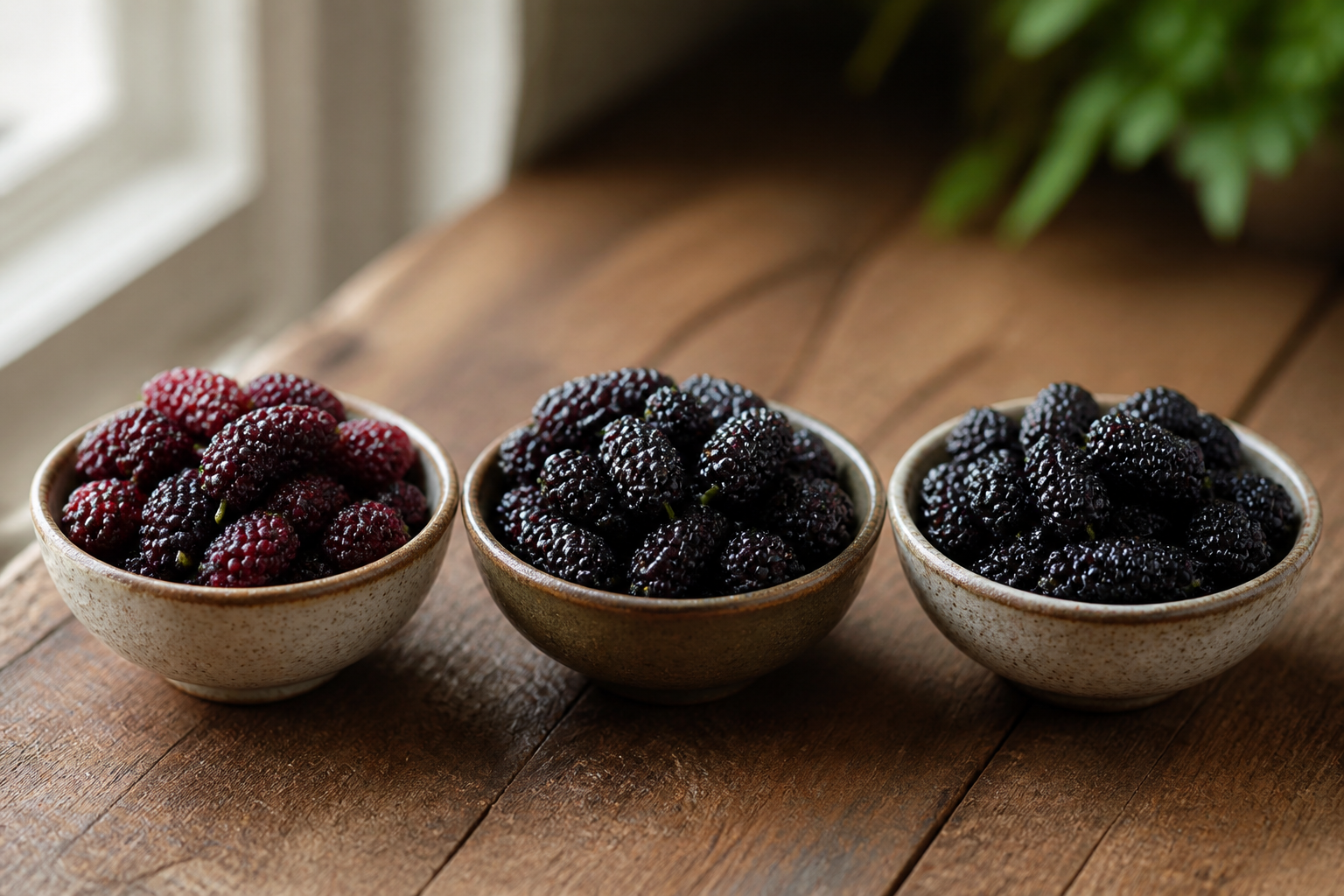
What makes Chiang Mai 60 special, according to growers who have fruited it, is the size and shape of the berries. They are genuinely large — noticeably bigger than most common white or red mulberries — and elongated rather than the plump rounded shape you might expect. The flesh is described as rich and sweet, with less water content than many other black mulberries, which means the flavor is concentrated. If you love the flavor and smell guide to what mulberries actually taste like, you know that texture matters as much as taste; Chiang Mai 60 apparently delivers on both fronts.
The catch — and it is a significant one — is that Chiang Mai 60 is a tropical selection. It has a fruiting habit suited to warm, humid climates. Growers in temperate US zones, from what I have read consistently reported in collector forums, say it needs protection or container culture to survive winter outdoors. If you live in zones 9 or warmer with reliable heat and humidity, you might be in luck. If you’re in zone 7 or colder, you’re either moving it indoors or accepting that you’ll treat it as a summer container plant and bring it in for the cold months.
I want to be transparent here: I have not grown Chiang Mai 60 myself, so I am relying on what collectors report rather than personal experience. The consistency of those reports — large fruit, excellent flavor, tropical needs — is reassuring, but it is still secondhand knowledge.
Austrian Mulberry: The Wine-Dark Flavor Specialist
Austrian mulberry is the odd one out in this comparison because it is not actually a mysterious tropical selection — it is a black mulberry (Morus nigra) cultivar that has been grown in Europe for a long time. What is sold as Austrian mulberry in the US collector trade has become a specific type: valued for a richer, more wine-like, decidedly less watery flavor than common white or red mulberry. Collectors often describe it as closer in character to a blackberry than to a typical sweet white mulberry.
The flavor intensity is the real draw here. Austrian mulberry does not taste diluted. The berry has a dark color — deep black when fully ripe — and the taste matches the appearance: complex, slightly tart underneath the sweetness, with a depth that lingers on your palate. If you have ever wondered what the difference is between a mass-market white mulberry and a serious black mulberry variety, Austrian is a good introduction to that spectrum.
Hardiness is another point in Austrian’s favor. As a black mulberry, it is generally hardy into zones 5 or 6 with some winter protection, certainly more reliable in cold climates than Chiang Mai 60. It also has a long history of cultivation, which means there is more documentation about it and fewer surprises in how it grows.
Brazilian Mulberry: The Cautionary Tale of a Nickname
Here is where I need to be particularly honest: “Brazilian” mulberry is a nickname, not a formally registered cultivar name. That matters more than you might think. Different sellers have, at various times, attached the name “Brazilian” to different plants — and I mean genuinely different parentage and characteristics, not just the same thing with different marketing.
If you are researching Brazilian mulberry, you should absolutely confirm with the specific seller what you are actually getting rather than assuming a single fixed variety exists. Some sources describe it as a large-fruited red mulberry with good flavor. Others describe something closer to a Morus alba hybrid. Without standardization, the name is almost meaningless.
This is not a judgment on Brazilian mulberry so much as a reality check: in the collector world, where we often rely on small specialty nurseries and scion-trading forums, nomenclature can be messy. When you see “Brazilian,” ask questions before you commit to sourcing scion wood or buying a grafted tree.
Comparing the Three: Flavor, Hardiness, and Availability
Let me lay this out in the clearest way I can, given what we know and what remains uncertain:
- Flavor: Chiang Mai 60 is described as very sweet and concentrated, with excellent berry size. Austrian offers a wine-like, complex taste with less sweetness and more tannin structure. Brazilian’s flavor profile depends entirely on which seller you are buying from — confirm before purchasing.
- Hardiness: Chiang Mai 60 needs warmth and humidity; it is a tropical plant in a temperate garden. Austrian is hardy into zones 5-6 and far more forgiving of cold winters. Brazilian’s hardiness is unknown without knowing which plant you are actually getting.
- Berry Size: Chiang Mai 60 is known for large, elongated berries. Austrian produces good-sized dark berries, though perhaps not quite as dramatic as Chiang Mai 60. Brazilian information is inconsistent across sources.
- Availability: All three are rare in mainstream nurseries. Chiang Mai 60 and Austrian are more consistently available through collector networks and specialty scion suppliers. Brazilian is less standardized and harder to source with confidence.
Should You Graft or Source These Varieties?
One of the most practical questions is whether it is worth the effort. If you are thinking about sourcing scion wood and learning grafting mulberry trees, including whether it is worth the effort, these three are exactly the kind of varieties that justify learning how. They are not available pre-grafted at most nurseries, so if you want them, you are probably grafting.
For grafting work, I recommend Zenport Grafting Tape — it is stretchy enough to work well with mulberry’s vigorous new growth, and it degrades naturally as the union heals, so you do not have to fuss with removing it. It has saved me time and heartbreak on difficult grafts.
What I Actually Recommend
If I am being honest about which of these three you should pursue, here is my recommendation:
Grow Austrian if: You live in zones 5-7, want a reliable, cold-hardy variety with genuinely excellent flavor, and prefer something with more historical documentation and fewer surprises. Austrian mulberry is the most “safe” choice among the three, and that is not a small thing when you are investing time in a rare cultivar.
Grow Chiang Mai 60 if: You live in zones 9+ with reliable heat and humidity, or you are willing to container-grow and overwinter indoors. If you have the climate and space for it, the large, concentrated-flavor berries are reportedly worth the effort. This is the specialty variety for serious warm-climate collectors.
Be cautious with Brazilian unless: You have confirmed with your specific source exactly which plant you are getting and have researched that particular selection’s characteristics independently. The lack of standardization makes it risky to source without extra due diligence.
If you have the space, growing multiple varieties can be rewarding. Mulberries are obliging enough to support several cultivars side by side. The Chiang Mai 60, Austrian, and Brazilian mulberry each represent different appeal: the tropical prize, the European classic, and the intriguing unknown. Each offers distinct characteristics worth exploring in a collector’s garden.
Frequently Asked Questions
Is Chiang Mai 60 mulberry hardy in cold climates?
Chiang Mai 60 is a tropical selection that needs protection or container culture to survive winter outdoors in temperate zones. If you live in zones 9 or warmer with reliable heat and humidity, it can grow outside. In zone 7 or colder, you’ll need to treat it as a summer container plant and bring it indoors for winter.
What is the difference between Austrian and Brazilian mulberry?
Austrian mulberry is a documented black mulberry cultivar hardy into zones 5-6, prized for wine-like, complex flavor. Brazilian mulberry is a nickname, not a registered cultivar, and different sellers have applied it to different plants with inconsistent characteristics. Confirm what you’re actually getting before sourcing Brazilian scion wood.
How big are Chiang Mai 60 mulberry berries compared to common varieties?
Chiang Mai 60 berries are noticeably larger than most common white or red mulberries and are elongated rather than plump and rounded. The flesh is described as rich and sweet with less water content, making the flavor concentrated rather than diluted.
Can you graft Austrian mulberry with regular tape?
Yes. Zenport Grafting Tape works well with mulberry’s vigorous new growth because it’s stretchy enough and degrades naturally as the union heals, so you don’t have to remove it. It can save time and heartbreak on difficult grafts.
Keep Reading
About This Article

Written by Ruth Nakamura. Ruth Nakamura is a backyard orchardist in the Pacific Northwest who has grown mulberries for fifteen years, cultivating twelve different varieties in her own backyard. Not a horticulturist by formal training - she shares what she has learned through hands-on growing, workshops, and connecting with nurseries and growers across the country. More about this site.
Scope and limits. Ruth is a backyard orchardist without formal horticultural training. Growing conditions vary enormously by region, so confirm variety, timing, and pest guidance with your local extension service.
Verify this against a primary source
Specifics change, and your situation may differ from the one described here. These are the authorities worth checking directly:
- USDA Plant Hardiness Zone Map — zone verification for your location
- Oregon State University Extension — fruit growing and pruning research
- USDA PLANTS Database — species range and identification