I got two emails in one week that made me sit back and laugh — not at my readers, but at how a single variety of mulberry tree has managed to become something of a folk legend that doesn’t quite match reality.
The first email came from a reader who’d found the Illinois Everbearing Mulberry recommended on every “dwarf mulberry” list she could find online. She ordered one for a small side yard, and a year later, it was already outgrowing the space she’d so carefully chosen for a compact tree. She felt frustrated — like she’d been sold a bill of goods.
The second reader had a different but equally thorny problem: deer had stripped the lower branches off her young Illinois Everbearing two years in a row. She wanted to know if this particular variety was somehow a deer magnet, or if she’d simply picked an unusually vulnerable cultivar.
Both of these questions — one about size, one about deer — kept coming back to the same root issue: the Illinois Everbearing has a reputation that does not quite match what it actually is. And if you’re thinking about planting one yourself, or you’ve already got one and you’re wondering what on earth to do with it, I want to clear this up for you once and for all.
What the Illinois Everbearing Mulberry Actually Is
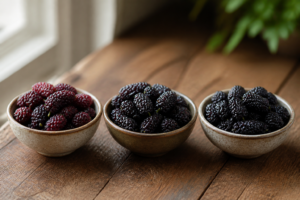
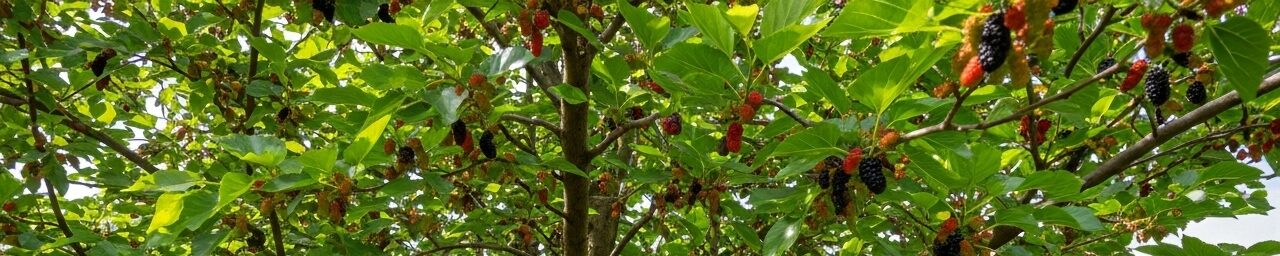
Let me start with what makes this variety genuinely special, because there’s real substance beneath all the hype. The Illinois Everbearing is truly a standout when it comes to cold hardiness. This hybrid, a cross between Morus alba (white mulberry) and Morus rubra (red mulberry), was specifically selected for two standout traits: extreme cold hardiness and an unusually long, heavy fruiting season compared to most other mulberry cultivars. If you’re in USDA zone 5, or even pushing into zone 4 with good siting, the Illinois Everbearing is one of the most reliable mulberries you can grow. The fruit production genuinely does continue well into fall when other mulberries have wrapped up for the summer.
Those are real advantages. They’re worth something. They’re why I understand why growers keep recommending it.
But here’s where the reputation starts to slip away from reality: the Illinois Everbearing is not a genetically dwarf cultivar, and it absolutely should not be landing on “best mulberry for small yards” lists the way it does.
The Size Question: Why an Illinois Everbearing Is Not Actually Dwarf
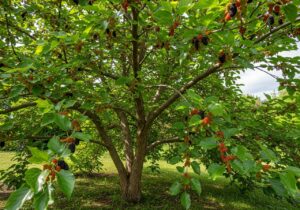
Left unpruned — or with just light pruning — an Illinois Everbearing mulberry commonly reaches 30 to 40 feet at maturity. Some growers report even larger specimens. It is a full-size tree with a vigorous, spreading habit that requires careful siting to avoid shading nearby plantings.
So why does it keep appearing on “dwarf mulberry” lists?
I think it’s because the Illinois Everbearing is so good at what it does — cold-hardy, prolific, delicious fruit — that growers want to fit it into smaller spaces. The variety’s merits are real enough that people will work around the size problem rather than just accept that it won’t fit their tiny yard. And sometimes that works out fine, if you’re committed to the work it takes. But too often, someone sees it on a “small space” list, plants it without understanding what’s really involved, and then gets a nasty surprise a couple of years in.
If you’re specifically looking for a genuinely compact mulberry that stays small by virtue of its genetics, I’d encourage you to check out my full breakdown of the best dwarf mulberry varieties for small spaces. Those varieties are a different ballgame entirely.
How to Actually Keep an Illinois Everbearing Small
That said, if you love the Illinois Everbearing for its hardiness and fruiting season — and I do understand the appeal — you absolutely can keep one in a smaller space. It just requires active, ongoing management. This isn’t a set-it-and-forget-it situation.
Here’s what that actually looks like:
- Establish a low framework. From the moment your tree is young, train it to a single, low-branching leader or a multi-stem framework no taller than you want the mature tree to be. This gives you a structure to work with rather than starting from scratch later. I started doing this with my own tree, and it made a world of difference.
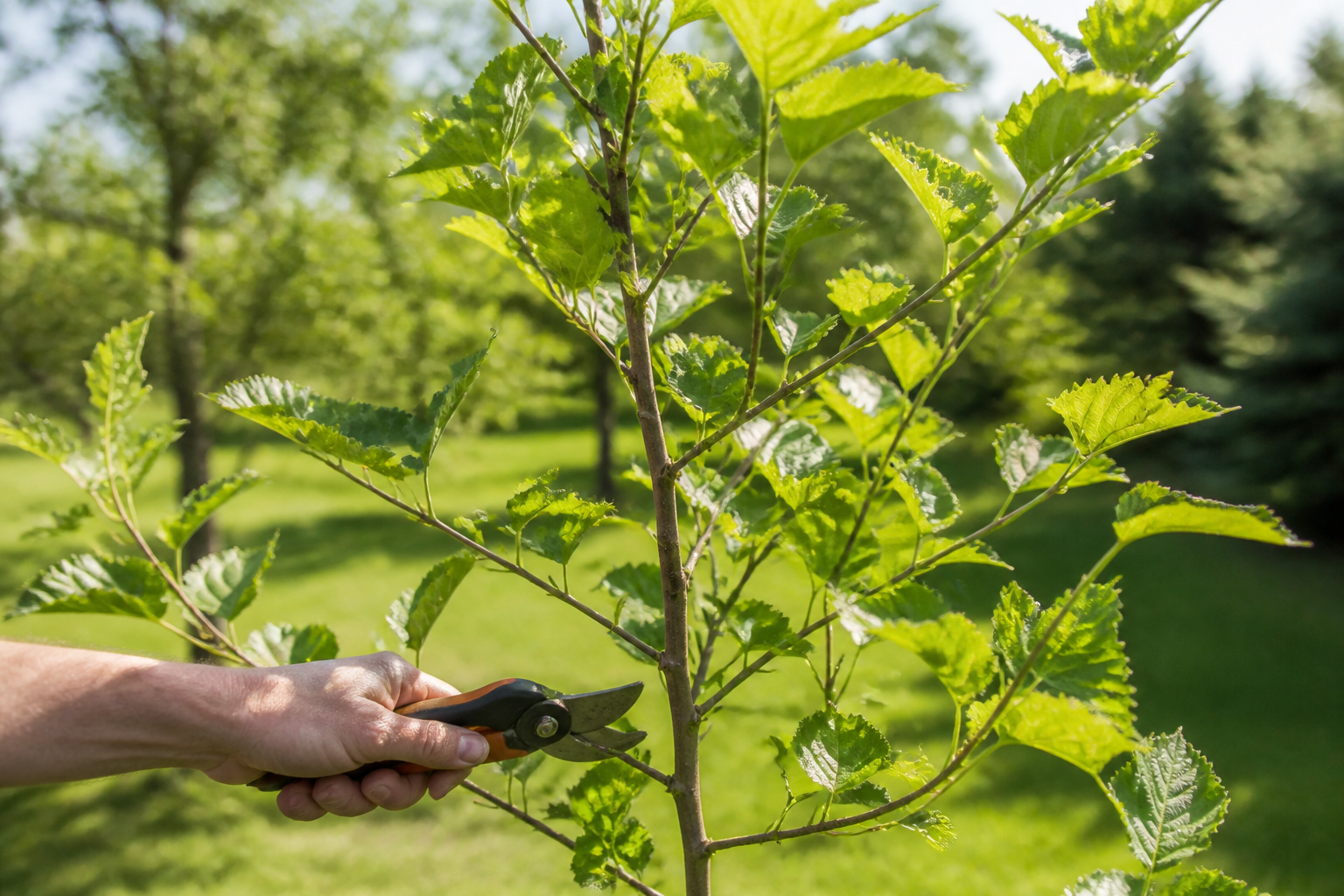
- Prune annually for structure. Every winter or very early spring, remove crossing branches, dense interior wood, and any shoots that are growing toward the boundary of your space. The goal is an open, balanced crown that’s easy to manage and doesn’t get away from you.
- Plan for harder pruning in tight spaces. If you’re really pushing the limits of your available space, you may need to do pollarding or hard heading cuts every one to two years — cutting back to established knuckles or a main framework to restart growth from known points. This is more work than standard pruning, and it does sacrifice some of that gorgeous natural form, but it’s the only reliable way to keep a full-size variety truly compact.
For more on the specifics of annual pruning technique, how to prune a mojo mulberry and other dwarf patio trees covers a lot of the same principles, even though those are smaller varieties to begin with. And if you’re seriously considering the harder approach, pollarding mulberry trees, for when pruning alone is not enough will walk you through what that commitment actually entails.
The Deer Question: Is Illinois Everbearing a Target?
Now, on to the second question: the deer browsing.
This one I want to be especially honest about, because it’s where I’m relying on what the broader research shows rather than my own personal experience. General wildlife-browse research on mulberry doesn’t show strong evidence that any one popular cultivar — including Illinois Everbearing — is significantly more or less palatable to deer than other mulberry varieties. I’ve had my own experiences with deer nibbling on various young trees, and I can say they can be a menace, regardless of the cultivar.
What does drive deer browsing pressure on young mulberry trees, according to what I’ve read from land managers and wildlife researchers, is far more about the tree’s age, size, and the local deer density in your area than about the specific variety you’ve planted.
A young, tender Illinois Everbearing in an area with high deer pressure will get browsed. But so will a young Pakistanis, or a Mojo, or any other cultivar at the same stage of growth. Mature mulberry trees, regardless of variety, are generally less vulnerable because the growth becomes less tender and the tree becomes less accessible at the heights deer prefer to browse. I’ve seen my mature trees standing tall and proud, untouched by those hungry deer!
If you’ve got a deer problem, the solution isn’t to switch varieties — it’s to protect the tree during its vulnerable young years. I’ve got my complete guide to keeping deer away from mulberry trees that covers the practical strategies that work: fencing, repellents, tree guards, and the timing that matters most. I’ve used a combination of these methods, and it has made a significant difference in keeping the deer at bay.
So, Should You Plant an Illinois Everbearing Mulberry?
Here’s my honest recommendation: the Illinois Everbearing is a wonderful mulberry variety if you’re in a cold climate and you want a heavy, long-season fruit production. Those genuine strengths are worth planting for.
But go into it with your eyes open. Don’t plant one for a small space unless you’re genuinely committed to annual pruning — or even harder pruning — as an ongoing practice, not an afterthought. And if deer are a concern in your area, don’t assume this variety is uniquely vulnerable; just plan from the start to protect a young tree until it’s large enough to defend itself.
When my reader with the overcrowded side-yard tree emailed back after we talked through what was really happening, she told me she was deciding whether to remove it or commit to the pruning work. I hope she chose commitment — I really do think the Illinois Everbearing deserves a home in gardens where it can be what it actually is. And for the reader with the deer? Once she understood that the variety wasn’t the problem, she felt a lot better about protecting the tree she had rather than starting over with something else.
So yes — plant your Illinois Everbearing if it calls to you. Just do it knowing the real story behind what you’re bringing into your garden.
Frequently Asked Questions
How big does Illinois Everbearing mulberry actually grow?
Left unpruned or with light pruning, an Illinois Everbearing commonly reaches 30 to 40 feet at maturity, with some specimens growing even larger. It’s a full-size tree with vigorous, spreading growth—not a naturally compact cultivar, despite appearing on dwarf mulberry lists.
Can you keep Illinois Everbearing mulberry small with pruning?
Yes, but it requires active, ongoing management. Train young trees to a low-branching framework, prune annually in winter or early spring to remove crossing branches and dense wood, and plan for harder pruning every one to two years if space is tight. It’s not set-it-and-forget-it.
Is Illinois Everbearing mulberry more attractive to deer?
No. General wildlife research doesn’t show that Illinois Everbearing is significantly more palatable to deer than other mulberry varieties. Browsing pressure depends more on tree age, size, and local deer density. Young trees of any cultivar need protection; mature trees are generally less vulnerable.
What makes Illinois Everbearing mulberry worth growing?
It’s exceptionally cold hardy—reliable in USDA zone 5 and even zone 4 with good siting—and produces an unusually long, heavy fruiting season, with fruit hanging into late September. These genuine strengths make it valuable if you live in a cold climate and want abundant fruit.
Keep Reading
About This Article

Written by Ruth Nakamura. Ruth Nakamura is a backyard orchardist in the Pacific Northwest who has grown mulberries for fifteen years, cultivating twelve different varieties in her own backyard. Not a horticulturist by formal training - she shares what she has learned through hands-on growing, workshops, and connecting with nurseries and growers across the country. More about this site.
Scope and limits. Ruth is a backyard orchardist without formal horticultural training. Growing conditions vary enormously by region, so confirm variety, timing, and pest guidance with your local extension service.
Verify this against a primary source
Specifics change, and your situation may differ from the one described here. These are the authorities worth checking directly:
- USDA Plant Hardiness Zone Map — zone verification for your location
- Oregon State University Extension — fruit growing and pruning research
- USDA PLANTS Database — species range and identification